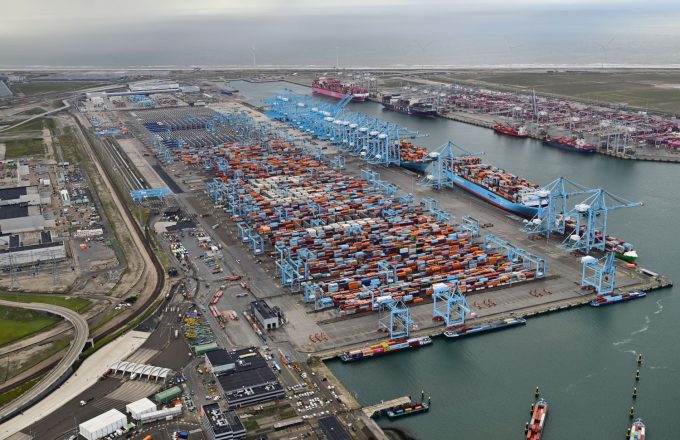

Artist’s impression of the new terminal (Photo: APM Terminals)
APM Terminals and the port of Rotterdam have unveiled plans to add a further 1.4m teu of capacity to the operator’s flagship Maasvlakte II facility in the Dutch hub.
With the terminal’s first phase of expansion recently completed, the new second phase will see a further 711 metres of quay built and 25ha of terminal yard space added.
“This expansion marks the next step in the long-term development of our terminal,” said Harold Kunst, managing director, APM Terminals, Maasvlakte II.
“We are creating space for future growth while continuing to develop a terminal that can serve our customers safely, reliably, and efficiently over the long term.
“Our collaboration with the Port of Rotterdam Authority is essential to achieving this. Together, we are laying the foundations for the next phase of Maasvlakte II,” he added.
However, formal approval for the terminal and the necessary investment by the port authority still requires its shareholders – comprising Rotterdam municipality with 70% and the national government with the remaining 30% – to vote for it unanimously, which is currently expected to be granted in February 2027.
As per usual in the landlord port model, the port authority will be responsible for funding and constructing the quay walls as well as dredging the access channel – the project is expected to require some 1.3m cu metres of sand to be dredged.
“The further development of APM Terminals Maasvlakte II marks an important step in our shared ambition to prepare the Port of Rotterdam for the future,” Boudewijn Siemons, chief executive of the Port of Rotterdam Authority, said.
“By investing in additional capacity and modern infrastructure, we are strengthening Rotterdam’s position as Europe’s leading container port.
“In doing so, we are increasing the resilience of logistics chains, contributing to security of supply for businesses and consumers, and strengthening the competitiveness of the Dutch economy,” he added.
Assuming it wins port authority shareholder approval, construction of the new area will begin in October 2027 and is scheduled to be completed by January 2030.
While the current APMT Maasvlakte II terminal is one of the key nodes in Gemini’s hub-and-spoke network, it has been constrained by its capacity so far – it hosts four of the partnership’s Asia-North Europe loops, but has only recently, with the opening of the phase one expansion, begun to service other Gemini trades.
In October the first of Gemini’s four North Europe-North America transatlantic services, the AL1, moved from the nearby Hutchison Delta facility to APMT, and the second phase of expansion will clearly allow the Gemini partners to consolidate more of their calls there.
The development will likely take Rotterdam’s overall capacity near 25m teu per year. According to Xeneta’s eeSea platform, other terminal improvements in Rotterdam will take combined capacity up to 23.3m teu a year by 2030, before the additional AMPT capacity is factored in.
Meanwhile, in the first nine months of this year total container throughput at Rotterdam hit 10.7m teu, which was just 0.1% up on the same period in 2025 – with an 8.9% increase in laden imports and a 1% growth in laden exports offset by a 20% decline in transhipment boxes.
“Due to long-standing capacity restraints at deep-sea terminals in Rotterdam, more cargo is being handled via other ports,” the port authority noted.