
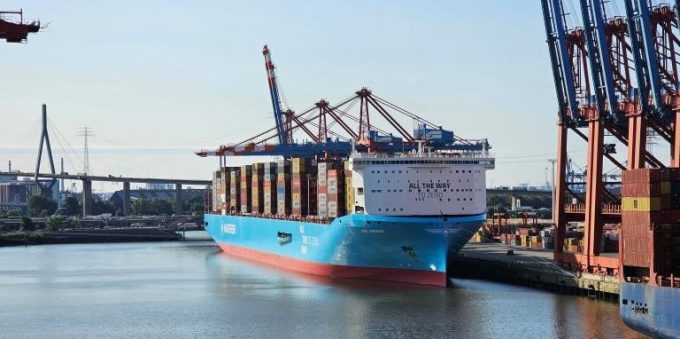
Ane Maersk. Photo: VesselFinder
The Houthis’ blockade on Saudi Arabia has not discouraged shipping lines from sending their vessels through the Bab-el-Mandeb Strait, delivering containers to Jeddah and other Red Sea ports.
Linerlytica noted that several carriers, including Maersk, CMA CGM and Wan Hai, were sticking to their renewed Suez transits.
The consultant has tracked 54 containership transits through the Bab-el-Mandeb strait in the past seven days, with no change to vessel schedules.
It added: “The pause in military exchanges is providing little clarity on the direction of the market, although container freight futures anticipate freight rates to drop from their recent peaks despite the recent rise in fuel prices.”
The 16,592 teu Ane Maersk entered the Red Sea from the Mediterranean last week and performed commercial operations at Jeddah. Normally deployed on Maersk’s Asia-Europe AE19 sevice, instead of moving to Port Said, the ship sailed to Mundra through the Bab-el-Mandeb Strait for extra loader work.
The AE19 was established by Maersk and Hapag-Lloyd’s Gemini Cooperation at the start of the US/Israel-Iran conflict in March, intending to maintain access to the Saudi Arabian market via Jeddah with large ships from Asia, detouring around the Cape of Good Hope, the Mediterranean, and finally Suez, to enter the Red Sea safely.
Linerlytica added: “The situation remains fluid and any further escalation in the Middle East conflict could drive out these ships from the Red Sea and add to further the vessel shortage as they seek alternative routes.”
Charter demand from operators running Red Sea transits therefore remains high. Operators such as Global Feeder Shipping, China United Lines and GT Lines have secured more than 12 new charters over the past two months for Middle East trading.
GT Lines’ partner on the West India-Middle East KIX1 service, Samudera Shipping, is adding capacity by introducing the chartered 1,471 teu Kuo Lung to join the 1,128 teu Guo Fu Min Qiang, operated by GT Lines.