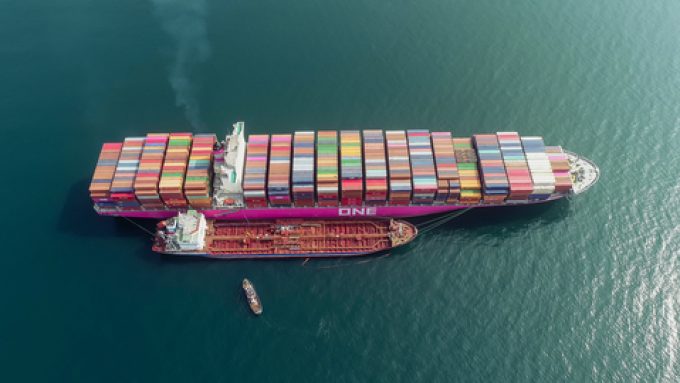
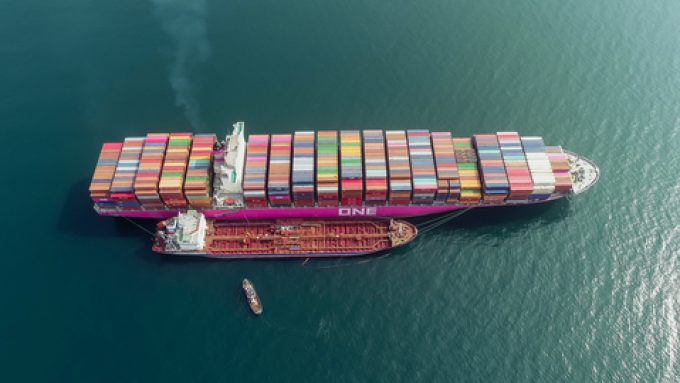
Photo: © Vladimir Serebryanskiy
Container lines are seeking a new wave of emergency fuel surcharges as an escalation of hostilities in the Middle East has made bunker fuel more expensive and availability increasingly volatile.
CMA CGM has told Indian customers it will impose a scale of surcharges on long-haul and intra-regional trades for cargo loaded from 1 August.
The updated levy will be $150 per teu for dry cargo and $165 per teu for reefer cargo on the headhaul leg, and $75 and $90 respectively on backhaul and intra-regional trade.
“Following the renewed escalation of hostilities in the Strait of Hormuz over the past days, fuel prices have surged sharply again, reversing the easing observed in recent weeks,” explained the Marseille-based carrier to customers.
Other major lines, including ONE, Maersk, and MSC, have also announced new fuel surcharges to recoup rising operating costs.
ONE’s revised EFS of $75 per teu for dry shipments and $100 per teu for reefers on the headhaul, and $38 and $50 on the backhaul and shortsea services, are slated for 15 August, the Singapore-based liner adding: “We will continue to monitor the evolving market conditions and will make necessary adjustments to the surcharge as circumstances dictate.”
Maersk applied its levy from 22 July, describing it as an “emergency inland fuel/energy surcharge”, on its Nordic trade coverage of Denmark, Norway, Sweden, Finland, Latvia, Estonia, and Lithuania.
Meanwhile, container freight rates from India to the Persian Gulf have continued to climb, as vessel capacity remains tight and port-to-port services remain problematic.
Industry sources have reported a 40% to 50% increase in booking prices out of Nhava Sheva (JNPA) to several key Middle East gateways over the past two to three weeks. For example, rates from JNPA to Dammam in Saudi Arabia have surged to about $6,500 per teu and $7,500 per 40ft, according to sources.
As mainline carriers struggle to move cargo into the conflict region, Indian port yards continue to be crowded by Middle East-related transhipment volumes, causing terminal congestion and slowing productivity, according to trade updates.
According to new data, JNPA saw some 93,000 teu of transhipment box movement in June, nearly as much as it had handled in May.
Raising fresh concerns, the Brihanmumbai Customs Brokers Association, representing customs agents in Mumbai, has told trade stakeholders its members should not be held responsible for any delays in cargo evacuation and “other potential penalty consequences”, like port ground rent and line detention charges.
“Road congestion in and around the port [JNPA], delays at the empty container depots, congestion at the terminals and elongated gate queues are together driving an increasing incidence of [cargo] shutouts,” the group claimed.
Check out this week’s News in Brief podcast, featuring Christos Spyrou of Neutral Air Partner and The Loadstar‘s Gavin van Marle