
© Mariusz Bugno
South Korea’s shipping industry is entering a more competitive phase in the intra-Asia market as HMM, the country’s flagship container carrier, expands into this segment that has been traditionally dominated by local feeder operators.
The shift is becoming particularly visible in Thailand, where growing Chinese investment is creating new manufacturing and logistics networks, and, in turn, increasing demand for container shipping between China, Thailand, South Korea, Vietnam and elsewhere in Southeast Asia. Thailand is becoming an increasingly important manufacturing base for Chinese companies pursuing a “China Plus One” strategy. Rather than concentrating all production in China, manufacturers are adding facilities in Southeast Asia to diversify their supply chains and gain access to ASEAN markets.
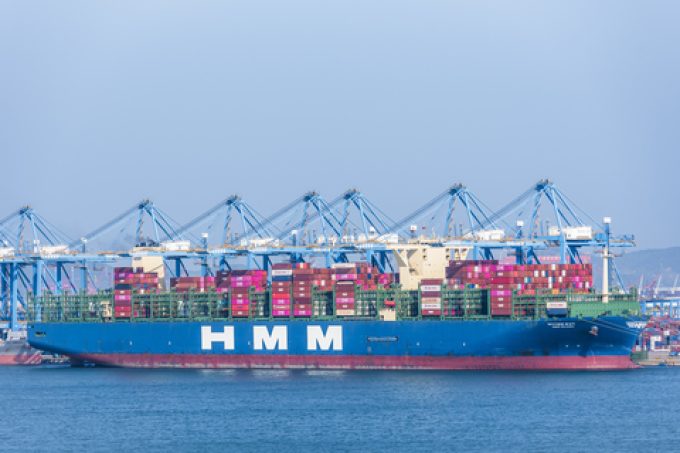
HMM has traditionally concentrated on long-haul services linking Asia with North America and Europe. But the company is now strengthening its presence in the intra-Asian market, putting it into more direct competition with compatriot carriers that have built their businesses around short- and medium-haul routes in the region.
HMM already operates services linking South Korea with Laem Chabang, Thailand’s largest container gateway, through Japan and Vietnam, as well as services connecting China and Thailand. Its expansion signals a broader effort to build a stronger regional network rather than relying primarily on long-haul lanes.
The company is scheduled to take delivery of 22 container vessels ranging from 1,800-2,800 teu from 2028. These smaller ships could provide additional capacity for expanding its intra-Asian network. In addition, HMM’s spokesperson confirmed to The Loadstar that two 1,956 teu newbuilding resales were lately bought from Chinese owner Baozhou Shipping. The vessels, HMM Milestone and HMM Harmony, will be delivered from Zhejiang Tenglong Shipyard in October and January 2027, to be assigned to intra-Asia routes.
Intra-Asia has long been an important market for South Korea’s mid-sized shipping companies. KMTC Line, Sinokor Merchant Marine, Dongjin Shipping, Heung-A Line, Namsung Shipping, Pan Ocean, SM Line and CK Line maintain local subsidiaries or agency networks in Thailand and operate services centered on ports such as Laem Chabang and Bangkok.
Many of these carriers have developed their competitive advantage through dense regional networks connecting major South Korean ports with China, Vietnam, Thailand and other Asian markets. Unlike the long-haul trades, where scale and large vessels are particularly important, intra-Asia relies heavily on frequent services, regional connectivity and the ability to serve diverse cargo flows.
Alluding to the competition among the South Korean operators, HMM’s spokesperson said: “HMM’s efforts to strengthen its intra-Asia presence, including in Thailand, are part of our broader mid-to-long-term strategy to optimise our regional network and enhance our hub-and-spoke feeder capabilities connecting with our mainline global services.”
The spokesperson added: “With cargo flows diversifying under global supply chain shifts, we’re proactively expanding our network and service coverage to meet customer demand for reliable and seamless transport solutions.”
Indeed the intra-Asian cargo base is changing rapidly.
China’s growing pivot towards Southeast Asia, evidenced by Pinglu Canal’s opening yesterday, is generating new two-way cargo flows. Components and raw materials are moving from China into Thailand, while finished products manufactured in Thailand are being shipped to ASEAN and global markets.
Laem Chabang, Thailand’s main container port, saw its volumes grow 7% year-on-year in 2025, to 10.15m teu. Accordingly, the Thai government wants to expand the port to raise annual capacity from 11m to 18m teu.