
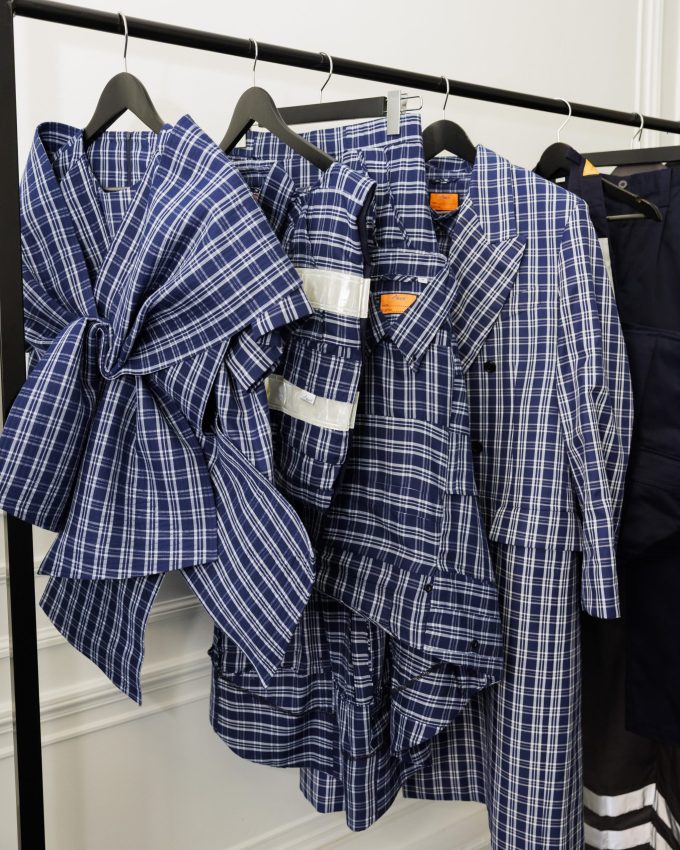
One of the world’s largest air cargo terminals is probably the last company most people would expect to find at Paris Fashion Week.
Yet for Hong Kong Air Cargo Terminals (Hactl), showcasing a collection inspired by its staff uniforms was never about entering the fashion business. Instead, it was an opportunity to tell a wider story about Hong Kong, sustainability, and the role logistics can play beyond simply moving freight.
The initiative also comes as Hactl marks its 50th anniversary, with the company looking beyond its operational achievements to highlight the people, creativity, and innovation that have helped shape both the business and Hong Kong’s position as the world’s leading air cargo hub.
The company partnered with fashion designer Sing Lo for this year’s Hong Kong Designers Showroom in Paris, organised by the Hong Kong Trade Development Council (HKTDC), with Hactl as strategic partner.
For Hactl’s newly appointed chief executive, Frosti Lau, who has had a whirlwind first fortnight in the job, the connection between cargo and couture is stronger than it first appears.
“Air cargo and fashion are culturally related,” he told 载星. “Their intersectionality is all there.

Frosti Lau
“Air cargo has always shipped samples, fashions for runway shows and showroom collections. Air cargo has always been part of the fashion industry.”
Fashion has long been one of air freight’s most important commodities. High-value garments, seasonal collections, and runway samples all rely on the speed of air transport to meet tight retail and fashion calendars, making logistics an often unseen but essential part of the global industry.
Yet it is also one of the world’s most environmentally scrutinised industries, with growing concern over waste, overproduction and the environmental cost of fast fashion.,
Against that backdrop, Hactl’s decision to showcase garments created from retired staff uniforms was intended to demonstrate how circular design can help reduce waste, while giving material a second life. But Mr Lau says the Paris project had a broader purpose than celebrating the industry’s role in transporting luxury goods.
“This is actually the first time HKTDC has worked with an air cargo terminal as a strategic partner,” he said. “We want to bring Hong Kong talent out to the international arena, to showcase what Hong Kong has in creativity, innovation, resilience and international taste.”

That ambition also reflects a more personal motivation.
“Hong Kong is my home,” said Mr Lau, who joined Hactl from Cathay Cargo in June after spending several years overseas. “I just want to continue to help it grow.”
The Paris collection is the latest stage in a collaboration that began in 2022, when Mr Lo was commissioned to redesign Hactl’s staff uniforms.
Rather than viewing the project as simply creating new workwear, they looked at what would happen when some 8,000 old uniforms reached the end of their working lives.
“From the outset, sustainability was a key consideration,” he said. “Rather than focusing solely on the new uniforms, we looked at their entire lifecycle, including how the retired uniforms could be repurposed in a meaningful and responsible way.”

Instead of being discarded, the garments became tote bags, teddy bears, mugs, and other everyday items before eventually being transformed into a collection of fashion pieces to be shown in Paris.
“Through upcycling, these garments have been reimagined as new fashion creations, demonstrating how existing resources can be given a second life,” Mr Lo said.
For Mr Lau, the project represents a practical demonstration of Hactl’s wider sustainability ambitions.
“Very important and very close to my heart, is sustainability,” he said. “We want to show the whole world – and Paris Fashion Week – that we should support sustainability through fashion upcycling.”
He believes logistics companies need to do a better job of explaining initiatives that might not appear immediately connected to the industry.
“We need to tell these stories a bit more,” he said. “This is not the first instinct that people click and say, ‘that’s highly relevant’. But the more you think about it, they’re highly relevant.”
That philosophy extends well beyond fashion.
Hactl has committed to reducing its scope 1 and 2 emissions by 50% by 2030, is supporting sustainable aviation fuel initiatives, has trialled post-consumer recycled plastic pallet wrap, and is investing HK$1bn in modernising its terminal to improve energy efficiency.
Mr Lau sees the Paris project as another example of thinking differently about how the company presents itself.
“For corporate work with HKTDC, it could be not just fashion,” he said. “We need to think creatively about how to promote Hong Kong as a destination, but more importantly for creativity and innovation.”
Whether Hactl returns to Paris Fashion Week remains to be seen. The company says it will evaluate the impact before deciding its next steps.
Mr Lau explains that the broader objective is already clear: if logistics wants to attract talent, champion sustainability, and showcase Hong Kong’s strengths, it has to find new ways to tell its story.
Despite high temperatures in a poorly air-conditioned Paris last week, Hactl’s team proudly wore their new collection clothes.
It was a small but fitting reminder that, for Hactl, sustainability is not simply a corporate target or an annual report commitment. From the uniforms its staff wear to the stories it wants to tell about Hong Kong, it is in fact part of the company’s identity.


This article is © The Loadstar. Reproduction, rewriting, or derivative use requires a license. Contact [email protected] for licensing enquiries.