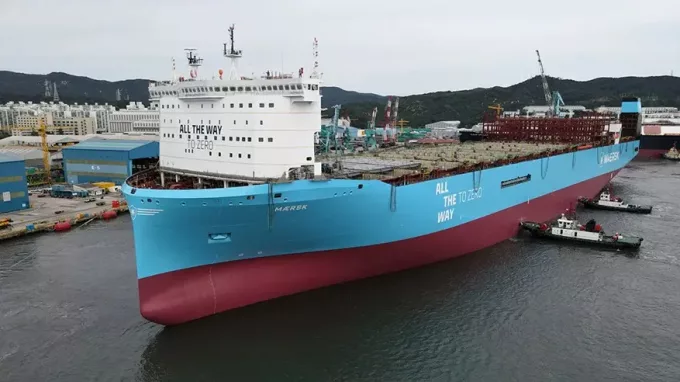
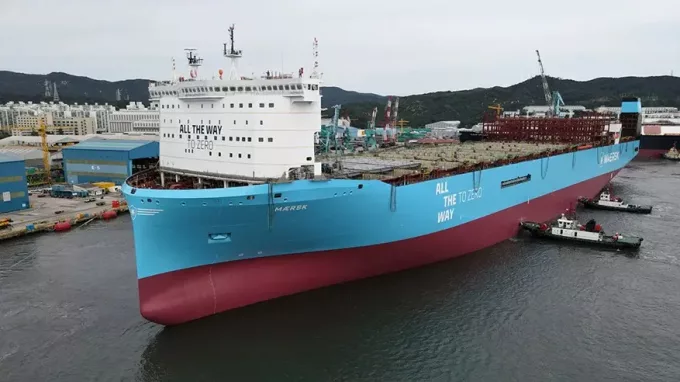
A Maersk methanol-fuelled ship
Shipping lines claim they are bearing the cost of investments in alternative fuels and lower-emission vessels, as shippers and their freight forwarders remain reluctant to pay more for greener shipping.
That is according to speakers at the Singapore International Bunkering Conference and Exhibition yesterday.
Pacific International Lines (PIL) head of operations and procurement (China) Chia Yujin said shippers in price-sensitive markets were not yet ready to pay for the industry’s transition to alternative fuels by 2050, leaving carriers to finance much of the investment.
In March 2022, PIL was the first Asian shipping line to commission LNG dual-fuelled ships, ordering four 14,000 teu vessels at Jiangnan Shipyard.
“Our ships trade in Latin America, we trade to Africa, and usually our shippers are from China,” Mr Chia said.
“At this point in time, people are a little bit more price-sensitive. Our shippers and consignees are typically not very ready to pay for the transition, so everything we do has to be voluntary, and come out from our own pocket,” he added.
Despite the lack of immediate financial returns, shipping lines are pressing ahead with alternative-fuel vessels and investing in the operational expertise needed to use them, it was said.
X-Press Feeders’ head of global operations, Vijayachelvan Silva Raju, said the company deployed methanol-powered ships without customers sharing the additional costs, partly to prepare its workforce for a future in which alternative fuels are expected to play a larger role.
And the world’s largest feeder operator is investing in crew training, building a pool of personnel experienced in handling methanol; Mr Raju argued that waiting until demand increased could leave it without sufficiently trained crews.
“We don’t have any shippers we could share the cost with. But why are we still operating these ships? Because we believe that when it comes to 2030, we will need to operate more ships with the same fuel, and I can’t go and find a trained crew at that time. So we are investing now, not just in assets, but also on crew and training,” he explained.
There are now 650 containerships capable of using alternative fuels including methanol and liquefied natural gas (LNG) on order, compared with around 330 in September 2023.
Maersk Line has 56 dual-fuelled ships on order and is already operating 24. Its head of fleet operations (East), Dinesh Kumar Balraj, said alternative fuels must be available at commercially viable prices, while ports need suitable bunkering facilities and ship operators must ensure their crews are trained to handle them.
“It’s not just placing orders for dual-fuelled vessels, but also how we optimise the existing fleet through retrofitting or other methods like digitalisation and network optimisation,” he said. “Now it’s about scaling what we’ve learned – we’ve had a lot of experience operating dual-fuelled vessels, learning about different fuels.
“Scaling doesn’t mean that an engine has to run on a particular fuel. The fuel and the bunkering infrastructure should be available; operationally, we must be ready, and the crew must be ready,” he added.