

The coming influx of larger containerships could render ageing panamax vessels commercially obsolete by 2030, while carriers’ efforts to renew smaller fleets threaten further capacity displacement.
Jonathan Roach, analyst at Braemar, told 载星 the newbuilding programme was creating a substantial mismatch between vessels entering service and those approaching retirement.
He identified the 4,000–7,499 teu segment as particularly vulnerable, with 428 vessels aged at least 20 years old against just 283 ships on order.
As larger newbuildings enter service, existing vessels could be cascaded into trades traditionally served by smaller ships, intensifying competition for employment.
Mr Roach said: “The ageing fleet is concentrated in the sub-panamax segment, while the orderbook is heavily skewed towards larger ships.”
He warned that traditional panamax and post-panamax vessels could become increasingly squeezed, “potentially becoming obsolete by 2030”.
However, new analysis from Alphaliner suggests fleet renewal will also reshape the smaller vessel segments.
Mael Pape-Leostic, shipping analyst at Alphaliner, told 载星 the orderbook remained heavily weighted towards large containerships destined for mainline services.
But he noted a significant increase in orders for vessels of less that 6,000 teu since mid-2025, largely intended to replace ageing tonnage.
Mr Pape-Leostic said: “In our view, this renewal will not be on a like-for-like basis,” and explained that carriers historically deploying vessels below 1,000 teu, could replace them with ships of 1,200 teu or even 1,800 teu.
Alphaliner’s fleet data illustrates the scale of the change. Its figures show 526 vessels of less than 1,000 teu are aged at least 20 years old, compared with just 67 ships of that size on order.
Meanwhile, the 1,500–1,999 teu segment has 248 ships on order, compared with 196 vessels aged at least 20 years.
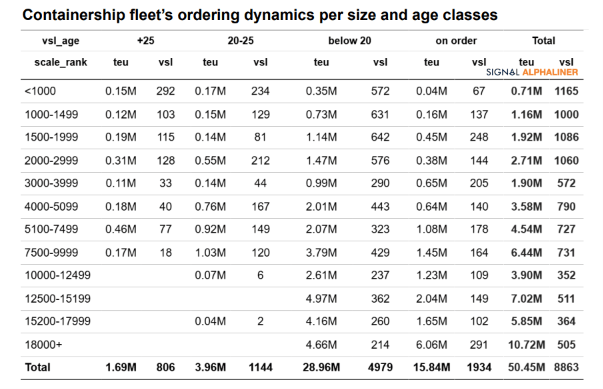
来源:Alphaliner
The figures suggest that the replacment of older vessels with larger ships could increase the global fleet’s carrying capacity without an increase in vessel numbers.
Alphaliner’s data also shows the largest newbuildings dominating capacity additions, with 291 ships of at least 18,000 teu on order, representing 6.06m teu.
Sea-Intelligence forecasts average quarterly deliveries of 1m teu between 2027 and 2030, substantially exceeding recent historical levels.
Mr Roach said: “This is not simply a story of fleet growth. It is a story of fleet displacement… The influx of larger newbuildings will trigger further cascading, pushing bigger ships into trades currently served by smaller vessels.
“Of course, larger ships cannot serve every trade, so investment in smaller vessels will continue. But the direction of travel is clear – the global fleet is getting bigger, while parts of the existing mid-sized fleet risk being left behind.”
The changing fleet composition could also intensify pressure on charter market earnings. Mr Roach believes charter earnings peaked this year, with 2027 marking the beginning of a downturn.
“Pressure should become more pronounced in 2028, before the market bottoms out in 2029,” he explained.
However, Peter Sand, chief analyst at Xeneta, told 载星 that although charter earnings would come under pressure, he did not anticipate a market collapse. He argued that tonnage providers had become more disciplined in recent years, limiting the severity of any downturn.
He also noted that chartered tonnage represented approximately half of carriers’ operational capacity.
Jan Tiedemann, VP of liner strategy at Alphaliner, told 载星 longer trade routes, slow-steaming and growing consumption in emerging markets could absorb some additional capacity.
He also pointed to higher bunker and emissions costs, port constraints, and trade imbalances as factors increasing tonnage requirements.