
图片来源:VesselFinder
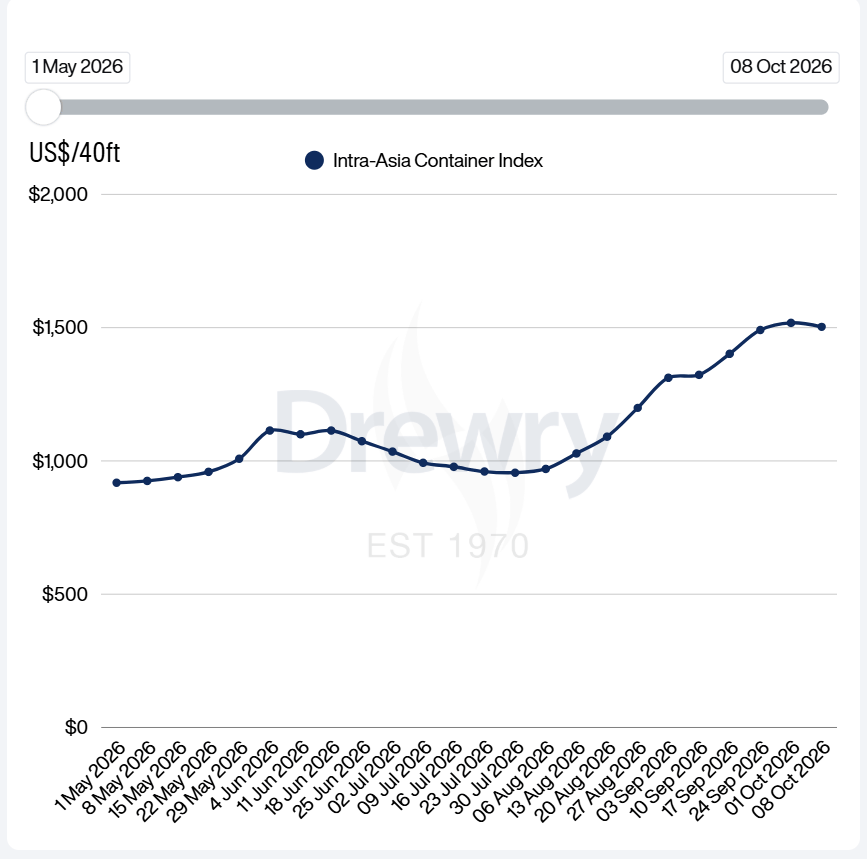
Intra-Asia container freight rates have marginally eased after hitting a post-Covid high prior to China’s Golden Week holiday, with elevated fuel costs, geopolitical disruptions, and operational constraints continuing to support the market.
The Drewry Intra-Asia Container Index (IACI) Composite Index declined 1% this week, to $1,503 per 40ft, ending six consecutive weeks of increases.
Source: Drewry
However, the index was up 209% year on year, and also remained largely unchanged during Golden Week, compared with a 12% decline during the same period last year.
Spot rates from Greater China to north-east, south-east and south Asia softened as demand weakened during the holiday, although network adjustments and operational disruptions limited the declines.
Yesterday, Shanghai-Laem Chabang, and Manila and Yokohama rates fell 3% from 1 October, to $1,690, $1,027 and $1,052 per 40ft, respectively. Shanghai-Jebel Ali rates remained elevated, at $8,662 per 40ft, amid worsening Middle East disruption.
Shanghai and Ningbo continued to experience vessel bunching and schedule delays after the August typhoon season, with average waiting times of three and 2.5 days, respectively.
This has cascaded to major ports in South and South-east Asia, and Shanghai-Singapore and Shanghai-Tanjung Pelepas rates increased 2%, to $2,123 and $2,100 per 40ft, respectively.
Elevated fuel costs are providing further support. Brent crude has remained above $100 per barrel since early September; CMA CGM introduced a $75 per teu emergency fuel surcharge on all intra-regional trades on 1 October.
In response to the higher rates, carriers are launching new services.
On 8 November, Regional Container Lines (RCL), Pacific International Lines (PIL), HMM, and Shanghai Jin Jiang Shipping will jointly start a weekly China-Indonesia-Straits service. PIL and RCL will market it as the NCI and RCI05, respectively, while HMM and Jin Jiang have yet to reveal their branding.
The partners will each deploy one ship: the 2,742 teu Whutthi Bhum from Jin Jiang; 3,565 teu Kota Makmur from PIL; 4,782 teu Hyundai Unity from HMM; and the 4,488 teu newbuild Chantisa Bhum from RCL.
The new service will replace a joint service between X-Press Feeders, PIL and HMM, branded NJX, NCI, and NIS by their respective partners.
Analysts at Linerlytica also said this week that the shortage of feeder ships – the intra-Asia lane’s main workhorses – has further supported the market.
“The lack of new feeder capacity, especially on the Bangkok-max segment where only five have been delivered so far this year, has further compounded the capacity shortage on the intra-Asia routes,” it noted.