
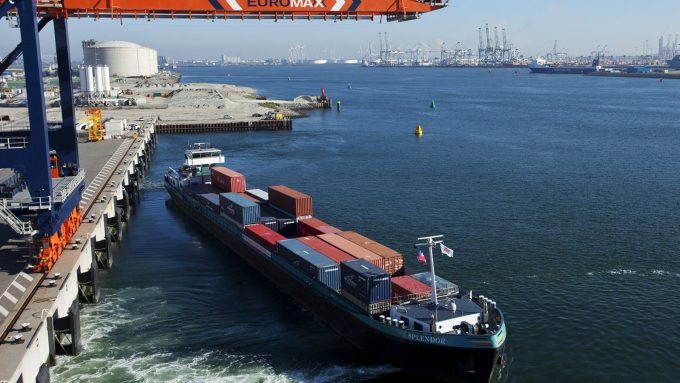
Photo: Binnenvaartschip Euromax
Transport operators are urging the introduction of road tolls across North Europe in an effort to dissuade motorists as congestion mounts on the back of low water levels along the Rhine, forcing evermore volumes into trucks.
据报道 载星 yesterday, container barge traffic has been almost to a halt amid the heatwaves the continent has seen – and there is little to suggest a break in the weather is coming.
Transport federation Febetra said: “At a meeting with container hauliers, it was noted that there is extra pressure [along the region’s roads], partly as a result of the difficult conditions for inland waterway transport.”
Noting that the drought had come at a somewhat fortunate moment, with the roads quieter during the summer holiday period – “a blessing in disguise” – the federation also stressed need for a long-term solution to what has become a persistent problem throughout the year.
Febetra said a general road toll may offer the most effective means of tackling the issue, as it “would make people think twice before driving their cars”, sources telling 载星 it could also support much-needed infrastructure changes.
One barge owner said the alternative rail and road routes for barge users were not fit for purpose, the additional stress brought about by barge traffic rapidly shifting was exposing the inherent weaknesses in this part of the supply chain.
Noting the Rhine handles approximately 275m tonnes of cargo annually, of which containers represent 10%, the barge owner said this equated to 7,500 teu a day being moved along inland waterways.
“Rail network capacity is already at its limits, this means very little can shift to rail – maybe about 15% – which leaves in excess of 6,000 teu a day needing to be moved to road freight,” the barge owner told 载星.
Compounding the problem is that the remaining barge traffic – particularly that generated by German chemical and steel industries – is unable to shift to rail or road. This, sources told 载星, meant these industries must continue sending volumes by barge but at a reduced utilisation rate of roughly 30% – if a barge is capable of carrying 100 tonnes of steel it can now manage only 30 tonnes.
While the middle section of the Rhine, where most of this activity occurs, does not include locks, the influx of extra vessels to offset this level of under-utilisation only worsens the congestion along the river, which is already measured in days.
Nonetheless, the authorities in Antwerp have found reason to cheer, noting that there is plenty of space for those wishing to access the port.
It said: “Fortunately, there’s still space available. Despite extra pressure, we can provide a suitable berth for every ship. This shows that we are not only an attractive cruise destination but that we can also respond flexibly to such unexpected situations.”