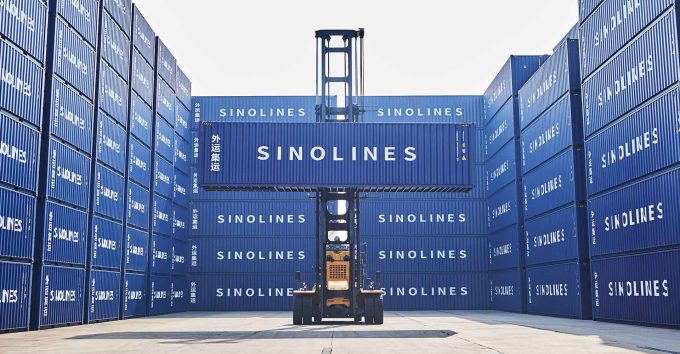

Freight forwarders could face a changing competitive landscape in China and intra-Asia shipping: Sinotrans Container Lines (Sinolines) has moved to take control of Antong Holdings, combining one of China’s major domestic container logistics networks with an international liner.
On Wednesday, China Merchants Energy Shipping (CMES) informed the Shanghai Stock Exchange that its subsidiary Sinolines now held 14.94% of the shares of Antong, the holding company of Quanzhou Ansheng Shipping, making it the Shanghai-listed company’s largest individual shareholder.
Together with its affiliates, China Merchants Group holds 24.84% of Antong’s shares.
In 2020, Antong, founded by the Guo family, came under state control after financial mismanagement resulted in a state-sponsored bailout involving the China Merchants group. A previous attempt by CMES to take over Antong in May 2025 failed, as market conditions shifted.
Now Sinolines has proposed an early re-election of Antong’s board and amendments to its articles of association. Its nominees, together with those put forward by China Merchants Port, account for more than half of the proposed board.
If shareholders approve the proposals and the nominees take office, Sinolines will replace Fujian Zhaohang Logistics Management Partnership as Antong’s controlling shareholder, while China Merchants Group will become the ultimate controller.
The transaction is expected to unify Sinotrans’ international container shipping network and Antong’s domestic container and multimodal logistics operations. CMES said the group intended to integrate domestic and international businesses to build an end-to-end logistics network.
Antong’s core business is container multimodal transport, with a network spanning waterway, road, and rail services. Sinolines, by contrast, is primarily a liner operator focused on intra-Asia services.
Sinolines has an owned fleet of 30,553 teu, which could more than double, as Antong owns 53,994 teu. Ship numbers apart, the combination could allow China Merchants to offer a more integrated product and, for shippers that need separate providers for domestic positioning, port handling, and ocean transport, such a model could be attractive.
For freight forwarders, this creates a potential new competitor, and one with greater control over the underlying transport assets.
The impact is likely to be most pronounced for forwarders handling China-origin cargo, particularly where domestic transport and ocean freight are bundled into a single service.
One forwarder told 载星: “Sinotrans’ logistics and forwarding activities already compete for some of the same shipper accounts served by independent forwarders. Greater control over Antong could give the group additional tools with which to compete.”
Another added: “A more integrated operation could potentially offer aggressive end-to-end rates to major shippers. That could put pressure on forwarders whose value proposition is largely based on combining ocean freight with inland transportation.”
And the effect could extend beyond China. Sinotrans has been expanding its international container network, while Antong has also been exploring ways to link its domestic and international operations. The two complementary asset bases therefore provide a foundation for a broader intra-Asia logistics proposition.