
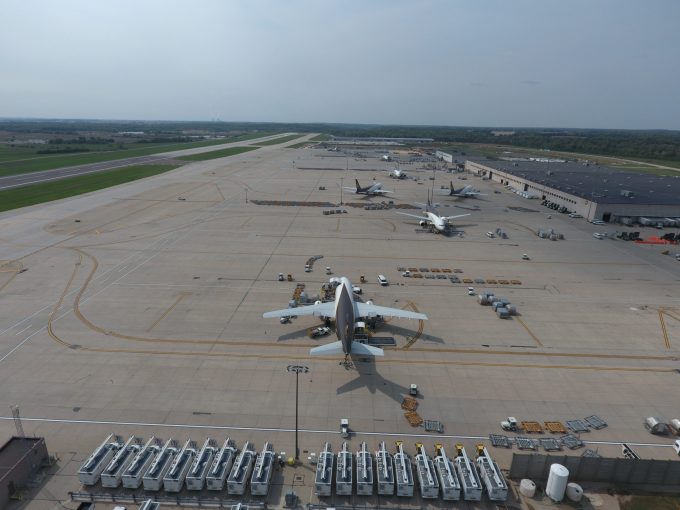
DCIM100MEDIADJI_0024.JPG
Chicago Rockford International Airport is looking to replicate the success of Liège Airport as it seeks to establish itself as a major alternative cargo gateway to Chicago O’Hare, according to Rene Espinet, vice-president of cargo business development at Rockford.
Mr Espinet told 载星 on the sidelines of the EU CBEC Ecommerce Forum last week that the airport’s new sister-airport relationship with Liège was aimed at learning how the Belgian hub had successfully attracted freighter operations away from Brussels Airport.
“Liège is right next to Brussels Airport,” he said. “Brussels is a passenger airport with flights coming in with combination carriers… and what Liège has successfully done is pull away all cargo flights and bring them to a cargo-friendly airport, and we want to do the same from Chicago O’Hare.”
Rockford wants to pursue a similar model around Chicago, targeting freighter operators looking for greater efficiency.
Mr Espinet said Rockford was still “10 to 15 years behind” where Liège had been when it began its development, but saw the relationship as an opportunity to learn from the Belgian airport and approach carriers already operating there.
“We can learn from them and take the best of the best of what they’ve done,” he said.
The strategy forms part of a wider push to turn Rockford from a predominantly domestic parcel hub into a more significant international cargo gateway. The airport handles around 85 freighters a day, with UPS and Amazon among its major operators.
“We do a lot of parcels for UPS and Amazon, and so [Liège] can learn from us the other way. We’re sharing best practices on both sides,” Mr Espinet said.
他告诉 载星 the focus for Rockford was now on attracting more international scheduled services and building a global hub. Rockford’s pitch to carriers is increasingly centred on efficiency – particularly compared with congested O’Hare.
Mr Espinet explained the airport could unload an aircraft within an hour, load trucks in 10-15 minutes and have freight delivered into Chicago in around an hour and 15 minutes.
Some Chicago facilities, he said, were finding freight arrived faster from Rockford than from O’Hare, despite O’Hare being closer.
The difference, he argued, was congestion at the larger airport, including aircraft taxiing and queues of trucks waiting to recover freight, whilst at Rockford, cargo is staged by truck number as it comes off the aircraft, allowing ground handlers to load two truck positions simultaneously once unloading is complete.
“It’s very, very quick,” Mr Espinet said.
He acknowledged that persuading carriers to move operations remained difficult, given their existing infrastructure, crews, warehouses and customer relationships at established gateways, but he argued that, where the economics work, Rockford could offer carriers and their customers both cost savings and greater efficiency.
“It makes economic sense,” he said. “You bring more efficiency… plus cost savings.”
However, whilst Liège is known for its ecommerce handling, Mr Espinet noted Rockford is “trying to focus on high-value cargo coming through”, but highlighted that there is still “a definite need” to bring ecommerce due to the volume that it attracts.
“So there’s verticals like aerospace, defense. I would say pharmaceuticals is also something that Liège has done very well, but we would like to see if we can copy and paste, maybe do it even better,” he explained.
来看看本周的 News in Brief podcast, featuring Rotate’s Jonathan Mellink.