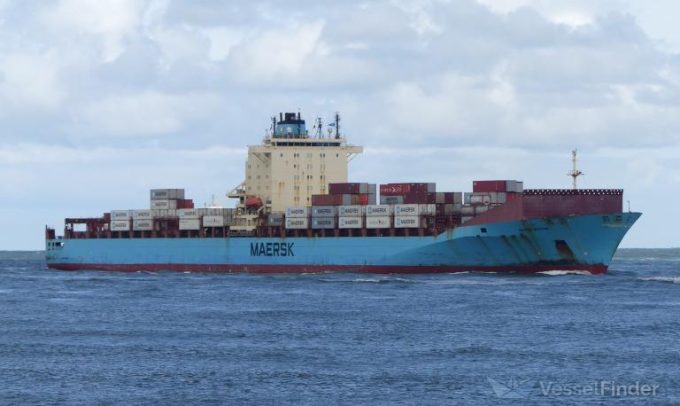

图片来源:VesselFinder
Maersk has announced that it is to suspend its standalone transpacific TPX extra loader service shortly before the beginning of China’s Golden Week holiday.
In a customer advisory the Danish carrier said the final sailing this year on the service would be the departure of the 4,200 teu Maersk Boston from the Vietnamese gateway of Vung Tau on 29 September.
“Following this voyage, TPX will remain suspended for the balance of Q4 2026.
“Further information regarding the potential reinstatement of seasonal TPX service in 2027 will be communicated once available,” Maersk said.
According to Xeneta’s eeSea liner database, the TPX service deploys seven vessels with an average capacity of 4,400 teu, and was originally scheduled to run until the end of November, which means the suspension is slightly earlier than forward planners expected.
It has a port rotation of Busan-Long Beach-Vung Tau.
It will cut Maersk’s weekly capacity on the route by over 10%, according to Linerlytica data which reports that the Danish carrier’s weekly transpacific capacity is currently 32,200 teu, and following the closure its offered capacity will be solely under the Gemini Cooperation services.
The move can be seen as part of a wider move by carriers to curtail transpacific capacity in an effort to maintain high spot rates as the peak season draws to a close.
MSC announced earlier this week it would blank the sailing of its Asia-US east coast Emerald service in week 41, due “to the anticipated slowdown in demand during and after the Golden Week holiday”.
US west coast freight forwarder Freight Right said this week that spot rates to both coasts would remain elevated for the remainder of this month as the window for US importers to replenish stocks in time for the traditional shopping season nears its end.
“China’s upcoming holidays are creating a final shipping push. With a long weekend approaching followed by the week-long early-October holiday, importers have a narrowing window to move cargo before widespread factory and logistics closures.
“Space is becoming more difficult to secure. Carriers have already announced blank sailings around the October holiday, while existing capacity is filling as shippers try to move freight before the shutdown,” it said, and added that further disruptions were likely, given continuing congestion at Chinese gateways.
“Shippers should expect continued blank sailings, booking rollovers and shifting ETDs.
“The recommendation is to increase booking lead time from roughly one week to two-to-three weeks, even when cargo is not yet ready – securing space early is increasingly important when schedule reliability is low,” it added.