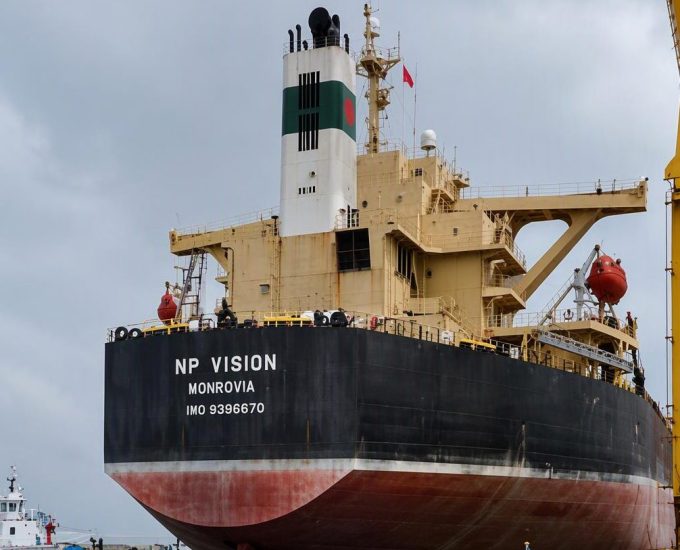

Wenzhou’s launch of a direct container shipping service to West Africa highlights a broader transformation under way across China’s port network, as improved infrastructure and rising demand from inland manufacturing industries blur the traditional distinction between river and sea ports.
Situated in Zhejiang province, Wenzhou is on the Oujiang river that leads into the East China Sea.
The new service began yesterday, giving manufacturers in southern Zhejiang and northern Fujian a new ocean route to markets including Ghana, Guinea, and elsewhere along the West African coast.
The inaugural sailing saw containers loaded onto bulk carrier NF Vision, scheduled to sail via the Cape of Good Hope to Bolar, Tema, and Conakry, taking around 55 days.
The service initially deploys three ships and is planned to expand to six, with sailings every two weeks. Local maritime authorities say this direct route can cut about seven days from conventional routes by reducing reliance on intermediate hubs. It also reflects growing trade between Chinese shippers and African markets, particularly for machinery, vehicles, electrical equipment, and other manufactured goods.
Wenzhou’s development follows the same logic increasingly visible along the Yangtze river: bringing international shipping capacity closer to the industrial hinterland. Yangtze ports such as Taicang, Nanjing, Jiangyin, and Wuhu have been expanding their ability to handle international container traffic while strengthening links with surrounding manufacturing centres.
Taicang, for example, has developed deeper-water facilities and international services, including routes for Chinese-made new-energy vehicles, while Wuhu has similarly benefited from infrastructure improvements and growing demand from Anhui’s automobile industry.
The trend is being supported by government investment in waterways, terminals, and multimodal transport. Infrastructure upgrades allow larger vessels to reach further inland, while improved road, rail, and waterway connections enable container movements between factories, logistics parks, and ports.
The result is a more integrated transport system in which river ports can increasingly function as gateways to international markets, rather than merely feeder points for major coastal hubs.
Industrial demand is crucial to this transformation. China’s inland manufacturing centres are producing increasingly sophisticated goods for export – from automobiles and electronics, to machinery and new-energy products – and as export volumes rise, manufacturers are more inclined to use nearby ports if they can offer competitive shipping frequencies, vessel access, and logistics costs.
The expansion of direct China-Africa shipping adds another dimension, as UNCTAD figures show trade between the two continents grew 18% year on year in 2025, to a record $348bn. Shipping lines have been adding services to West Africa, while ports there have improved their ability to handle larger vessels. Direct links can reduce transhipment, shorten supply chains, and give Chinese exporters more predictable access to African markets.