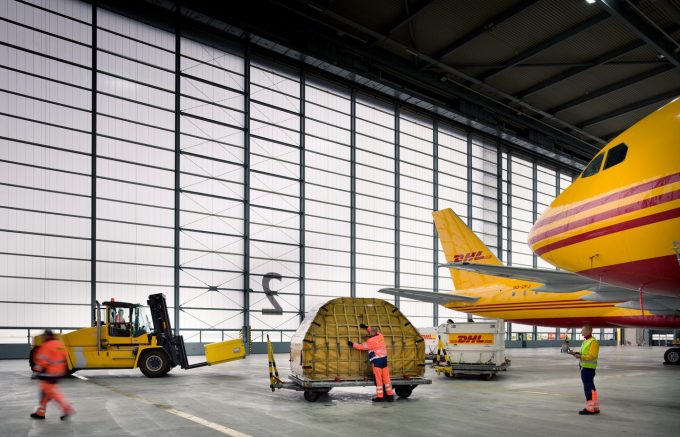

Rüdiger Nehmzow / DHL Group
Four months after its initial announcement, DHL Express has formally introduced its international express service for shipments up to 3,000 kilos in the US market. It is the latest move in a shift of the integrators to heavier cargo in verticals that offer better margins than the heavily contested B2C parcel market, where out-of-gauge shipments are at odds with automated systems geared for smaller sizes.
DHL’s ‘Heavy Weight Express’ (HWE) is designed for pieces of up to 1,000 kilos, with a maximum shipment weight of 3,000 kilos. It is an end-to-end service using the integrator’s proprietary infrastructure and equipment, including its freighter fleet. Each shipment is allocated to a dedicated team, and special handling is available for fragile, valuable or regulated goods. The company is setting up ‘Heavy Weight Priority Desks’ around the globe to monitor these shipments.
Another feature is set pricing, without additional handling fees or surcharges, which sets the service apart from B2C shipments. DHL markets HWE as offering “the speed of express with the capacity of freight”.
According to the company, it targets manufacturers facing production delays, technology firms planning product launches and the life sciences sector. In terms of verticals, HWE is aimed at the technology, auto manufacturing, engineering, machinery, life sciences, pharmaceuticals and energy sectors.
Arguably the new service cannibalises DHL’s forwarding arm, but in an earnings call on the company’s second quarter performance management noted that the share of heavier shipments in the express channel had grown and that it was a factor behind 30% profit growth in the quarter.
DHL Group CEO Tobias Meyer added that the express offering had increasingly improved its cost position compared to the forwarding sector.
In stark contrast with the rise of heavy shipments in B2B express, the share of big and bulky shipments in the B2C sector has been slowing, according to Armstrong & Associates’ recent report ‘Delivering through Uncertainty: Big and Bulky Last-Mile Delivery in the United States’. It noted that the segment had shown an average growth rate of 11.4% between 2017 and 2024 but slowed to an estimated 7.2% growth in the 2024-2026 period, largely due to declining consumer spending.
As the gyrations of FedEx and UPS in their dealings with Amazon amply reflect, the integrators have increasingly moved away from the B2C arena, where they cannot match the costs of crowd-sourced providers on the final mile. This summer UPS unveiled a time-definite heavy freight service utilising its own aircraft alongside trucks between the US and Mexico.
The service, which features one-, two- and three-day delivery options in both directions targets the manufacturing sector, above all the automotive industry. Teams with industry-specific experts assist clients to choose and monitor the best solutions to move high-value, time-sensitive parts with enhanced speed and predictability.
“Our automotive and industrial customers want an easy button for logistics,” commented Matt Guffey, UPS chief commercial and strategy officer.
UPS invested $50m in the creation of the new service. Between 2024 and 2028 the company is spending over $2bn on a range of initiatives, including the new hub at Clark Airport in the Philippines (set to open in the fourth quarter of this year) and a new air hub in Hong Kong scheduled to come on stream in 2028.
According to the company, these new facilities are part of its “investment in healthcare and other strategic market segments, including high-tech, automotive and industrial manufacturing”. It allocated $48m to its cold chain infrastructure supporting healthcare traffic in the US, Asia, Europe and the Americas.
In June FedEx established a dedicated organisation under the ‘FedEx Life Sciences’ moniker to cater to healthcare and pharmaceutical business.
来看看本周的 News in Brief podcast!