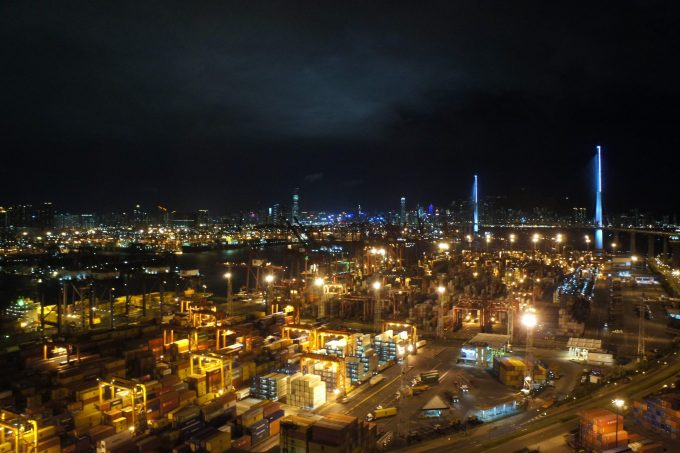

Kwai Tsing Container Terminals Photo: Mk2010 / Wikimedia Commons / CC BY-SA 3.0
Hong Kong is reviewing permit fees charged to river trade vessels as it seeks to maintain its port’s competitiveness amid growing competition from mainland Chinese terminals in Guangzhou and Shenzhen.
The secretary for transport and logistics, Chan Mei-po, announced the review in a written reply to the Legislative Council on Wednesday.
China-flagged vessels carry containers between ports in the Pearl River Delta and Hong Kong, where cargo may be transferred to ocean-going vessels for onward shipment.
Mainland Chinese ports offer incentives to attract inland waterway vessels carrying cargo, promising financial subsidies and exemptions from mandatory pilotage requirements.
Hong Kong operates a multiple-entry permit scheme, allowing operators to make up to 10 port entries within a month for a fee equivalent to five single-entries – the “buy five, get five free” system.
Ms Chan said: “The Action Plan on Maritime and Port Development Strategy proposes various measures to strengthen Hong Kong’s position as a regional transhipment hub, including reviewing the permit fees charged to river trade vessels in order to maintain the competitiveness and attractiveness of the port to the industry. We have completed a preliminary review and are now discussing the matter with relevant departments, with the details to be released in due course.”
Laden container movements between Hong Kong and mainland China account for more than 40% of the territory’s annual laden container throughput. But statistics show a decline in river cargo vessel arrivals and associated container volumes since 2023.
The numbers cover vessels mainly berthing at Kwai Tsing Container Terminals. In 2023, there were 4,344 arrivals, handling 1.63m teu. By 2025, this had fallen to 3,519 arrivals and 1.52m teu. In the first seven months of 2026, there were 2,101 arrivals, handling 878,000 teu.
Decades ago, Hong Kong was among the world’s three busiest container ports. but mainland ports have overtaken the territory as Chinese exports surged and their port infrastructure was upgraded.
Hong Kong handled 12.99m teu in 2025, down 5.1% year on year.