
Hong Kong is looking to the new Pinglu Canal to stem the decline in cargo volumes at its port by extending its reach into western China’s inland markets, and strengthening its role as a regional transhipment hub.
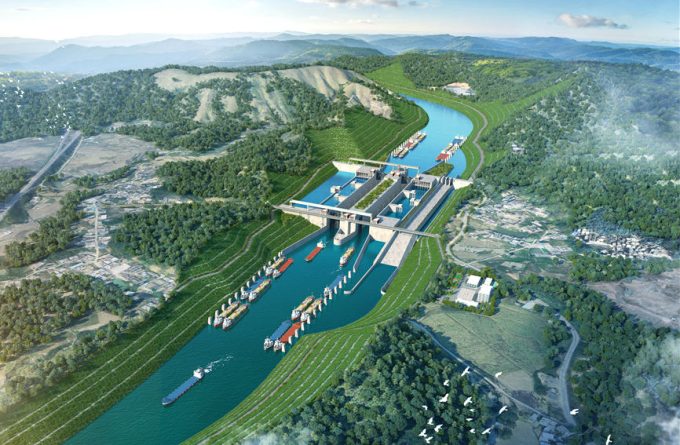
The Hong Kong government sees the newly opened canal, which links inland industries in China’s Guangxi Zhuang Autonomous Region, with Beibu Gulf, as a means to broaden the port’s cargo catchment area and competitiveness.
Decades ago, Hong Kong competed with Singapore and Rotterdam as the world’s busiest port. But in recent years, mainland Chinese ports have taken the top spots as exports surged and port infrastructure was upgraded. By 2025, Hong Kong was ranked the 12th busiest port, as volumes dropped 6%, to 12.91m teu.
Chan Mei-po, secretary for transport and logistics, said at a legislative council meeting yesterday that Hong Kong would “seize the opportunity presented by the opening of the Guangxi Pinglu Canal”.
The government aims to extend Hong Kong’s cargo source base inland, while developing more multimodal connections with China’s western land-sea corridor.
The strategy reflects a broader shift in Hong Kong’s approach to its port. Rather than relying solely on its traditional role as a high-volume container gateway, the government wants to transform it into a “value port”, with greater emphasis on logistics, maritime services, finance, digitalisation, and other higher-value activities.
But it also stressed this did not mean abandoning the physical port.
Ms Chan said: “We are closely aligned with the dual-core strategy of enhancing port competitiveness and improving the high value-added maritime service ecosystem.”
Hong Kong is already growing the links. Container traffic between Guangxi and Hong Kong reached 160,000 teu in the first half of 2026, up 22% year on year, according to the government. which wants to build on this growth by combining the canal with existing sea-rail services and new land and river connections.
Among the services already linking Hong Kong to China’s western land-sea corridor are a Hong Kong-Guizhou daily service and a Chongqing-Qinzhou-Hong Kong sea-rail intermodal service.
And Ms Chan said Hong Kong port retained significant operational strengths. Average containership turnaround was slightly more than one day, about half the average for the world’s top 20 container ports.
Kwai Tsing Container Terminal had also recently handled more than 8,300 container moves on a vessel with capacity of more than 23,000 teu.
The government is also proceeding with the “intelligent transformation” of Kwai Tsing, supporting the development of shore power and potentially to introduce port fee discounts to attract liner calls. At the same time, Hong Kong is expanding its port community system, which has more than 9,000 registered companies, and has facilitated more than 20 cases of trade financing using trusted cargo-flow data.