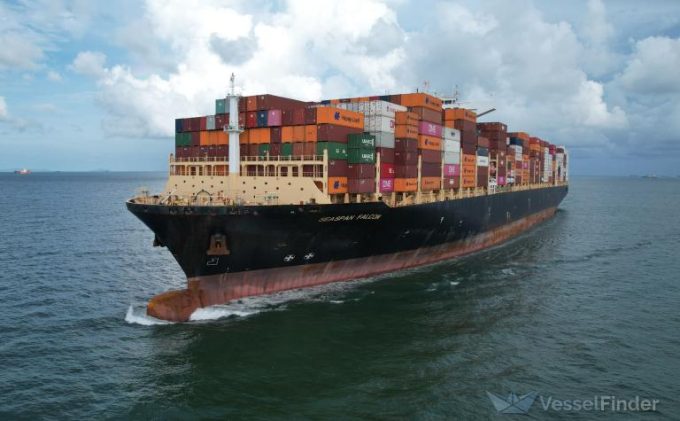

图片来源:VesselFinder
Hapag-Lloyd will next year exit the vessel-sharing agreement (VSA) it has on the Asia-east coast South America trade with MSC and ONE.
“The existing VSA on the Ipanema service…will be coming to an end in its current configuration,” MSC told customers today.
“However, MSC and ONE remain committed to the service and will jointly operate the weekly sailing, maintaining fast and reliable connections from a broad range of Asian origins to the east coast of South America,” it said, adding that the first sailing under the new agreement will depart Shanghai on 3 April.
According to Xeneta’s eeSea liner database, the Ipanema service – marketed as X1 by One and AS2 by Hapag-Lloyd – deploys 13 vessels with an average capacity of 11,700 teu. Five are currently supplied by Hapag-Lloyd and are expected to be replaced by MSC tonnage.
Indeed, the customer advisory explained: “MSC will deploy additional vessels, further strengthening our presence on one of the most reliable, stable, and successful services in the trade, and enhancing our ability to support customers’ growing needs.”
Meanwhile, the Ipanema’s port rotation will remain unchanged at: Shanghai-Ningbo-Shekou-Hong Kong-Singapore-Santos-Paranaguá-Navegantes-Montevideo-Buenos Aires-Rio Grande-Paranaguá-Navegantes-Santos-Singapore-Hong Kong-Shanghai.
Last week saw the beginnings of a substantial redrawing of the web of container liner services that connect Asia and the east coast of South America, which saw Maersk and CMA CGM end their ASAS2/SEAS3 service, the French carrier consolidating its services on the route with its Ocean Alliance partners.
Loadstar contributor Nils Roche 著名的 that VSA changes under way on the Asia-SAEC trade were beginning to reflect wider network trends taking place globally.
He wrote: “ECSA shows where the industry is heading. MSC stands tall alone, Ocean Alliance consolidates, Maersk bets on controlling its own network, Hapag-Lloyd hedges across every camp, and smaller lines get pushed to the edges.
“Shippers on this trade will feel it first. They should treat December as a preview of what alliance strategy does to trades well beyond South America,” he added.
However, with its departure from the Ipanema VSA, Hapag-Lloyd will be left with two services on the trade – the AS3/ZFS string it operates in cooperation with Zim, and Maersk’s ASAS, on which it buys slots.
Mr Roche last week 预测 that Singapore carrier PIL could be added to the AS3/ZFS string: “I expect PIL to join AS3/ZFS, bringing four 14,000 teu ships from its old ES1 slot. That suits Hapag-Lloyd and Zim, which are short of tonnage to complete the rotation.”
However, the freeing-up of five vessels from Ipanema could be a ready solution to the tonnage shortage.
A further possibility is that Hapag could redeploy the Ipanema vessels to Maersk’s ASAS service, in a de facto extension of their Gemini agreement on the Asia-South America trades.