
© Ajdibilio
Airlines are reshaping freighter networks as uneven demand and a shortage of available aircraft make the deployment of existing capacity increasingly important. Airports, too, are having to fight harder to attract capacity.
The latest WorldACD figures point to an increasingly fluid freighter market, with aircraft shifting between tradelanes in response to changes in demand.
WorldACD said the slowdown in ecommerce traffic into Europe had prompted a “quick re-allocation of freighter capacity from Asia Pacific-Europe to transpacific sectors”.
Rather than a wholesale expansion in available lift, global air cargo capacity has remained remarkably stable, fluctuating within a range of just plus or minus 1% week on week since late June.
In week 36, worldwide capacity slipped 1%, with Asia Pacific and North American capacity both down 1% and Central and South America down 3%.
WorldACD said the relatively static global capacity picture partly reflected continuing supply chain problems affecting the output of new widebody aircraft, while the “re-deployment of freighters from slower to more active markets” had helped keep rates relatively stable.
That approach to capacity is increasingly visible in carrier schedules and partnerships.
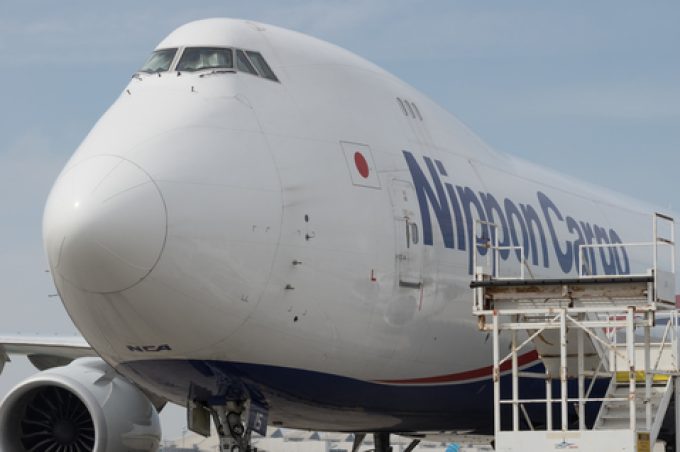
ANA Group, which is preparing to combine ANA Cargo, Nippon Cargo Airlines (NCA) and NCA Japan into a single cargo airline next year, has been adjusting its freighter operation in response to what it describes as “changing market conditions”.
For the winter season, NCA’s separate Narita-Dallas and Narita-New York routes are being restructured into a combined Narita-Dallas-New York operation, while frequencies on the Narita-Singapore-Bangkok route are being increased.
The group is also leaving room to add charter and extra-section flights as demand dictates, saying it will use “agile network optimisations” to respond to customer requirements.
The strategy will become increasingly important after the three cargo businesses are integrated on 1 April next year. ANA announced this week that the new operation would be branded ANA Nippon Cargo, with the corporate name subsequently scheduled to change to ANA Nippon Cargo Airlines.
The group intends to combine dedicated freighters with the belly capacity of ANA’s expanding passenger network to capture cargo flows between Asia, Europe and North America.
But the group’s network reach is not limited to its own aircraft – it also uses Mexico’s mas, via a block space agreement, for services from Los Angeles to Mexico City’s Felipe Ángeles International Airport (NLU) and Guadalajara, while mas takes space on NCA flights between Los Angeles and Narita.
Mas typifies airlines trying to extract more from its fleet of just five A330 freighters while struggling to source additional aircraft. The carrier’s fleet is currently spread across three areas of operation: an Americas network connecting Los Angeles with South America through NLU; four weekly flights to China; and European flying from Zaragoza for a major fashion retailer through Galistair, in which mas owns a 49% stake.
Chief executive Robert Van De Weg said last month that mas wanted to add one or two widebody freighters this year and expand its fleet to eight-to-10 aircraft by 2030, but acknowledged the shortage of suitable aircraft was making expansion difficult.
Rather than continue adding destinations, he said the immediate priority was to increase frequencies on its existing network.
“We would like to add more stations, but for now I think we are good with our stations spread until we can grow,” said Mr Van De Weg.
“I think the prime purpose now is not to add new stations but to increase frequencies, but for that again we need the fleet growth.”
Cathay Cargo, meanwhile, is also changing where and how it deploys freighter capacity.
It said it was adding additional freighter lift to the Americas from September to meet current demand and prepare for the fourth quarter, while a leased A330 converted freighter will join its operation later this year.
The aircraft will be operated on Cathay’s behalf by subsidiary Air Hong Kong, in a new operating model for the two carriers, and will be aimed at increased regional demand for general cargo.
Other carriers are finding opportunities at less traditional freighter gateways.
Air China Cargo this month added a twice-weekly link between Ürümqi and Glasgow Prestwick, adding to its services between the Scottish airport and Guangzhou, Chengdu and Shanghai.
Prestwick now has 16 scheduled weekly services to and from mainland China and said its cargo tonnage had quadrupled year on year.
The airport is also seeking to build traffic in the opposite direction. Some 1.78m kg of Scottish salmon was exported through Prestwick in the first half of the year, and the airport sees the Ürümqi service as offering further opportunities for seafood and whisky exports.
Qatar Airways Cargo has similarly moved into a new market, launching a weekly 777 freighter service from Doha to Helsinki via Budapest earlier this month, giving Finland its first dedicated scheduled cargo connection to Asia.
For airports seeking a share of this shifting capacity, however, simply having the infrastructure available may no longer be sufficient.
Navi Mumbai recently introduced substantial incentives for international operators, including the 90% first-year reduction in landing charges for new international freighter services and a 50% reduction in year two.
The airport had argued that international airlines were proving reluctant to commit capacity amid high operating costs and wider uncertainty, prompting India’s Airports Economic Regulatory Authority to revise the incentive structure.
Relatively new or secondary gateways can offer carriers new network possibilities, but they still have to persuade airlines that deploying scarce aircraft there makes commercial sense. And carriers are now having to make their freighters work harder as the freighter crunch begins to bite.
来看看本周的 News in Brief podcast, featuring Rotate’s Jonathan Mellink!