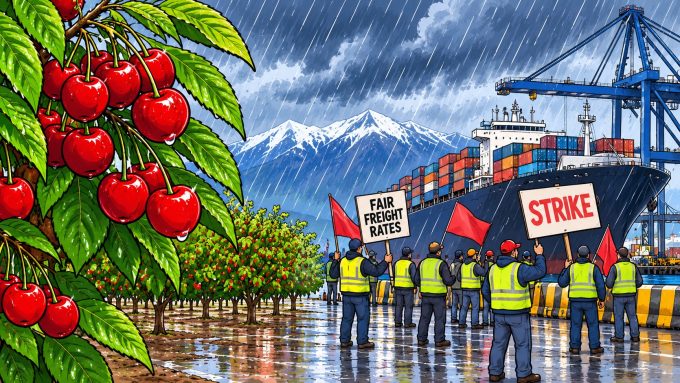

When it rains, it pours. Agriculture exporters in Latin America’s southern cone have struggled with headwinds from weather hitting crops as well as transport routes, on top of gateway problems and high transport costs.
Chile’s cherry export season got off to a rocky start when truckers staged a protest about high costs that cut off access to the container terminals at the port of San Antonio. They were up in arms over stalled freight rates, rising fuel costs and new charges on the main highway between the port and Santiago.
The strike disrupted the official start of Chile’s cherry export season that was set to kick off with the sailing of the first ‘Cherry Express’ to China, scheduled for 9 November, with loading planned to commence two days earlier.
San Antonio is the nation’s main gateway for marine cherry exports, which have gained ground over airfreight in recent years. The port reportedly handles nearly half of Chile’s fruit exports.
Industry body Frutas de Chile called for a swift end to the strike, warning that a prolonged stand-off would affect crop quality, as the port was already at 90% of storage capacity.
The blockade was called off late on Friday after nine days, following an agreement on an 8% adjustment on overland freight rates and a commitment to implement an indexing mechanism. By that time, however, the first ‘Cherry Express’ had been diverted to Valparaiso, causing a scramble to move cherries there.
For growers, the disruption piled additional grief on a reduced crop of inferior quality as a result of massive rainfall caused by this year’s El Niño, which has been flagged as an extreme weather event and affected crops in other parts of South America as well.
“Exporters in Chile have been very worried about the situation,” reported Federico Calvo, director of Intermodal Logistics. “Cherry volumes are starting up, but not as strong.”
On 2 November, Chile’s Ministry of Agriculture declared an agricultural emergency in parts of the Maule region, an area dominated by forestry and agriculture, especially wine growing. Media reported serious damage caused by rains, hailstorms and strong winds.
El Niño also hit Argentine exporters. Snow on the Andean passes and heavy rain repeatedly blocked the main road from Argentina to the Chilean ports, resulting in ten days of closures at the border.
Typically, border crossings are closed during the southern winter only for a couple of days, Mr Calvo said.
The situation is causing concern for blueberry growers in Argentina and Chile, just as they are poised to benefit from a weather-related slowdown of blueberry exports from Peru. Their northern rivals had thundered to the top of South America’s blueberry-producing nations with a rapid expansion of cultivated areas.
This year, El Niño has impacted Peruvian blueberry output, opening the door to growers in the south to boost their exports. Proarandanos, the Peruvian blueberry industry body, has lowered its forecast for this year’s crop several times. Its most recent forecast, from mid-October, is 6% lower than the projection from the beginning of that month, and down 10% year on year, despite a 15% increase in the acreage for production. Predictions for the fourth quarter flag a decline of nearly 25%.
Last week, Peru’s Ministry of Foreign Trade and Tourism called a meeting with government agencies and industry bodies to discuss measures to maintain operations during climate-related disruptions. Among the proposals that came up at the event are identifying vulnerable ports and transport routes, evaluating alternative routes and setting up response procedures for logistics disruptions.
Chilean and Argentine shippers using or contemplating airfreight to move produce to overseas markets have also faced challenges. The current upgrading of the secondary runway at Buenos Aires’ Ezeiza airport involves work on the intersection with the airport’s main runway from 26 October to 15 November, which cut the latter’s length from 3,300m to 1,850m. Several airlines have suspended flights to Ezeiza for the period, while a few have added refuelling stops in Montevideo or Sao Paulo to reduce take-off weight at Ezeiza. As a result, airfreight pricing has gone up, Mr Calvo noted.
He added that fuel surcharge adjustments of several airlines serving the Chilean capital have translated into price increases up to 35% there, which have also been hard to stomach for produce shippers.