
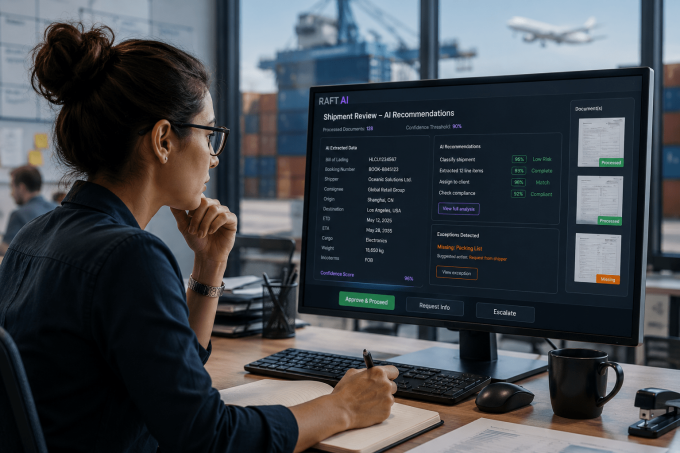
A growing gap between executive enthusiasm and frontline confidence is emerging as one of the biggest obstacles to AI adoption across the supply chain industry, according to a new survey from 载星 and Raft.
这 State of AI in Supply Chain report, based on responses from more than 200 supply chain executives and practitioners worldwide, found that while AI is delivering measurable gains in areas such as document processing and productivity, most organisations remain far from achieving large-scale deployment.
Only 22.2% of respondents said AI had been deployed at scale across multiple teams or had become core to operations, while 43.2% remained in experimentation phases or had not yet started adoption.
The research suggests the biggest barriers are organisational rather than technical. More than half of respondents (53.8%) cited a lack of in-house AI expertise and change-management capability as the main obstacle to scaling deployments, while 48.7% pointed to difficulties integrating AI with existing systems.
Perhaps the most striking finding was the divide between senior leadership and frontline employees.
Among vice presidents and executives, 77.5% described themselves as optimistic or enthusiastic about AI’s impact on their careers. That figure dropped to just 37.5% among analysts, specialists and other individual contributors.
James Coombes, chief executive of logistics AI provider Raft, said the findings highlighted a confidence gap rather than widespread fear of automation.
“The biggest eye-opener for me was the massive sentiment gap between the boardroom and the front lines,” he said.
“While 77.5% of VPs are highly optimistic about AI, that enthusiasm plummets to just 37.5% among the individual contributors actually doing the work – yet, fascinatingly, only 9% of those frontline workers feel threatened by it.
“This tells us the issue isn’t frontline fear, but rather leadership selling a grand vision that their execution teams simply haven’t seen delivered in reality yet.”
According to the report, document extraction and processing remains AI’s clearest success story, with 79.7% of respondents identifying it as the area where the technology had generated the most tangible operational impact. Speed and productivity gains were cited by 89.5% of organisations already seeing measurable value.
However, measuring that value remains a challenge. Nearly two-thirds (62.8%) of respondents said they had either not measured the return on investment from AI initiatives or were unsure how to do so.
Mr Coombes argued that the industry was experiencing an execution gap rather than an AI hype cycle.
“I’d push back on the word ‘hype’. Hype implies the value isn’t real, and across more than 100 deployments with Raft the value is undeniable,” he said.
“The people actually using AI are getting genuinely faster output. What the survey exposes is something more interesting: a measurement and execution gap. Most firms still can’t put a number on what AI is doing for them, and far fewer have deployed at scale than are talking about it.”
The survey also revealed significant regional differences. North America recorded the highest proportion of companies yet to begin AI adoption, with 25.6% reporting no meaningful implementation efforts.
Mr Coombes suggested the region’s lag reflected operational complexity rather than a lack of ambition.
“North America doesn’t have an ambition problem. The leaders I speak with are some of the most bullish in the world. It does, however, have a complexity problem,” he said.
He pointed to the breadth of services managed by many US-based logistics providers, the legacy of extensive offshoring, and deeply embedded operating processes as factors making change more difficult than in other markets.
Looking ahead, the report argues that competitive advantage will depend less on access to AI technology and more on organisational readiness, including data quality, integration and change management. Some 65.8% of respondents said data quality and integration would be the key differentiator between AI leaders and laggards over the next two to three years.
Mr Coombes believes the next major shift will come in back-office operations.
“Within three years, the high-volume document triage and actioning that has bottlenecked the logistics back office for decades will be gone,” he said.
“Reconciling an invoice against an accrual, making a customer booking, chasing a missing field – all of it automated by default, handled before a human ever sees it.
“What will be left will be high-stakes data that needs human review, mission-critical exception management, and relationship management with both customers and service providers,” he said.