
The global solar energy boom is showing no signs of slowing down, with falling costs and ambitious clean energy targets continuing to drive rapid adoption. Last year, solar capacity additions surged 11% Y/Y to a record 647 GW worldwide, bringing the total cumulative solar capacity across the globe to 2.9 TW and cementing its position as the world’s fastest-growing electricity source. Indeed, in April 2026, monthly global electricity generation from solar and wind surpassed gas-fired generation for the first time ever, a major milestone considering that natural gas provided double their combined output just five years ago. Unfortunately, the vast majority of that energy can only be fed to power grids when the sun is shining. Currently, more than 90% of all operational solar capacity is standalone and not paired with batteries, in large part due to the fact that li-ion batteries for large-scale energy storage have traditionally been prohibitively expensive. But things are changing quite rapidly. What developers are looking for are hybrid solar-plus-storage plants that allow them to bypass grid bottlenecks and maximize land use, while grabbing higher revenues.
Indeed, Brookfield Asset Management (NYSE:BAM), the primary investment manager of Brookfield Renewable Partners (NYSE:BEP), now says that corporate power purchase agreements (PPAs) that pair clean energy generation with battery storage are actively displacing standalone solar and wind contracts. According to the asset manager, the shifting dynamics in the renewable energy market are being driven by the massive global buildout of clean energy, which has introduced significant market risks for large-scale energy buyers. Brookfield Asset Management is the leading alternative asset manager globally with over $1 trillion in assets under management (AUM).
Related: Ukraine’s Drone Campaign Forces Russia to Buy Gasoline From India
According to BAM, the rapid buildout of solar flood power grids with electricity during peak sunlight hours leads to the value of standalone solar plummeting, sometimes into negative territory. Older standalone corporate PPAs signed before 2022 lacked structural protections against negative pricing. Consequently, corporations often find themselves forced to pay fixed contract rates for electricity that is effectively free on the spot market.
“There’s a lot of renewables being built in many markets, and the attractiveness of these renewable megawatt hours in the middle of the day is declining to a point where many large off-takers no longer want standalone solar,” said Arnaud Jouvin, who leads Brookfield’s global energy storage strategy.
According to Jouvin, corporate buyers are increasingly shunning standalone solar power in favor of hybrid models due to several distinct advantages. First off, Battery Energy Storage Systems (BESS) shield clean energy asset owners and corporate buyers from market risk by acting as financial and operational buffers. Batteries recharge during peak generation hours, saving asset owners from being penalized or forced to sell power at a loss. Storage then discharges this power later in the day when the sun sets or wind drops, taking advantage of peak pricing periods.
Second, corporate buyers prioritize grid reliability and want to hedge their costs against power price spikes. Co-locating energy storage with renewable generation directly tackles corporate buyers’ needs for grid reliability and cost hedging. By combining production with storage, buyers achieve stable, predictable costs. Further, corporate Power Purchase Agreements (PPAs) paired with storage are highly desirable to lenders and developers, mitigating financial risks associated with merchant revenues.
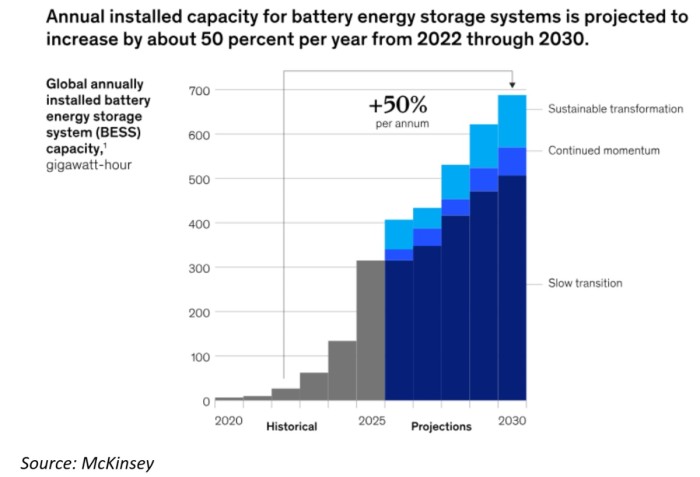
Not surprisingly, the BESS sector is expected to enjoy exponential growth in the coming years. According to McKinsey, global Battery Energy Storage Systems (BESS) market capacity expansion is expected to clock in at 50% per annum to hit ~680 GWh by 2030 driven by falling lithium-ion costs, renewable integration and surging AI-driven data center demands.
Source: McKinsey
Thankfully, there’s no shortage of stocks to play the BESS boom, including pure-play integrators and developers as well as diversified utilities and power producers.
Fluence Energy (NASDAQ: FLNC) is a 50/50 joint venture between Siemens and AES. The company operates as a major global player in the BESS market, specializing in grid-scale deployments, cloud-based software and AI-enabled bidding optimization. Driving the company’s massive $5.6 billion backlog is a rapid surge in multi-gigawatt demand from the utility and data center sectors. Fluence has secured Master Supply Agreements (MSAs) with two major hyperscale data center developers to provide qualified technology solutions globally, specifically buffering massive computing loads and extreme power spikes.
Bimergen Energy Corporation (NYSE: BESS) is an independent power producer and developer headquartered in Newport Beach, California. The company specializes in utility-scale BESS and solar farms to capture energy arbitrage revenue and provide grid stabilization services. Bimergen builds, owns, and operates standalone battery storage and solar portfolios, managing the full lifecycle of these assets. Rather than manufacturing batteries, the company functions as a project developer and asset owner, monetizing facilities through Investment Tax Credits (ITC) and direct market energy sales. The company estimates that a standard 100-megawatt battery farm requires approximately $125 million to construct, and projects around $25 million in annual revenue once operational. Management is targeting $300 million to $400 million in annual energy arbitrage revenue over the next three to four years.
Brookfield Renewable Corporation (NYSE: BEPC) is one of the largest publicly traded pure-play renewable platforms globally. BEPC was designed to provide investors who would not otherwise invest in a limited partnership (BEP) with the economic equivalent of a BEP unit in the form of a corporate exchangeable share. Its multi-billion dollar portfolio features hydroelectric, wind, solar, and energy storage. With over 33,000 MW of operating capacity and a multi-gigawatt development pipeline, BEPC is leading the global corporate decarbonization drive. Brookfield has secured massive Power Purchase Agreements (PPAs) with major technology firms, including a landmark 10.5+ GW clean energy delivery agreement with Microsoft (NASDAQ:MSFT) for powering data centers and artificial intelligence needs.
By Alex Kimani for Oilprice.com
More Top Reads From Oilprice.com
- Asian Refiners Redirect Middle East Crude to the U.S. as Hormuz Flows Recover
- Pakistan Pays Premium for Urgent LNG Cargo
- VLCC Earnings Near $470,000 a Day as Hormuz Hopes Drive Tanker Frenzy