
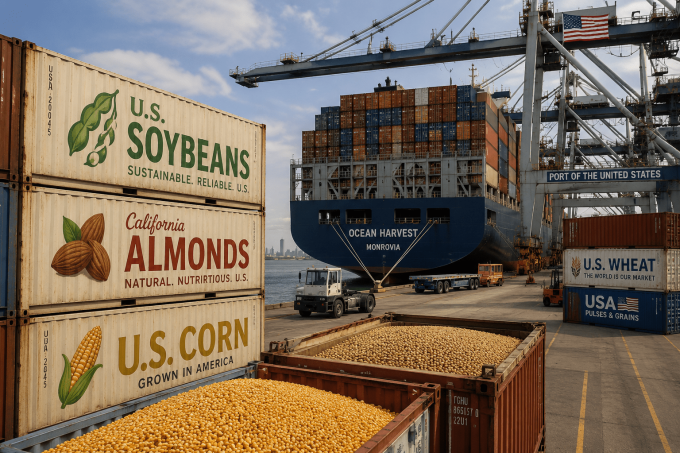
US agriculture exporters are gearing up for another fight over Washington’s plans for penalties on Chinese-built ships, warning the measures could add as much as $900 per container to transport costs and wipe out export sales across a swathe of commodities.
The Agriculture Transportation Coalition (AgTC) sounded the alarm yesterday, after Senators Elizabeth Warren and Mark Kelly urged US trade representative Jamieson Greer to reinstate suspended port fees on Chinese-built and -operated vessels.
Calling the proposal a “renewed federal government threat to US ag exports”, AgTC said the fees could prove existential for some sectors.
“The proposed remedies threaten the very existence of large segments of US agriculture, by denying them the ability to continue to export,” said executive director Peter Friedmann.
According to AgTC, fees of $1m-$1.5m per vessel call would ultimately be passed on to shippers, adding an estimated $600-$900 per container to freight costs.
For exporters already battling razor-thin margins and fierce competition from Brazil, Canada, and Australia, that could be enough to price US products out of overseas markets, it added.
AgTC estimates the additional costs would increase the delivered price of US soybeans to South-east Asia from $12 to $12.81 a bushel, corn from $8 to $8.81 a bushel, and timber exports to China from $500 to $575 per cu metre. In each case, the coalition argues, foreign buyers would simply switch suppliers.
“Hogs in China could[n’t] give a damn if the soybeans come from the US or Brazil,” the coalition told the USTR.
The latest warning follows a letter from Senators Warren and Kelly, demanding the Trump administration explain by 21 June whether it intends to restore the fees, which had been suspended until November during trade negotiations with China.
The senators argue the measures are needed to counter China’s dominance of global shipbuilding and maritime logistics, claiming carriers had already begun shifting vessel orders away from Chinese yards before the suspension.
But exporters see the proposal very differently.
Beyond the fees themselves, AgTC warns that carriers would likely cut calls at smaller US ports and consolidate services at major gateways to reduce their exposure, making exports more expensive and less accessible for producers in agricultural regions.
The coalition is also fiercely opposed to proposals requiring a growing share of US exports to move on domestically built and flag ged vessels. It argues there are no commercially viable ships available to meet the requirement, and says compliance would be “impossible” without massive government subsidies and years of American shipbuilding investment.
The clash sets up a renewed battle between advocates of rebuilding US maritime capacity and exporters who fear they will be forced to foot the bill.
“Nothing we produce in agriculture or forest products here in the US cannot also be sourced from a foreign country,” AgTC said. “If we cannot deliver to our overseas customers affordably and dependably, they will find alternative sources.”