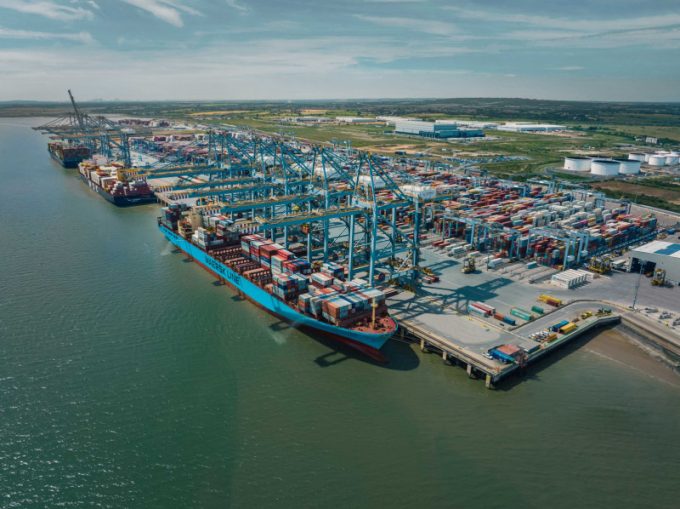
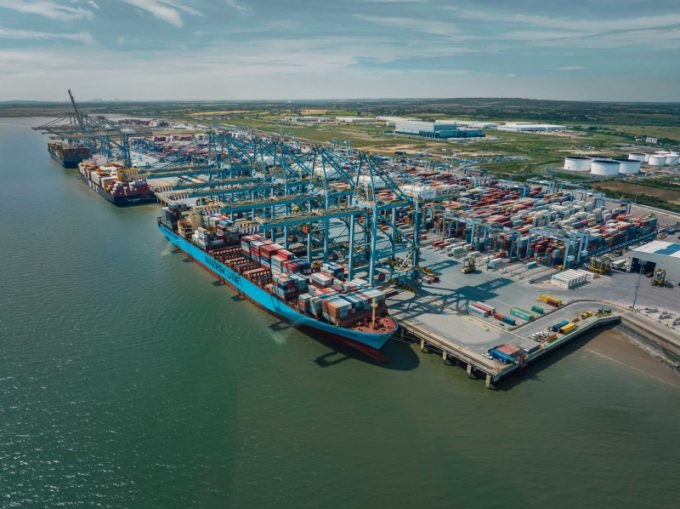
Photo: DP World
UK lobbyists today pushed back at attempts to have the EU designate the ports of Felixstowe, London, and Southampton as “neighbouring container transhipment ports”, in the ongoing question of whether shippers are rerouting cargo to avoid ETS scheme charges.
In July, the EU ETS Observatory – developed by Spain’s state-owned ports administrator Puertos del Estado as a way of monitoring “carbon leakage” from its transhipment hub of Algeciras to Morocco’s Tanger Med after the introduction of EU-ETS at the beginning of 2024 – published a report which appeared to suggest that the container volume growth seen in UK ports during 2025 was the direct result of shippers seeking to minimise EU-ETS charges.
It had led to a “reduction in the connectivity of container traffic for long-distance services operated at EU ports, compared with neighbouring countries not subject to European environmental regulations, measured in terms of the teu-mile parameter”.
London Gateway owner DP World said its 2025 throughput at the port was just over 3m teu, a rise of 52% on 2024, while Felixstowe’s throughput was 3.6m teu, flat year on year. UK Department for Transport data shows UK-wide container volumes up by 600,0000 teu.
However, the British Ports Association (BPA) today argued that 2025’s volume growth seen at the UK’s three main ports was caused by a combination of new capacity coming onstream at London Gateway and the reorganisation of the deepsea shipping alliances that took place at the start of the year.
One the chief effects of the new alliance networks was the switch of Maersk from Felixstowe to London Gateway, as the Gemini Cooperation’s chief Asia-Europe UK port.
“Of the approximately 600,000 additional container units handled nationally, London accounted for around 500,000. The DfT explicitly links London’s increase to additional capacity at London Gateway. This is not the pattern that would most naturally be expected from a general UK wide regulatory advantage.
“The overwhelming majority of national growth occurred in the port area where a major new tranche of container capacity had just become available,” the BPA paper stated.
It also argued that measuring traffic by teu-miles was not a “measure of the containers handled by a port, the cargo imported or exported through it, vessel utilisation or conventional cargo market share”.
“The metric is particularly sensitive to port-call sequencing,” it added. “Consider an Asia-North Europe service that calls at both Rotterdam and Felixstowe; if Rotterdam is the first European call, the long intercontinental leg is associated with Rotterdam.
“Reverse those two calls and the UK’s measured transport work can rise sharply, even if the same vessel continues to call at both ports and the amount of cargo handled at each changes little.”
However, as The Loadstar reported in September, recent analysis by freight intelligence platform VesselBot shows EU importers with cargo on an Asia-Europe vessel which calls at the UK before continental Europe, have been faced with significantly lower ETS charges than if an EU port was its first call.
However, the BPA also notes that, with the UK also set to introduce a carbon charging mechanism designed to largely align with the EU, the cost differential is expected to exist for a relatively short window.
“The current UK–EU carbon-pricing difference is itself transitional: the UK ETS Authority has proposed extending the scheme to 50% of emissions from international voyages from 2028, mirroring the present EU approach.
“EU ETS may affect the economics of some individual rotations at the margin. But the structural explanation for the UK’s stronger position lies in long-planned investment, increased capacity, carrier-network restructuring, and operational performance.
“UK connectivity gains should therefore not be characterised as regulatory avoidance or carbon leakage, without much stronger evidence that the activity concerned would otherwise have taken place at EU ports,” it says.