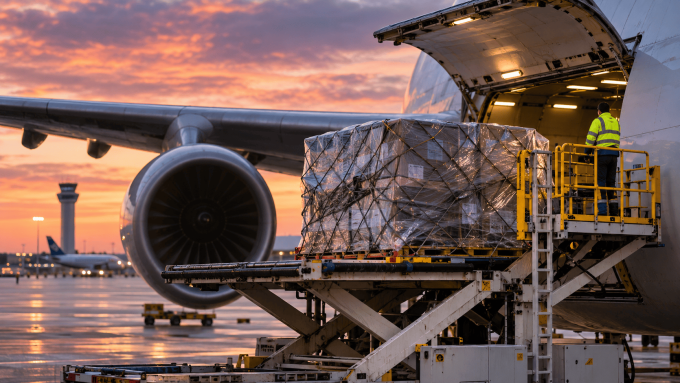

Transatlantic airfreight rates have hit their highest level since December 2022, as peak-season demand and tightening capacity push prices up – although last week’s US aviation disruption appears to have had little additional impact.
According to Freightos, Europe-US rates jumped 12% last week, to $3.27 per kg, while China–North America prices rose 16%, to $9.25 per kg, already exceeding last year’s December peak of $8.
The increases predated the nationwide US flight grounding on 13 November, neither lane recording a significant further rise following the disruption.
Thomas Cullen, Transport Intelligence analyst, noted that the FAA failure appeared to have had “remarkably little impact” on US airfreight operations. UPS and FedEx had warned of possible delays, while Delta briefly embargoed pharmaceutical and fresh cargo, lifting the restrictions the following day.
Meanwhile, data supplied to The Loadstar by freight forwarder ExFreight suggested transatlantic increases had accelerated sharply this month.
For shipments of more than 100kg, the average Europe-US rates remained virtually unchanged between June and October, at around $3.06 per kg, but jumped 25%, to $3.83, this month. Asia-US rates rose more moderately, increasing 10% between June and November, from $7.81 to $8.63 per kg.
However, individual European lanes recorded considerably steeper increases. Denmark–US rates soared 191%, from $2.55 to $7.41 per kg, while Sweden prices rose 59%, France 53%, Austria 47%, Switzerland 39%, and the UK 25%.
In Asia, South Korea prices recorded a 64% increase, followed by Indonesia, at 53%, Hong Kong 34%, Japan 28%, China 21%, and Malaysia 14%.
Conversely, rates from India fell 17%, Sri Lanka 14%, and Taiwan 7%, highlighting the uneven nature of the market.
Charles Marrale, CEO of ExFreight, told The Loadstar: “Honestly the market is very weird right now. We are seeing larger accounts slow down, but then we are adding on a lot of new business from smaller accounts.”
He said the company’s API connectivity was attracting smaller businesses embracing AI and looking to integrate freight providers directly into their enterprise resource planning systems.
Meanwhile, Cathay Cargo reported an 8% year-on-year increase in October tonnage, despite available freight tonne km rising just 1%. Tonnage for the first 10 months was up 9%.
The carrier attributed the growth primarily to strong exports from North-east and South-east Asia, with network equipment shipments supporting demand for Cathay Priority and semiconductor traffic underpinning Cathay Expert.
It said it expected demand to remain strong through the traditional peak season and plans to introduce an additional A330 freighter, operated by Air Hong Kong, on selected regional routes.
Freightos suggested Europe-US demand was being supported by seasonal volumes and Asia-origin cargo seeking alternative routings, while reduced winter passenger schedules and freighter redeployment could be further restricting capacity.
Mr Marrale warned that reductions in US airline capacity, driven by higher fuel costs and weaker passenger demand, could keep prices elevated.
He also highlighted the continuing Middle East tensions, noting passenger demand to Dubai remained 28.1% below last year’s levels, with the wider region down around 30%.
“I don’t expect Gulf capacity to increase until the current situation with Iran is settled,” he said.
Looking ahead, Mr Marrale suggested potential US tariff reductions under the incoming Congress could prompt importers to rush to restock, triggering another increase in airfreight rates.
However, he acknowledged that the absence of a veto-proof majority made any legislative changes uncertain.