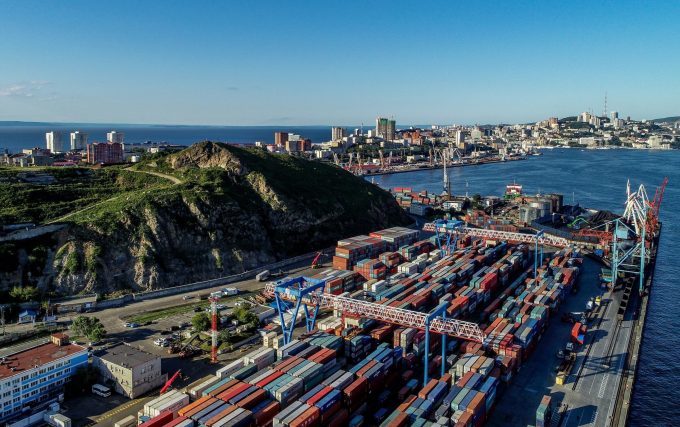

Port of Vladivostok
Growing congestion along the Trans-China and Trans-Siberian railways, linking China and Russia, has boosted South Korea-Russia container volumes, encouraging shipping lines to consider deploying larger vessels this month.
In August, more than 33,000 teu was transported from Busan to ports in Russia’s far east, such as Vladivostok, a slight increase on July. Of this, exports, excluding transhipment cargo, were 8,000 teu.
Volumes are said to have remained at the same level in September, as South Korean shippers rushed to get cargo out before the country’s Thanksgiving Day holiday on 25-26 September and China’s week-long National Day on 1 October. Last month’s exports are estimated at 8,800 teu, up 10% on August.
Consequently, cargo “rollovers”, where shipments are delayed due to a lack of space, are becoming increasingly frequent and Busan-Vladivostok freight rates now average $1,700 per teu, up from $1,500 per teu in August, which had seen a $300 jump from July.
A representative at Dong Young Shipping, which offers South Korea-Russia services, said: “We’re considering deploying larger vessels than those currently in use, so we can offer more slots.”
Congestion around major Chinese hub ports following the East Asia typhoon season in August resulted in more Chinese shippers opting for rail freight to Europe.
This caused bottlenecks on Trans-China Railway hubs like Lianyungang, Qingdao, and Tianjin, and shifts of cargo to the Trans-Siberian Railway. While Vladivostok has upgraded its facilities, more time is required to transfer cargo from sea to the TSR.
And as rail capacity has failed to keep pace with the surge in cargo volume, waiting times for train departures now exceed one week.
South Korean exports are typically transported to the Russian hinterland by being first shipped from Busan to Vladivostok, and then railed along the Trans-Siberian Railway. Key exports include automobile parts and components, electronics, industrial equipment, and consumer goods.
In response to rising volumes, Russian Railways plans to hike Trans-Siberian Railway freight rates by 8% this month.
Watch our latest podcast with Portcast to learn more about where margin leaks occur in freight forwarding, and how to mitigate against it!