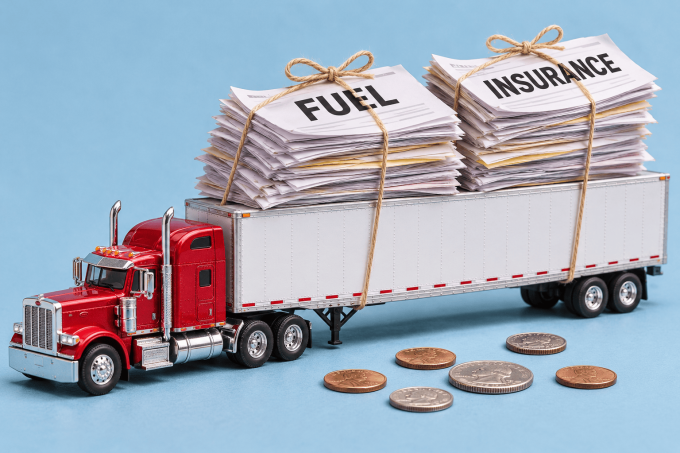

AI-generated image
As rising costs outpace rate increases, the pool of truckers in North America continues to shrink – and industry experts see no end to the bloodletting.
The C-suites of large trucking firms are, however, upbeat on their prospects.
Industry reports show a steady increase in casualties in the trucking industry: in the five weeks from mid-September into October ,at least 16 carriers filed for Chapter 11 bankruptcy protection, or simply collapsed with Chapter 7 submissions.
Bankruptcy filings have occurred all across the US, many are small and mid-sized truckers, tanging from owner-operators with a single vehicle to firms fielding 50-100 trucks, crushed by liabilities of several hundred thousand dollars up to several million.
Recent filings include Silk Route Transportation from Maryland (12 trucks in its fleet), buckling under liabilities of $541,000, and California-based Road King Transport (20 trucks), with almost $3.4m in debts.
The shrinkage of capacity, precipitated by Washington’s crusade to push non-resident truckers and drivers with inadequate English language skills out of the industry, has been lifting trucking rates, but costs for truckers have risen even faster.
Elevated fuel costs have been a heavy burden, which has fallen disproportionately on smaller outfits that do not have fuel surcharge mechanisms to mitigate the impact, as the pricing over load boards is all-inclusive.
Oil prices have retreated lately, but the outlook remains grim. The Energy Information Administration updated its projected retail prices of petrol and diesel for next year on 5 November, to an average of $5.03 per gallon of diesel, up from $4.49 in October.
Brent crude oil prices, currently around $92 a barrel, are expected to average $86 next year, but still way above 2025 levels.
According to Satish Jindel, founder and president of SJ Consulting, the hit from fuel cost is not as heavy as the rise in insurance costs in the wake of the Montgomery lawsuit ruling of May, which found brokers and 3PLs liable in cases of serious crashes involving truckers they hire. This has raised the bar for these firms to ensure carriers they use have good safety credentials and insurance.
As with fuel costs, smaller truckers are hit hardest by this, as they tend to pay the most per unit and lack the leverage of bigger competitors to negotiate insurance discounts.
Mr Jindel predicted that casualties on the trucking scene would continue, although the shrinkage of operators would maintain upward pressure on trucking rates.
“Small truckers and brokers will go out of business, but it will have no impact. Shippers may have to pay more, but freight continues to move,” he said.
Indeed, the number of trucks on US roads has not dropped as steeply as the number of trucking firms. While many operators have gone bankrupt, others have decided to put their trucks to work for larger operators, primarily mid-sized firms.
From the vantage points of the large trucking providers, the landscape looks decidedly brighter, as the shrinkage of capacity has enabled them to raise their pricing, despite sluggish demand. Recent earnings calls showed optimism.
“We believe we are still in the early innings of a multi-year upcycle,” commented Derek Leathers, CEO and president of Werner Enterprises. “Structural supply contractions continue across the industry. Customer demand remains stable, and our pricing discipline remains firm, with rates continuing to move upward toward more sustainable re-investable levels.”
And James Grant, group CFO of Covenant Logistics Group, said: “I think coming out of a four-year downcycle and moving into a stronger freight cycle, the types of opportunities that we have in front of us today are plentiful.”
Meanwhile, another potentially tectonic change appears to be closing in faster than anticipated. According to research from Kearney and the MIT Mobility Initiative, the cost of operating autonomous trucks in the US could be on a level with fielding trucks driven by humans as soon as 2028.
This year, running an autonomous truck costs around $4 a mile, compared with $2.50 a mile for human drivers, but the rates are expected to converge, as autonomous trucking costs sink to $2.60 a mile by 2028, while human truck operation costs could rise to $2.70 a mile.
The study predicts that the convergence of costs in Europe and the Middle East to play out closer to 2030 and 2032, respectively.
Mr Jindel is less sanguine on autonomous trucking, suggesting: “Today autonomous trucking is a hype. There will be an impact, but not soon.”
Regulators are not going to rush, given question marks over the safety of autonomous operations at this point, he pointed out, adding that progress in trucking would be significantly slower than with passenger vehicles, given the potentially much higher impact of an accident involving an autonomous truck.
Check out today’s News in Brief podcast, on the latest developments in US tariffs and customs enforcement, what a Democrat-controlled Congress could mean for the US trade agenda – as well as air freight updates.