
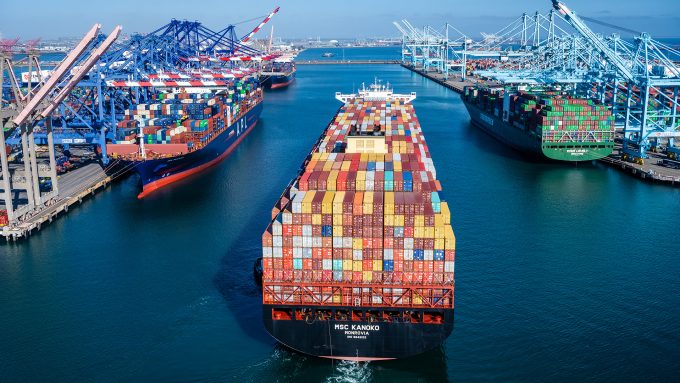
In the absence of carrier-led price hikes, container spot rates largely flattened on the transpacific and Asia-Europe trades this week.
The one exception was the transpacific Asia-North America west coast trade, which saw a 12% week-on-week increase, according to Drewry’s World Container Index.
The WCI’s Shanghai-Los Angeles leg this week finished at $5,750 per 40ft, some 54% higher than the corresponding week in 2025.
“Rates remained elevated this week, with standard market levels still pushing above $6,000 per container,” US west coast forwarder Freight Right said.
“However, carriers and agents are increasingly making deals or promotional rate structures available, allowing some shipments to move closer to the $5,700–$5,800 range when volume, allocation, or carrier-ratio requirements can be met,” it added.
It further explained that “blended deals” – combining lower contracts rates with spot rates in one booking – were being hiked up to the spot market levels by carriers being disciplined over allocations.
“To guarantee vessel occupancy while capitalising on high spot rates, carriers are tying low, fixed-contract space of around $3,000 to standard market-rate space.
“These ratios have become significantly tougher for forwarders, escalating from a 1:1 requirement to 1:3, 1:4, or even 1:5, effectively dragging the blended deal price closer to the standard spot market,” it said.
Meanwhile, there was flatter growth on the WCI’s Shanghai-New York route, which was up 6% week on week, to end at $7,149 per 40ft.
According to Drewry’s Container Capacity Insight, only four blanked sailings have been announced on the transpacific for the next week, “reflecting tight capacity” and analysts predicted further rises on both routes next week, due to new general rate increases (GRIs) and new bunker adjustment factors (BAFs) scheduled for 1 July.
Today’s Shanghai Shanghai Containerised Freight Index (SCFI) – which records rates quoted for the forthcoming week and, as such, indicate the behaviour of the following week’s WCI (as it did last week) – shows spot rates to both North America east and west coasts climbing 7%.
However, with the peak season clearly settling into a fortnightly pattern of sharp carrier-induced prices rise one week, followed by a plateauing the following week, the 7% increase for next week is far gentler than the double-digit hikes seen in May and June, and suggests the market could be nearing a price peak.
It could also reflect more capacity coming into the trades – according to Xeneta, this week saw Asia-US west coast capacity up 10.5% on the previous week, up 12.1% on Asia-US east coast and up 11.9% on Asia-North Europe, the largest weekly increases seen since the Strait of Hormuz closed.
“It has been a long time coming, but carriers have finally responded to spiralling spot rates and supply chain disruption on major ocean container shipping trades out of Asia by deploying significantly more capacity this week,” said Xeneta chief analyst Peter Sand.
“This raises an uncomfortable question from shippers – why has it taken until now for carriers to act when they have endured months of triple-digit freight rate increases and delays in getting containers on board ships?” he added.
On the Asia–Europe trades, the WCI’s Shanghai-Rotterdam leg rose 1%, to $4,392 per 40ft, while the Shanghai-Genoa leg was flat, at $5,759 per 40ft.
“For shippers, more capacity is always welcome and will help them to get supply chains moving more reliably, but they should not expect this to translate into falling freight rates,” Mr Sand continued.
“The only good news for shippers is that the situation is not as bad as it would otherwise have been, with spot rates expected to climb further, heading into July, but with slower growth than recent weeks,” he added.
However, sharper increases are expected next week, with today’s SCFI showing a 12% increase on its Shanghai-North Europe base port leg and a 12.5% increase on the corresponding route to the Mediterranean.
This would be pushed by new FAK (freight all kinds) levels due for 1 July, in addition to the new BAFs – in one example, CMA CGM new FAK rates of $6,300 per 40ft to North Europe and $7,700–$8,500 to the Mediterranean, as well as a PSS of $1,000 and $1,400 per teu to North Europe and the Mediterranean, respectively.