

Dreamstime
Maersk has lost both its partners on Asia–East Coast South America in three months, and what looks like a local reshuffle is the alliance map redrawing on a trade the alliances never formally covered.

Figure 1: Summary of events, by Solvens Advisory
In September, Zim quit Maersk’s ASAS loop to launch the AS3/ZFS with Hapag-Lloyd; yesterday, Maersk and CMA CGM said they would end their joint ASAS2/SEAS3 service, with the last sailing leaving Shanghai on 8 December; and CMA CGM is relaunching its two remaining loops, SEAS 2 and SEAS A, a few days after that.
East Coast South America (ECSA) has always been a trade on which carriers mixed freely, whatever badge they wore on Asia–Europe. From December, I expect it to look like a scale model of the alliance world.
Who sails with whom
The clearest move is Ocean Alliance closing ranks. My read is that the revised SEAS 2 and SEAS A will carry only CMA CGM, Cosco, OOCL and Evergreen – PIL and Yang Ming, long-standing members of that ECSA consortium, are out.
PIL does not go far. I expect it to join AS3/ZFS, bringing four 14,000 teu ships from its old ES1 slot. That suits Hapag-Lloyd and Zim, which are short of tonnage to complete the rotation. It also creates a third bloc built around Hapag-Lloyd, even though its merger with Zim is stuck in regulatory review.
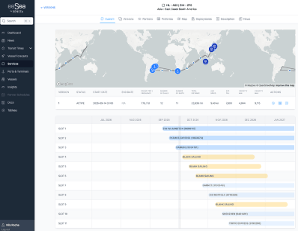
Figure 2: eeSea by Xeneta, ZFS vessel deployment
Yang Ming falls back on SX2, the loop it shares with ONE and HMM. The three Premier Alliance lines end up on one ECSA loop together, and on the smallest one, with ships averaging around 6,600 teu.
Maersk is now sole operator on ASAS, with Gemini partner Hapag-Lloyd buying slots. MSC carries on with Ipanema and Carioca, with Hapag-Lloyd and ONE on board. Hapag-Lloyd is the only carrier sitting in three camps at once: on Maersk’s loop, on MSC’s, and on its own with Zim.
Ports: calls move, few disappear
The loop redesigns shift calls rather than cut them. SEAS A puts Santos first and adds Coega (Ngqura) on the way home, but drops Rio de Janeiro and Paranaguá. SEAS 2 picks up Itajaí from the departing ASAS2 and calls Rio twice. Navegantes loses its SEAS 2 call and leans on SEAS A.
The winners are Coega, which now has two direct Asia-bound reefer options in ASAS and SEAS A, and Rio, which keeps strong coverage. Xiamen depends on a single loop, AS3/ZFS. Singapore is the call I would watch: AS3/ZFS skips it, and PIL, whose home hub it is, will want it added.
YML & PIL are losing a wide range of coverage: Navegantes, Buenos Aires and Montevideo – the former could also be added in ZFS with PIL coming in, the later would be a harder sell to Zim/Hapag-Lloyd as it would transform their new product structurally. Ocean-Alliance and MSC would then be the only carriers to serve Plata ports with direct products for the time being.
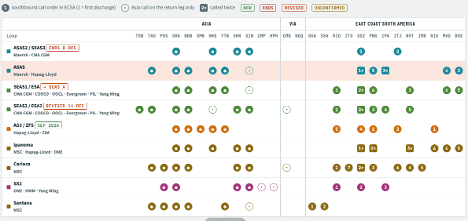
Figure 3: Current port coverage
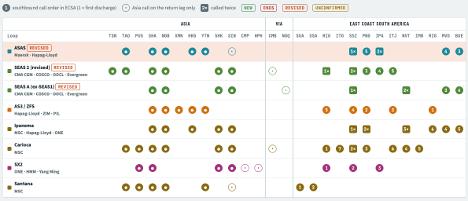
Figure 4: Expected unconfirmed scenario
Shippers: less capacity, fewer fallbacks
By my count, nominal weekly capacity from Asia drops about 4%: ASAS2’s seven CMA CGM ships would leave the trade, and PIL’s larger ships on AS3/ZFS only partly offset that. With demand looking healthy, that gives carriers a firmer floor into the first quarter of next year.
The bigger change is resilience. Maersk now has one loop and no in-house backup when a sailing is blanked. Yang Ming customers move onto a small, shared loop with no direct Paranaguá, Itajaí, or River Plate calls, so I expect tight space and rollovers there.
My advice to shippers is simple: check your December routings now, and split contracts across at least two carriers that run their own ships.
A scale model of the bigger game
ECSA shows where the industry is heading. MSC stands tall alone, Ocean Alliance consolidates, Maersk bets on controlling its own network, Hapag-Lloyd hedges across every camp, and smaller lines get pushed to the edges.
Shippers on this trade will feel it first. They should treat December as a preview of what alliance strategy does to trades well beyond South America.