
November WTI crude oil futures spent the week caught between two opposing trades. Gulf crude flows improved as Saudi Arabia restored export routes and producers found ways around the Strait of Hormuz disruption. That was the supply relief sellers needed.
The fuel market would not let them run with it. Diesel, gasoline and jet-fuel flows remain constrained, Russia has restricted diesel exports, and China has pulled refined-product cargoes from the export market. Reports Thursday that the United States is sending a third carrier strike group to the Middle East put the escalation premium back into the trade.
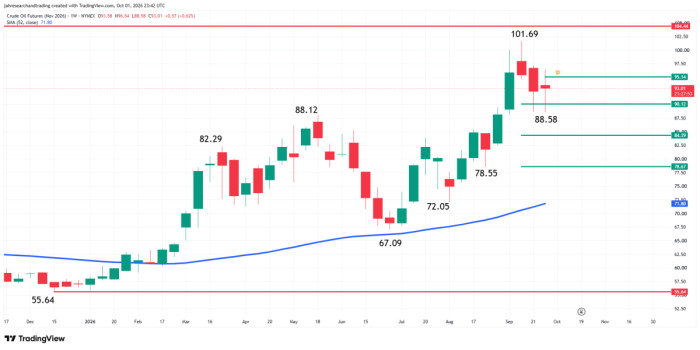
At 23:23 GMT Thursday, November WTI crude oil futures are trading at $93.00, up $0.56 or +0.61% for the week. The contract traded from $88.58 to $96.54.
Gulf Barrels Gave Sellers Something to Work With
The break to $88.58 showed traders were willing to believe the crude supply problem was easing. Saudi Arabia restarted the East-West Pipeline and resumed tanker loadings at Yanbu, restoring an export route to the Red Sea. The pipeline does not make Hormuz irrelevant, but it gives Saudi Arabia a way to move barrels without depending on the Strait.
Goldman Sachs estimated Gulf oil exports, including dark exports, recovered to 23.3 million barrels per day over the prior week, near the 2025 average. That is a large improvement from the period when disrupted Saudi loading plans put a much bigger supply premium into WTI and Brent.
The recovery…
November WTI crude oil futures spent the week caught between two opposing trades. Gulf crude flows improved as Saudi Arabia restored export routes and producers found ways around the Strait of Hormuz disruption. That was the supply relief sellers needed.
The fuel market would not let them run with it. Diesel, gasoline and jet-fuel flows remain constrained, Russia has restricted diesel exports, and China has pulled refined-product cargoes from the export market. Reports Thursday that the United States is sending a third carrier strike group to the Middle East put the escalation premium back into the trade.
At 23:23 GMT Thursday, November WTI crude oil futures are trading at $93.00, up $0.56 or +0.61% for the week. The contract traded from $88.58 to $96.54.
Gulf Barrels Gave Sellers Something to Work With
The break to $88.58 showed traders were willing to believe the crude supply problem was easing. Saudi Arabia restarted the East-West Pipeline and resumed tanker loadings at Yanbu, restoring an export route to the Red Sea. The pipeline does not make Hormuz irrelevant, but it gives Saudi Arabia a way to move barrels without depending on the Strait.
Goldman Sachs estimated Gulf oil exports, including dark exports, recovered to 23.3 million barrels per day over the prior week, near the 2025 average. That is a large improvement from the period when disrupted Saudi loading plans put a much bigger supply premium into WTI and Brent.
The recovery is incomplete. JPMorgan’s longer 10-day measure was lower, near 20.5 million barrels per day, or 89% of normal. One strong week of loading does not prove that flows have returned to normal.
Producers are using ship-to-ship transfers off Oman, military escorts and changed loading plans to keep exports moving. The barrels are getting through, but they are moving through a system that costs more, takes longer and can break again on one attack.
OPEC+ is expected to leave November production targets unchanged when it meets Sunday. That removes one possible supply surprise, leaving traders focused on whether Gulf flows can stay near their recent recovery level.
Diesel Is Carrying the Premium
More crude cargoes can pressure WTI. They do not create diesel for Europe, Asia or the United States.
Russia has restricted diesel exports through October after attacks damaged refinery infrastructure. Middle East product supply has also been disrupted. Gasoline, diesel and jet-fuel shipments from the region remain well below their pre-war pace, forcing end users to compete for a smaller pool of finished fuel.
U.S. inventory data showed the split. Commercial crude stocks rose 922,000 barrels to 427.3 million barrels, when the market had expected a draw. Distillate inventories fell 2.3 million barrels to 105.2 million barrels, and gasoline stocks dropped 1.7 million barrels to 204.4 million barrels.
The crude build was bearish. Product draws carried more weight. Refiners are already running hard for the margins, with U.S. utilization averaging 96.3% in the third quarter, up from 94.7% a year earlier. There is not much spare capacity left to solve a diesel shortage with another round of runs.
Washington is responding to the same problem. The White House has urged the European Union to consider releasing emergency diesel inventories. It has also weighed expanded use of red-dyed diesel instead of a diesel export ban. Those are fuel-shortage responses, not policies for an oversupplied market.
China Tightened the Product Side Again
China added to the concern Thursday. Refiners reportedly suspended oil-product exports beyond Hong Kong and Macau until further notice. The lost volume may not match the supply already missing from Russia and the Middle East, but it closes another release valve at the wrong time.
Chinese refiners are keeping gasoline, diesel and jet fuel at home as global diesel stocks remain tight. That leaves fewer cargoes for a market dealing with refinery damage, high freight costs and difficult shipping routes.
The conflict started as a problem of getting crude through Hormuz. It has become a problem of getting finished fuel to the right buyers.
A Third Carrier Group Changed the Weekend Trade
Thursday’s rally was also about military risk. The Wall Street Journal reported that the United States is sending a third carrier strike group to the Middle East, with Marine Corps ships and up to 10,000 additional troops expected to follow.
The report put the possibility of a wider confrontation with Iran back in front of the market. The United States already has the USS George H.W. Bush and USS George Washington in the region. The Theodore Roosevelt departed San Diego on a scheduled deployment Sunday.
Traffic through Hormuz has improved from its worst point but remains far from normal. Maritime security agencies reported that at least three tankers were struck while trying to transit the Strait this week. More U.S. military assets raise the odds that another tanker incident, refinery attack, or Iranian response becomes the next price driver.
Weekly November WTI Crude Oil Futures Technical Analysis
Анализ трендовых индикаторов
November WTI crude oil futures are edging higher for the week after recovering from a three-week low at $88.58. The main trend is up according to the weekly swing chart. A trade through $101.69 will reaffirm the trend. Taking out $67.09 will change the main trend to down.
The minor trend is also up. A trade through $78.55 will change the minor trend to down.
Based on the price action over the past two weeks and the reaction to a short-term 50% level at $90.12, it looks as if the market is in a normal corrective phase.
Additional support levels are at $84.39 and $78.67. The price action also suggests that traders could remain in “buy the dip” mode until there is a sustained break below the 52-week moving average at $71.80.
The new minor range is $101.69 to $88.58. This puts the focus on the pivot at $95.14 during the upcoming week.
Еженедельный технический прогноз
The direction of the Weekly November Crude Oil futures contract for the week ending October 9 is likely to be determined by trader reaction to $95.14.
Бычий сценарий
A sustained move above $95.14 will signal the presence of buyers. This will put the market in a position to possibly retest the contract high at $101.69 if the headlines turn bullish again. Potential upside targets include $104.44 and $110.08.
Медвежий сценарий
A sustained move under $95.14 will indicate that buying is slowing and the selling pressure is increasing. If it creates enough downside momentum, then we could see a retest of $88.58. A trade through this level will send a strong signal that the rally is weakening, with $84.39 and $78.67 as other potential targets.
Weekly Outlook
The crude market has supply relief, but not a clean supply solution. Saudi Arabia is loading at Yanbu, Gulf exports are improving, and OPEC+ is unlikely to add to the supply problem on Sunday. Those developments limit the upside as long as they continue.
The fuel market remains the problem for sellers. Diesel supply is tight, refinery capacity is stretched, and China’s export decision leaves fewer product cargoes available. The European Union’s discussion of emergency diesel stocks could ease pressure, but it does not repair refineries or normalize trade flows.
WTI can give back more premium if Gulf exports keep improving and shipping becomes less costly and more reliable. A failure in U.S.-Iranian diplomacy, another attack on shipping or infrastructure, or fresh evidence of tighter diesel supply would put the premium back to work quickly.
This week’s $88.58 to $96.54 range showed how fast crude traders can switch from supply relief to escalation risk. The physical crude market is improving. The fuel market is still short, and that is why oil has not been able to stay down.
During the week ending October 9, the direction of the November WTI crude oil market is likely to be determined by trader reaction to the minor pivot at $95.14.