
November WTI crude oil futures were trading at $96.35 at 0:51 GMT early Friday, up $0.49, or 0.51%, for the week. The contract traded as high as $101.69 and as low as $94.64. The range reflects a market caught between broken Saudi infrastructure and an export workaround that only moves part of the lost volume.
Saudi Arabia’s East-West pipeline outage drove WTI through $100. The kingdom’s Sohar transfers to Asian refiners pulled the contract back. The supply problem remains in place. The market is now putting a smaller premium on it.
Saudi Pipeline Attack Changed the Supply Math
A drone attack damaged three pumping stations along the East-West pipeline, Saudi Arabia’s main route for moving crude to Yanbu and around the Strait of Hormuz. The line normally carries roughly 4 million to 5 million barrels per day. With it down, Saudi exports became more dependent on a waterway where traffic has already been severely disrupted.
WTI reached $101.69 because the market was trading the loss of Saudi Arabia’s main Hormuz bypass, not a demand surprise. Repair estimates range from a partial restart within days to five or six weeks of work. That gap created the week’s range.
Houthi attacks on Saudi targets and the group’s hold near Perim Island at the entrance to the Red Sea added to the concern. The Middle East has fewer safe routes for crude and products than it did a month ago.
Oman Took the Panic Premium Out
Saudi Arabia began offering more crude…
November WTI crude oil futures were trading at $96.35 at 0:51 GMT early Friday, up $0.49, or 0.51%, for the week. The contract traded as high as $101.69 and as low as $94.64. The range reflects a market caught between broken Saudi infrastructure and an export workaround that only moves part of the lost volume.
Saudi Arabia’s East-West pipeline outage drove WTI through $100. The kingdom’s Sohar transfers to Asian refiners pulled the contract back. The supply problem remains in place. The market is now putting a smaller premium on it.
Saudi Pipeline Attack Changed the Supply Math
A drone attack damaged three pumping stations along the East-West pipeline, Saudi Arabia’s main route for moving crude to Yanbu and around the Strait of Hormuz. The line normally carries roughly 4 million to 5 million barrels per day. With it down, Saudi exports became more dependent on a waterway where traffic has already been severely disrupted.
WTI reached $101.69 because the market was trading the loss of Saudi Arabia’s main Hormuz bypass, not a demand surprise. Repair estimates range from a partial restart within days to five or six weeks of work. That gap created the week’s range.
Houthi attacks on Saudi targets and the group’s hold near Perim Island at the entrance to the Red Sea added to the concern. The Middle East has fewer safe routes for crude and products than it did a month ago.
Oman Took the Panic Premium Out
Saudi Arabia began offering more crude through ship-to-ship transfers off Sohar, Oman. The route allows cargoes to reach Asian refiners while the pipeline remains unavailable, but it is slower, more complicated, and cannot replace normal flows through Yanbu.
That was enough to take the immediate panic premium out of WTI and Brent. Crude sold off after the high as traders backed away from the idea that Saudi exports would stop altogether. It was not evidence of a clean supply recovery.
Energy Secretary Chris Wright said pipeline flows could resume within days. The market needs actual barrels moving through the line. Until then, Saudi Arabia is relying on a workaround while the repair timetable remains uncertain.
Hormuz Traffic Is Thin, but Barrels Are Still Moving
Visible traffic through Hormuz stayed extremely low. Preliminary vessel counts fell to four transits on Tuesday (although that was later revised higher to 12), and preliminary tracking showed just three vessels crossing on Wednesday. Before the war, the waterway averaged about 125 vessel movements a day.
Macquarie estimated crude, condensate and product flows through Hormuz have held above 7.5 million barrels per day since fighting resumed on August 30. Transponders go dark, and cargoes are using less visible routes, but some barrels are still getting through.
That explains the pullback. Thin ship counts keep the risk premium alive. Continued flows prevent the market from pricing a complete shutdown. A drop in actual flows would bring buyers back quickly.
Diesel Is Still Refusing to Follow Crude Lower
The fuel market did not confirm the crude selloff. European gasoil reached a record high this week, and U.S. ultra-low sulfur diesel remained near record territory. Russian refinery damage, fuel-export restrictions and lost Middle East product flows are keeping distillate supplies tight.
Refiners are favoring diesel over gasoline because margins remain too strong to ignore. Saudi Arabia can move some crude through Oman, but that does not repair refineries, restore product exports or reduce freight and insurance costs.
China and the SPR Provide Little Relief
China processed 13.91 million barrels per day in August, its strongest run rate since March. Refinery demand exceeded crude imports and domestic production, forcing refiners to draw from storage.
That cushion cannot support higher refinery runs, expanding fuel exports and weaker imports indefinitely. A more aggressive return by Chinese refiners to the seaborne market would add demand to a supply system already relying on Saudi workarounds.
The U.S. Strategic Petroleum Reserve is also less able to calm the market. Stocks fell to 285 million barrels as a 172-million-barrel release continued. Washington can release more oil, but traders are measuring what remains and how quickly it can reach refiners.
Weekly November WTI Crude Oil Futures Technical Analysis
Анализ трендовых индикаторов
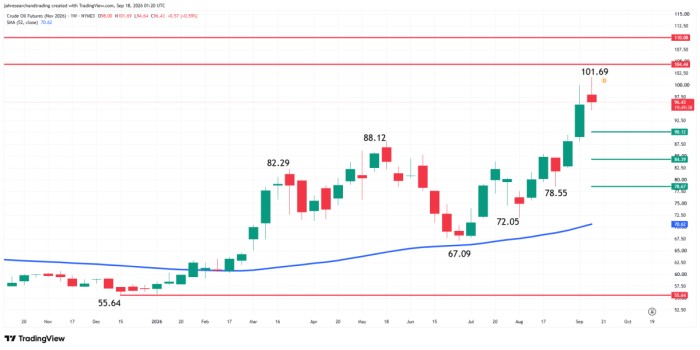
November WTI crude oil futures are edging higher for the week, but the market is close to posting a weekly closing price reversal top. The contract reached a new main top at $101.69 before turning lower. Last week’s close was $95.86. A weekly close below that level would confirm the reversal pattern. It would not change the main trend, which remains up, but it could shift momentum to the downside.
The nearest minor bottom is $78.55, and the main bottom is $67.09. The short-term retracement target is the 50% level at $90.12. The main 50% level at $84.39 is the next downside target. Both sit well above the rising 52-week moving average at $70.62. On the upside, a trade through $101.69 resumes the uptrend and opens the door to former tops at $104.44 and $110.08.
Еженедельный технический прогноз
The direction of the Weekly November Crude Oil futures contract for the week ending September 25 is likely to be determined by trader reaction to $95.86.
Бычий сценарий
A sustained move above $95.86 will signal the presence of buyers. This will put the market in a position to possibly retest the contract high at $101.69 if the headlines turn bullish again. Potential upside targets include $104.44 and $110.08.
Медвежий сценарий
A sustained move under $95.86 will indicate that buying is slowing and the selling pressure is increasing. If it creates enough downside momentum, then $90.12 will become the next target. A trade through this level will send a strong signal that the rally is weakening, with $84.39 another possibility.
Weekly Outlook
The Saudi pipeline is the headline that matters next week. A verified partial restart would extend the correction by proving the kingdom can again bypass Hormuz. More Sohar transfers would help, but they would not restore normal export capacity.
Diesel is the other test. If gasoil and ULSD break with crude, the relief trade gains traction. If fuel prices remain firm, buyers are likely to treat the pullback as a pause inside a supply-driven market.
WTI is only 0.51% higher for the week, but the $94.64 to $101.69 range shows how quickly this trade can turn. The bulls have damaged infrastructure, thin visible Hormuz traffic, and tight diesel. The bears have Oman cargoes, possible pipeline repairs, and hopes that diplomacy lowers the risk premium.