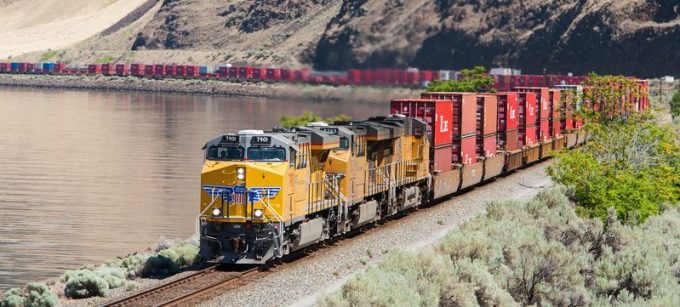

Photo: David Johnson
Union Pacific led the way on the North American containerised rail freight front over the three months to October, amid all the noise surrounding its pending acquisition of Norfolk Southern – but it was not alone in enjoying a bountiful summer.
In general, North American intermodal operators benefited from an upswing in domestic freight demand and a continuing tightening in the trucking market, with revenues up for all four of the major carriers.
Boasting a 27% year-on-year revenue increase, Union Pacific took home some $1.52bn over the quarter, with volumes up 11%, to 956,000 carloads, and pointing specifically to reduced trucking capacity as behind the gains.
EVP marketing and sales Kenny Rocker said: “Domestic delivered its fifth consecutive record quarter in volume and revenue. Our foundation of service, combined with strong business development and deployment of buffer resources enabled volume growth.
“International intermodal volumes improved 8%, driven by west coast import volumes and business wins. In automotive, business wins offset continued market softness. We saw strength in auto parts driven by growth with our current OEMs.”
EVP operations Eric Gehringer added that its intermodal service performance index finished the quarter at 92%, despite volumes increasing 11%, noting it responded to the improving freight market by “unstacking containers and utilising our buffer of resources”.
Sharing the positivity, CSX also boasted a strong third quarter, with intermodal revenue increasing 20%, to $634m, while volumes climbed 7%, to 820,000 units, attributing gains to landing key customers, new service offerings, and the tighter trucking environment.
Chief commercial officer Maryclare Kenney said: “Conversions from the highway remain strong, and the new service offerings through Birmingham, Myrtlewood, Baltimore, and other areas are performing well and attracting new business.”
She noted that international volumes had been relatively flat, particularly during the latest quarter, but pointed to the completion of full double-stack clearances through the Howard Street Tunnel in Baltimore as another opportunity to attract traffic.
“We’re very optimistic about the opportunities as we close this year and go into next on the domestic intermodal side,” she told investors, adding that the tightening in trucking could prove a boost when yields come up for renewal.
Not one to miss out, Canadian Pacific Kansas City (CPKC) also reported double-digit revenue growth in intermodal, up 22% year on year to $583m, as volumes rose 9%, to 489,800 carloads.
Together with the increased traffic, stronger pricing likely played its part in driving the improvement for the Canadian operator that saw its revenue per carload increase 12% year on year, to $1,190.
There was another CPKC performance in the build-up to those results being released, namely its latest effort to derail Union Pacific’s proposed purchase of Norfolk Southern, an intervention described by Premium as “extraordinary”.
In a 30 October submission to the US Surface Transportation Board, the carrier urged the regulator to terminate its review of the deal, alleging UP’s campaign for approval “had intimidated shippers and compromised the integrity of the proceeding”.
The argument is not whether a coast-to-coast network would raise rates or eliminate competitive routes, but “whether the STB can reach a trustworthy decision if the people who depend on the applicants for rail service are reluctant to testify against them”.
Meanwhile, Canadian National was the only one of the big four railroads to record a decline in box volumes, as they fell 6% on the same period last year, to 542,000 teu, despite recording a 9% year on year revenue bounce, to $765m.
Explaining the drop-off, CN pointing to the decline in international shipments through the ports of Halifax and Prince Rupert, with the upturn in Vancouver traffic insufficient to offset those losses.
As to why this did not eat into revenues, it seems the higher income per RTM – 12% up on 2025 to a little over $6 – likely offset the reduction in volumes – although not doing enough to see a clean sweep of revenue and volume growth across all big four operators.