
Two and a half years ago, NVIDIA was a $300 billion gaming chip company.
Today it’s the most valuable company in history at over $4 trillion. Investors who saw what was coming and got positioned early made generational money. A $10,000 stake in NVIDIA at the start of 2023 is worth more than $130,000 today.
The trade looks obvious in hindsight, but very few investors caught it in real time. Demand for AI compute had exploded, the supply of high-end chips couldn’t catch up, and NVIDIA happened to be the only company on earth capable of making what the AI economy needed at scale. That gave the company almost unlimited pricing power and rewrote its valuation in the process. Find the bottleneck, find the company that owns it.
And one company well positioned to own the new bottleneck is Bitzero Holdings, Inc. (NASDAQ: AIBZ), an under-the-radar stock that most investors have never heard of.
The Lesson From the Chip Shortage
Look at what actually happened with NVIDIA.
ChatGPT launched in November 2022 and went from zero to 100 million users in two months. Every major tech company suddenly needed AI compute and they needed it yesterday.
The problem was that high-end GPUs took years to design, months to manufacture and required specialized equipment that only a handful of foundries on earth could produce.
NVIDIA was the only company that had the chips. And that mismatch between desperate demand and constrained supply helped turn what had been an “ordinary” semiconductor company into the most valuable enterprise in human history.
So what was the lesson?
When the entire economy depends on something that’s in short supply, the company that controls that something gets to set the price. And the bigger the gap between demand and supply, the bigger the wealth transfer.
A similar gap is coming. Only this time, it isn’t chips.
The New Bottleneck Almost No One Is Pricing In
NVIDIA can ship as many Blackwell chips as TSMC’s foundries can produce. The chip supply problem is largely solved.
But none of those chips can run without electricity.
A single ChatGPT query consumes roughly 10 times the energy of a Google search. Training the next generation of large language models requires the equivalent power draw of small cities. Industry forecasts now put AI data center capital expenditure at roughly $5.2 trillion between now and 2030. Goldman Sachs Research projects global data center power demand will surge up to 165% by 2030 compared to 2023 levels.
The grid was not built for this. It was built for a world where electricity demand grew at 1-2% per year, predictably, with decades of warning. Now, hyperscalers are showing up at utility offices asking for hundreds of megawatts on three-year timelines. The answer keeps coming back the same: we can’t deliver it.
Berkeley Lab recently found that more than 70% of grid interconnection requests in the United States are ultimately withdrawn because the grid simply cannot accommodate them. Kevin O’Leary, the Shark Tank investor and longtime infrastructure backer, has gone further. He believes 50% of the data centers currently planned across the United States will never get built.
This is the new bottleneck. And it’s a much bigger problem than the chip shortage ever was.
Why the Power Shortage Will Be Even Larger
The chip shortage was an 18 to 24 month manufacturing problem. And while it was certainly painful while it lasted, it did prove solvable with more fab capacity.
The power shortage is a 10-year infrastructure problem with no shortcut.
New nuclear plants take 10 to 15 years from approval to operation. New transmission lines take 8 to 12 years to permit and build. Even adding renewable generation requires years of environmental review, grid interconnection studies and utility approvals. None of these timelines compress, regardless of how much capital gets thrown at them.
The hyperscalers know this, which is why they’re already scrambling. Microsoft signed a 20-year deal to restart the Three Mile Island nuclear plant, a facility that has been offline since 2019, specifically to feed its AI ambitions. Amazon paid $650 million for a data center campus directly co-located with the Susquehanna nuclear station in Pennsylvania. Google announced agreements with Kairos Power for small modular reactors. Meta has been pursuing similar nuclear partnerships and recently issued a request for proposals seeking up to 4 gigawatts of new nuclear capacity.
These are admissions that scarce, secured, low-carbon power is now the most important asset in the AI economy. The companies with the deepest pockets on earth are committing billions and waiting years to lock it in.
The chip shortage created the most valuable company in history because demand outran supply for less than two years. Imagine what happens when the same dynamic plays out with electricity over a decade.
Investors have already started gravitating toward companies exposed to different parts of the AI infrastructure buildout. SpaceX Corp. (NASDAQ: SPCX) has attracted growing investor attention as demand for low-latency connectivity, satellite communications, and global data transmission rises alongside AI-driven cloud infrastructure. Wolfspeed (NYSE: WOLF) offers a more specialized angle, producing silicon carbide semiconductors that improve power efficiency across everything from data centers to grid infrastructure and electric power systems. Meanwhile, Broadcom (NASDAQ: AVGO) has become one of the largest beneficiaries of the AI boom itself, supplying critical networking hardware and custom AI chips that enable hyperscale data centers to operate at scale. Together, these companies highlight an increasingly important reality for investors: the next phase of the AI race will not be won by software alone, but by the physical infrastructure—including connectivity, power management, and networking—that allows AI systems to function.
The Bottleneck Has Moved…But the Formula Hasn’t
The investors who got rich on NVIDIA didn’t need a complicated thesis. They saw a bottleneck forming and identified the company that controlled the supply. That was the entire trade.
The same formula applies now. Power is the bottleneck. So who owns power at scale, in the right jurisdictions, at the right cost, ready to serve AI workloads today?
The answer is a very short list. Bitzero is on it.
Bitzero Holdings, Inc. (NASDAQ: AIBZ) locked in more than 1 gigawatt of secured, low-cost power capacity across four strategic sites in Norway, Finland and the United States, before the AI boom kicked into high gear. That capacity is permitted, contracted and in many cases already operational.
The crown jewel is the company’s Norwegian flagship at Namsskogan, where Bitzero operates as a licensed grid operator at the 132 KV level. Most data center operators connect at 22 KV through a utility, paying middleman fees and waiting on utility timelines, while Bitzero connects directly to the high-voltage grid and works directly with hydroelectric power plants.
The cost difference is dramatic. Bitzero’s all-in power cost at its Norway facility, including grid fees, taxes and every other charge, currently sits at 3-4 cents per kilowatt-hour. The US average is closer to 12 cents. American operators competing for AI workloads are paying three to four times what Bitzero pays for the same electron.
Norway has effectively closed the door on new entrants, capping new operators at just 5 megawatts of initial allocation. Finland and Sweden are tightening as well. The companies that secured Nordic power before the surge are sitting on something that cannot be replicated, no matter how much capital is thrown at it. The window is closed.
The companies that own that capacity get to set the price. And one of them just put a number on it.
Bitzero Holdings: The Convergence Trade, with a Binding Letter in Hand
Three months ago, Bitzero was an unusually well-positioned power infrastructure company without a major contracted tenant. Today it’s something different.
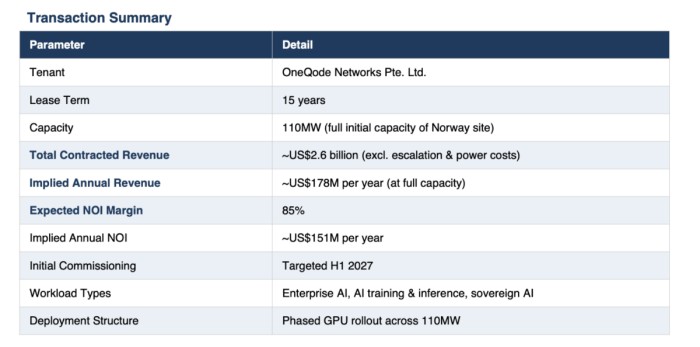
On May 5, 2026, Bitzero signed a binding letter with OneQode Networks Pte. Ltd. for a 15-year lease of the entire 110 megawatts at its Namsskogan, Norway site. Total contracted revenue runs approximately $2.6 billion over the term, with implied annual revenue of $178 million at full capacity and a net operating margin of 85%.
The tenant is deploying GPU clusters for enterprise AI, large language model training and sovereign AI workloads. Commissioning is targeted for the first half of 2027, with the lease then running through 2042 at minimum. The deal is binding subject to definitive documentation, which management has indicated could close within the next 60 to 90 days.
This is the same kind of long-duration HPC contract that drove the multi-billion dollar valuations of TeraWulf ($12.8 billion in contracted HPC revenue), Hut 8 ($7 billion, 15-year Fluidstack lease for 245 megawatts) and Core Scientific ($10.2 billion CoreWeave deal across roughly 500 megawatts). Each of those announcements rerated the underlying stock substantially. Bitzero’s market cap, as of this writing, sits at roughly $130 million.
The OneQode deal does not stand alone. Three other announcements landed inside the same rolling window and reinforce the same trajectory.
Two weeks before the OneQode signing, Bitzero acquired its first eight NVIDIA Blackwell B300 servers, representing 64 GPUs total. These are the latest generation of the same chips that made NVIDIA worth $4 trillion, deployed at the Norway site as the company’s first direct entry into AI compute revenue.
In the same month, Bitzero announced a partnership with Hydra Host, a top-10 NVIDIA Cloud Partner backed by Founders Fund. Hydra Host operates GPU clusters across more than 50 locations worldwide and brings Bitzero’s compute capacity to a global enterprise customer base through its Brokkr platform.
Bitzero also retained CBRE as the strategic broker for its 200-megawatt Finland site, with the explicit mandate of marketing that capacity to hyperscale customers seeking AI infrastructure. CBRE manages roughly $6 billion in annual data center transaction value and has direct, active relationships with every hyperscaler on earth. With Norway under contract to OneQode, Finland becomes the next available block of AI-ready capacity in the Bitzero portfolio.
Most companies in the AI economy are either chip-heavy or power-heavy. NVIDIA owns the chips. Power producers own the electricity. Bitzero now owns secured low-cost power, has the latest NVIDIA Blackwell chips deployed on that power, has Hydra Host distributing the resulting compute to global customers, and has a $2.6 billion long-term tenant signed for its largest single block of capacity.
That’s the convergence trade. It didn’t exist 90 days ago.
Already Profitable…And Just Getting Started
The thing that separates Bitzero from most early-stage infrastructure plays is simple. The company is generating revenue today.
Bitzero mines Bitcoin at its Norway site at a blended power cost of approximately $0.035 per kWh. The all-in cost to mine one Bitcoin sits around $50,000, roughly half the industry average of $100,000. The company’s hashrate has grown steadily from 0.4 EH/s in early 2024 to 1.08 EH/s by January 2025 to roughly 2.80 EH/s today, a 7x increase in two years. At current network conditions that’s around 1.1 Bitcoin per day in production.
That revenue funds operations and demonstrates infrastructure reliability under sustained, real-world high-load conditions. AI customers want to see exactly that before signing multi-year hosting agreements.
The 110 megawatts at Namsskogan are now committed to OneQode under the contemplated 15-year lease, with HPC commissioning targeted for the first half of 2027. The growth runway extends beyond that initial block. Bitzero has a clear path to approximately 325 megawatts at the same site by late 2027, with the largest infrastructure components, including a Siemens GIS breaker with 200 megawatt capacity, already paid for and installed.
The Valuation Gap Is About to Close
Bitzero’s pro forma revenue profile, once the OneQode lease commences, could put it in the same conversation as the Bitcoin mining and HPC infrastructure names already trading at multi-billion dollar market caps.
IREN Limited (Nasdaq: IREN) trades at a market cap above $21.75 billion. TeraWulf Inc. (Nasdaq: WULF) sits above $13 billion. Cipher Mining (Nasdaq: CIFR) is north of $10 billion. Hut 8 (Nasdaq: HUT) и Core Scientific (Nasdaq: CORZ) both trade above $8 billion. Each of these companies has built its valuation on the same thesis Bitzero is now executing: owned power infrastructure plus a credible long-duration HPC contract.
Bitzero currently trades at a market cap of roughly $130 million.
A company with more than 1 gigawatt of secured capacity across four sites, a 15-year $2.6 billion AI lease signed with OneQode, profitable Bitcoin mining operations, CBRE marketing the Finland site to hyperscalers and NVIDIA Blackwell GPUs deploying in Norway trades at roughly 1% of IREN’s market cap.
The company has raised approximately $100 million in capital to date, including roughly $75 million in equity and $25 million in debt. Phoenix Group, the publicly-listed Bitcoin miner ranked tenth globally by market capitalization, holds a 20.8% equity stake in Bitzero and a board seat. Kevin O’Leary is on the cap table. The proposed board includes investment banking veterans from Credit Suisse and JPMorgan.
The Bottom Line
The chip shortage made NVIDIA worth $4 trillion in less than three years. Investors who saw the bottleneck early walked away with the kind of returns most people see once in a lifetime.
The power shortage is the same trade running at larger scale. Demand is stronger, supply is tighter, and the constraint takes 10 years to solve rather than two. The hyperscalers figured this out a while ago, which is why they’re restarting nuclear plants and locking in 20-year contracts. Wall Street is just now starting to catch up.
Bitzero Holdings, Inc. (NASDAQ: AIBZ) owns the asset every AI dollar eventually has to flow through. The OneQode deal proves a top-tier AI operator was willing to commit $2.6 billion for 15 years of access to it. The company generates profitable Bitcoin mining revenue today, has CBRE marketing its Finland site to hyperscalers, has Hydra Host distributing its compute capacity globally and has the latest generation of NVIDIA Blackwell GPUs already deployed in Norway.
The formula that minted fortunes on NVIDIA could be repeating itself at a larger scale. The window to position before the institutional crowd catches on is open right now, and it won’t stay open for long.
By. Josh Owens
ВАЖНОЕ УВЕДОМЛЕНИЕ И ОТКАЗ ОТ ОТВЕТСТВЕННОСТИ
Neither the author nor the publisher, Oilprice.com, was paid to publish this communication concerning Bitzero Holdings, Inc. (NASDAQ: AIBZ). The owner of Oilprice.com owns shares and/or stock options of the featured company and therefore has an incentive to see the featured company’s stock perform well. The owner of Oilprice.com may buy or sell shares of the featured company at any time including at or near the time you receive this communication. This share ownership should be viewed as a major conflict with our ability to be unbiased. This is why we stress that you conduct extensive due diligence as well as seek the advice of your financial advisor or a registered broker-dealer before investing in any securities.
This communication is not, and should not be construed to be, an offer to sell or a solicitation of an offer to buy any security. Neither this communication nor the Publisher purport to provide a complete analysis of any company or its financial position. The Publisher is not, and does not purport to be, a broker-dealer or registered investment adviser. This communication is not, and should not be construed to be, personalized investment advice directed to or appropriate for any particular investor. Any investment should be made only after consulting a professional investment advisor and only after reviewing the financial statements and other pertinent corporate information about the company. Further, readers are advised to read and carefully consider the Risk Factors identified and discussed in the advertised company’s SEC, SEDAR and/or other government filings. Investing in securities is speculative and carries a high degree of risk. Past performance does not guarantee future results. This communication is based on information generally available to the public and does not contain any material, non-public information. The information on which it is based is believed to be reliable. Nevertheless, the Publisher cannot guarantee the accuracy or completeness of the information.
INDEMNIFICATION/RELEASE OF LIABILITY. By reading this communication, you acknowledge that you have read and understand this disclaimer, and further that to the greatest extent permitted under law, you release the Publisher, its affiliates, assigns and successors from any and all liability, damages, and injury from this communication. You further warrant that you are solely responsible for any financial outcome that may come from your investment decisions.
TERMS OF USE. By reading this communication you agree that you have reviewed and fully agree to the Terms of Use found here http://oilprice.com/terms-and-conditions If you do not agree to the Terms of Use http://oilprice.com/terms-and-conditions, please contact Oilprice.com to discontinue receiving future communications.
INTELLECTUAL PROPERTY. Oilprice.com is the Publisher’s trademark. All other trademarks used in this communication are the property of their respective trademark holders. The Publisher is not affiliated, connected, or associated with, and is not sponsored, approved, or originated by, the trademark holders unless otherwise stated. No claim is made by the Publisher to any rights in any third-party trademarks.