
сгенерировано ИИ
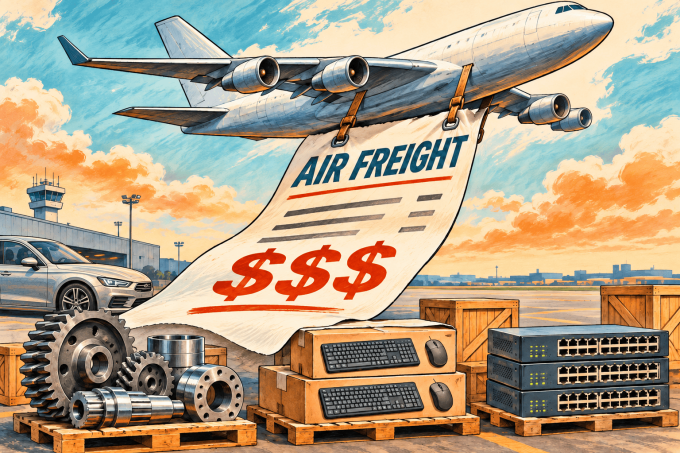
Even as forwarders and shippers lock in air cargo capacity, production setbacks and unreliable ocean services are still forcing manufacturers to pay heavily for emergency lift to meet customer deadlines.
Recent earnings disclosures from Rico Auto Industries, Netgear, and Logitech show how quickly supply problems translate into additional airfreight costs – squeezing margins and leaving companies seeking to recover the bill from customers or suppliers.
Shippers preparing next year’s freight tenders still face the risk of costly last-minute shipments, even if overall airfreight rates fall.
Rico Auto, in last week’s earnings call, disclosed a ₹400m ($4.3m) airfreight bill after longer ocean journeys and difficulties launching new components left it struggling to build sufficient inventory for programmes serving BMW and Toyota.
Chairman and CEO Arvind Kapur said US-bound shipments that normally took five to six weeks were taking 10-11 weeks, sometimes stretching to 12.
“We could not stop the lines of the customer,” he said. “We paid a very heavy price.”
Rico increased production to supply customers by air, while simultaneously rebuilding its ocean pipeline and warehouse stocks. Problems were concentrated in new iron components, whose weight compounded the cost of flying them.
But management acknowledged that disruption was only part of the explanation.
“Could we have done better? Yes, we could. We should have been more agile,” said Mr Kapur.
The company looked for contributions towards the additional airfreight expenditure, with one customer already having agreed to participate. It did not identify the customer or disclose the amount.
Rico expected the emergency air shipments to cease after this month, as ocean deliveries replenished stocks.
The alternative can be more expensive still. Siemens’ True Cost of Downtime 2024 report put the cost of an hour’s unplanned downtime at a large automotive plant at $2.3m. Chapman Freeborn’s Isidro Nuñez Oñate said last month that urgent freight requests could stem from planning errors, defective components, or transport disruption.
“Car plants run like clockwork, so it takes very little to throw everything off,” he said. “If the truck delivering parts for step four breaks down, or every windscreen needed for step ten turns out to be defective, the cars cannot move forward. Suddenly, the whole plant is at a standstill, with costs continuing to rise for every hour production remains inactive.””
Netgear, meanwhile, said a poorly executed factory transition by a manufacturing partner had constrained supplies of enterprise switches and some consumer routers.
During the company’s 4 November earnings call, CEO CJ Prober identified increased airfreight use among the factors behind a sequential decline in enterprise margins – however, those margins remained higher year on year.
The company was also discussing “appropriate commercial remedies” with the manufacturer, and transferring some products to other suppliers, although it did not specify whether that would cover the freight costs.
Netgear’s experience also demonstrates the limits of buying faster transport: its CFO said planned airfreight spending had been lower than anticipated because the expected production ramp failed to materialise.
The company forecast around 150 basis points of consolidated gross-margin pressure in Q4, primarily from rising memory costs and transportation associated with production recovery.
For Logitech, the deadline is the Christmas sales window. Its October earnings call included an allowance for 30-40 basis points of gross margin pressure from premium expedited airfreight in the December quarter to mitigate supply disruption and ensure products were available for holiday demand.
Commercial Vehicle Group also reported premium freight and overtime costs as production volumes increased, while recovering higher freight, commodity, and tariff costs from customers continued to lag the expenditure.
The emergency premium reflects how much capacity is committed before an urgent shipment reaches the market.
As DSV’s Achim Martinka explained at TIACA’s Air Cargo Forum in Miami: “Usually, our contracts are already signed for six or 12 months with the airlines. So everything which comes on a spontaneous, ad hoc basis will be even more expensive than the base load already on the aircraft.”
For shippers preparing their own tenders, buying longer-term protection also carries a cost.
“Forwarders can, of course, offer shippers 12-month deals, but given the market conditions, they would have to bake-in so much uncertainty the price becomes uncompetitive,” said Xeneta’s Niall van de Wouw.
JTD Advisory founder David Kerr argues that buyers should focus on securing capacity and examining fuel surcharge terms alongside the headline rate.
In his latest advisory, he urges buyers to “buy capacity, not rate”, and to “write fuel clauses against jet, not crude”, warning that falling crude prices may not translate into lower jet fuel costs.
Xeneta’s baseline is for airfreight rates to decline overall in 2027. It also expects some cargo that switched to air for reliability, rather than speed, to return to ocean once shipping schedules improve sustainably, most likely from the second quarter.
But that recovery remains conditional. Ocean schedule reliability from the Far East to North Europe was still around 10% in October, according to Xeneta.
For manufacturers facing immediate customer commitments, potentially cheaper freight next year offers little protection against the cost of recovering a missed deadline now.