
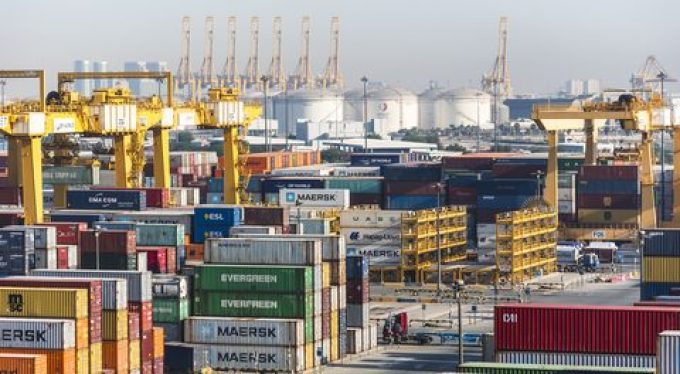
Фото: Мариуш Буньо, Dreamstime.com
The gradual regionalisation of global supply chains is becoming one of the most important trends shaping container shipping, according to Braemar, as new trade agreements and shifting geopolitical dynamics redraw cargo flows.
Analysing the World Bank’s latest global outlook, consultancy Braemar said the institution’s prediction that the 2030s could become the most prosperous decade since the 1970s carried significant implications for liner shipping, despite a challenging near-term market.
The World Bank argues that artificial intelligence, energy security and regional trade integration could drive a new era of economic growth next decade, however, global growth is expected to reach just 2.5% this year, while container trade volumes are forecast to expand by only 2.5%-3.5%.
For shipping, the most immediate structural shift is the rise of regional trade.
According to Braemar, the number of regional trade agreements has risen from around 300 in 2020 to nearly 400 today, with such agreements now accounting for 60% of global trade, compared with 40% in 1990.
“This isn’t abstract,” said Braemar analyst Jonathan Roach. “The interesting stuff is in the regional and inter-regional trades.”
Braemar expects future growth to be increasingly concentrated on intra-Asia, intra-African and nearshoring corridors such as Mexico-US and Eastern Europe-EU routes, rather than exclusively on traditional east-west trades.
The shift is also influencing vessel ordering patterns, it noted. Of the 1,621 containerships currently on order, only 114 are ultra-large vessels of 20,000 teu or more, suggesting owners are prioritising regional and mid-sized tonnage over additional megaships.
“The ‘hub-and-spoke’ geography of container shipping is slowly becoming more ‘spoke-and-spoke’,” Mr Roach noted.
“The decade ahead could be golden,” Mr Roach underscored. “But shipping networks built for the last 30 years of globalisation may need rewiring for the next 10.”
Beyond regionalisation, Braemar highlighted the energy transition as another potential source of future box demand. Global clean-energy investment reached $2.2trn in 2025, accounting for roughly two-thirds of all energy investment.
While stricter environmental regulations are increasing costs, with IMO carbon rules adding an estimated $150-$400 per container on some routes, demand for solar panels, batteries, turbines and associated infrastructure could provide a long-term boost for containerised trade.
AI presents a more complex picture. Braemar said the construction of data centres would generate short-term demand for servers, cooling systems, generators and electrical equipment moving in containers, creating what it described as an “AI infrastructure bow-wave”.
However, the firm cautioned that once facilities are built, ongoing AI growth would rely more on computing power than freight demand.