
Big Tech companies are quietly moving farther and farther away from their decarbonization goals. Back in 2019, Amazon pledged to become carbon neutral by 2040, thereby setting a goalpost ten years ahead of the Paris climate agreement in a show of dedication to becoming a leader in decarbonization. The next year, in 2020, Google and Microsoft upped the ante when each pledged to become carbon-free by 2030. Now, just six years later, those companies are heading in the opposite direction, seeing their emissions balloon by double-digit increments thanks to hyperscaling of energy-hungry data centers to power their artificial intelligence ambitions.
To fuel their ballooning energy needs, Big Tech firms are investing in the rapid expansion and advancement of all kinds of energy production capacity and supportive infrastructure, some clean and some very, very dirty. Amazon is currently building a gas-fired power plant in Texas that is set to become the single-biggest source of power-related emissions in the entire United States.
“The new gas-burning plant, if built to specifications, would be permitted to release 33 million tons of carbon dioxide a year, regulatory records show, more planet-warming gases than any other power plant in the country,” the New York Times wrote earlier this week in a bombshell report. At the same time, the company is still pledging allegiance to the decarbonization imperative.
“The world looks different now than when we co-founded the climate pledge,” Margaret Callahan, an Amazon spokeswoman, told the Times. However, “our commitment hasn’t changed,” she went on to say.
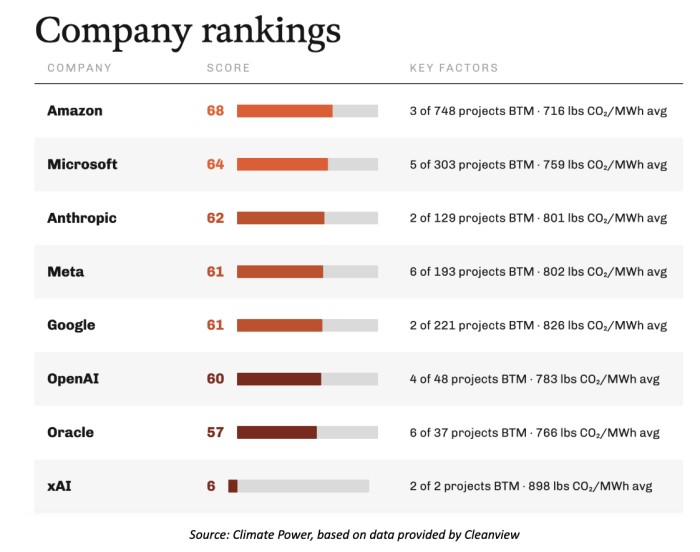
But while Amazon has dominated headlines this week as reporters name and shame the company’s misaligned public front and private dealings, it is far from the biggest emitter in the AI arms race. In fact, among the eight Big Tech frontrunners tracked by Climate Power’s Data Center Air Pollution Tracker, Amazon is the cleanest of all, scoring 68 out of a possible 100 points (with 100 representing all clean energy). The score is calculated based on two criteria: whether the firms’ data centers burn gas behind the meter (BTM) on-site, and how clean the electrical grid is where the data centers are built.
So who are the biggest culprits of AI data center emissions? As of data from August 13, the dirtiest AI firm – by a shockingly wide margin – is Elon Musk’s xAI, with a score of just 6 points on Climate Power’s scale. This score is derived from the fact that all of the firm’s projects are gas-powered BTM, with an average of 898 pounds of carbon dioxide emissions per megawatt-hour. These figures are nothing short of shocking. The next dirtiest player is Oracle with a score of 57, making xAI nearly ten times dirtier than the next dirtiest AI frontrunner. The rest of the tracked companies, from dirtiest to cleanest, are OpenAI (60 points), Meta and Google (both with 61), Anthropic (62), and Microsoft (64).
However, these figures are not representative of total emissions. Amazon, Microsoft, and Google’s projects may be relatively clean on average, but there are many more of them, and they are much more massive in scale, than their competitors. Together, these three companies emitted as much carbon dioxide as a third of France over the last financial year, at 19 million metric tonnes of carbon dioxide equivalent. In short – these companies’ efforts to clean up their acts, while better than some, are insufficient.
“Claims by Microsoft, Amazon and Google about their clouds being ecologically friendly and sustainable are a marketing strategy. Governments should remember these expanding carbon footprints when the very same companies offer addressing the ecological crisis with AI solutions,” Cecilia Rikap, an economics professor at University College London, сказал The Guardian last month.
Making matters worse, we might be majorly underestimating these firms’ emissions thanks to extreme opacity in the sector as well as some cloak-and-dagger maneuvering. “As migration to their clouds expands, and companies store data and train and use AI models and all sorts of digital technologies, these other companies are outsourcing their own digital/AI carbon footprint to cloud giants,” Rikap went on to say. “Basically, shifting to the cloud helps other corporations obscure their environmental footprint.”
Автор: Хейли Заремба Oilprice.com
Другие лучшие статьи с сайта Oilprice.com
- Kazakhstan Accuses Big Oil of $10.7 Billion Corruption in Kashagan Oil Project
- Нефтеперерабатывающие заводы на западном побережье США используют поставки из Малайзии.
- Почему рекордно сильное явление Эль-Ниньо всё ещё может не спасти европейский газовый рынок