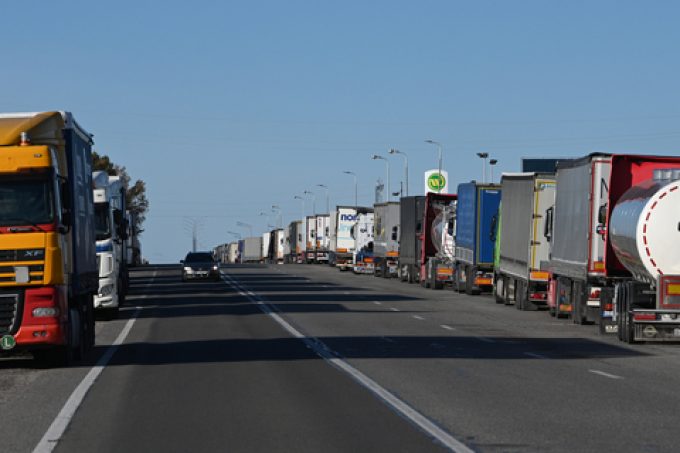

Poland-Ukraine border © Bumbleedee
Following Poland’s accession to EU membership in 2004, its road haulage sector underwent a meteoric rise to the top. Business tripled and its truckers became European leaders with an estimated market share of 20%.
Just over two decades on, the picture is radically different.
“We’re operating with no profit margin and hoping for a miracle,” said Jan Buczek, president of the Alliance of Polish International Road Hauliers (ZMPD), who was one of the authors of a recent report published by the Polish Economic Institute (PEI) on the current state of the sector.
Since 2020, Polish hauliers have faced a series of setbacks, but in the first half 2026 a new low was reached with more than 1,000 Polish companies reported to have gone into administration.
The operating cost advantage it enjoyed in relation to western Europe counterparts has gradually evaporated as a result of Poland’s growing economic prosperity. The country’s minimum wage has almost doubled since the start of the current decade.
This has significantly reduced profit margins which are already under pressure from competition within the EU – Lithuania and Romania in particular – as well as from outside the EU.
“There is a lack of oversight; some companies without European licences are operating in our market,” said Mr Buczek. “We are sometimes offered prices that do not even cover our costs.”
One of the main concerns for Polish haulers is competition from their Ukrainian counterparts. Following Russia’s invasion in February 2022, Ukrainian hauliers were granted the right to operate more freely within the EU but without having to respect the operating regulations in force in the 27-member bloc.
It has led to them taking a large share of the Poland-Ukraine trade which has triggered sporadic protests from Polish hauliers in the form of blocking the border between the two states.
Hardest-hit have been haulage firms in eastern Poland who have seen their business with Belarus and Russia shrink considerably due to sanctions.
The environmental measures set out in the EU Mobility Package and the reforms to the ETS carbon quota system scheduled to take effect in 2027, are also weighing on Polish hauliers.
“Polish companies are particularly affected by these measures, given their often ageing and high-emission fleets. The medium-term impact is arguably greater than competition from Ukraine,” said Jan Strzelecki, one of the authors of the PEI report.
Moreover, the sector’s highly fragmented, SME ecosystem, with more than 80% of firms operating with fewer than 10 trucks, together with the difficult economic climate, leave little scope to invest in electrification, he warned.
Like the rest of the EU, Poland is also having to cope with a severe shortage of truck drivers. Attracting young people to the profession is a particular challenge with under-25s only accounting for 3% of drivers, in contrast to one-third being over 55.
“As living standards have risen, attitudes towards work have changed,” Mr Buczek noted.
The ZMPD estimates that there is a shortfall of 100,000 drivers in Poland.
In order to recruit drivers, Polish haulage firms are looking abroad, with candidates more than likely to be drawn from Ukraine or Belarus. However, in recent months this has been expanded to include countries further afield, in Asia and Africa.
Indeed, simplifying the administrative procedures for recruiting foreign workers has now become one of the sector’s main demands.