
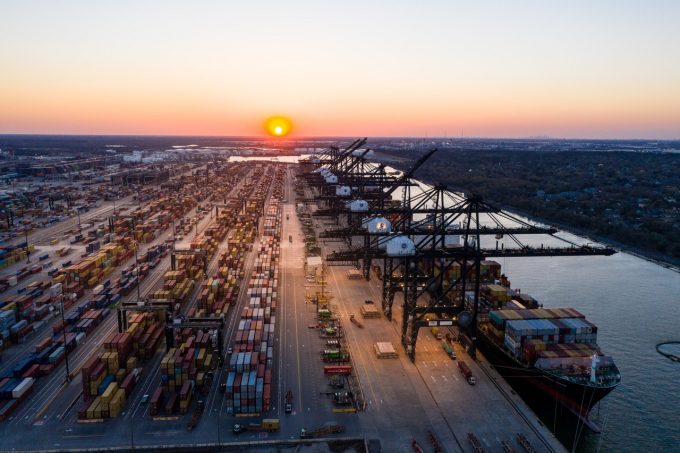
Credit Port of Houston
Elevated import volumes have strained drayage capacity at US container gateways.
Much of the recent spotlight has been on the port of Houston, which is handling record volumes of cargo, and traffic is expected to keep growing, fuelled by multiple drivers.
Since mid-August US trucking and logistics firms have blamed tight drayage capacity as the biggest brake on growth and warned of bottlenecks at ports and inland rail ramps. The biggest factor has been the tightening trucking sector, exacerbated by a seasonal shift of drivers from drayage to the longhaul sector, in response to peak volumes.
This year’s peak season has lasted longer than usual, owing to uncertainty over tariffs and front-loading to beat higher fuel surcharges. According to Descartes, US imports of containerised cargo were up 10.3% year on year (YoY) in September.
By late August the National Drayage Spot Market Index was up 8.2% YoY. By the beginning of this month this had climbed to 9.8%, and the national drayage demand index was 18% higher than the past six months and 9% above the previous four weeks.
Various sources have reported higher-than-average increases in drayage rates from Houston. According to data provider Drayrates, they were up 34% on a year earlier, whereas the national average was +18%.
Paul Brashier, VP of global supply chain at ITS Logistics, an Echo company, reported that dray rates in Houston had shot up 40% over the past four months – albeit from a low base.
He was not surprised; he had already warned about the build-up of traffic through the port late last year and flagged the gateway as a pain point a month ago.
He pointed to a convergence of factors that have boosted traffic through Houston: record container volume for the first half of this year, with its teu count up 3% YoY; through August loaded imports were up about 5% YoY, with traffic from Asia up nearly 12%; and imports have surged because of rapid expansion of manufacturing in Texas and the tidal wave of equipment and materials for the build-out of AI-related infrastructure in the state. At the same time exports of resins have jumped, as the hostilities in the Middle East have disrupted exports from that region.
Other dynamics have added to the momentum on the import side. Over the past 45 days, some cargo owners have apparently booked transatlantic routings via the US Gulf coast to avoid congestion at the Panama Canal, Mr Brashier noted. He added that concerns over large volumes of imports stretching dwell times at the California container gateways had prompted cargo owners to move some imports through Houston instead. Moreover, the volume of containers entering the port en route to Mexico had grown, he added.
The port of Houston has also been the most prominent maritime gateway for outsize and project cargo for the US, which has added to the rise in volumes leaving the port on the land side, mostly for the build-up of manufacturing in Texas and work to beef up the US power grid infrastructure. Some of the logistics providers that specialise in this sector feel encroachment from the container business.
“Now there are containers everywhere at the port,” said one project forwarder executive.
The National Retail Federation recently signalled that the extended peak season should be winding down this month, as most of the holiday merchandise had arrived. Containerised imports at the major US box ports are forecast to add up to 25.8m teu for the full year, an increase of 1.4% from 2025.
The anticipated waning of retail imports will alleviate some of the pressure at Houston, but the other drivers of volume are showing no signs of slowing. Mr Brashier is bracing himself for further volume growth going forward.
“Houston is adding another [container] terminal. That speaks volumes to what they see on the horizon,” he said.
ITS has expanded its footprint at the port over the past three years, and will continue to do so, trying to keep up with demand, he added.
Despite the increase in throughput and the diminished driver pool, the situation has not stymied flows from the port to the interior, Mr Brashier said.
“We’re not seeing a significant amount of dwell,” he reported. “The port and the ecosystem, and the chassis, seem to be pretty resilient. It’s just not having enough trucking capacity.”
He advised cargo owners to strengthen and expand their relationships with drayage providers, and to make early arrangements for capacity and chassis equipment, especially when it comes to special cargo, like hazmat or reefers.
“If you haven’t upped capacity, do that now because the market continues to grow,” he warned.