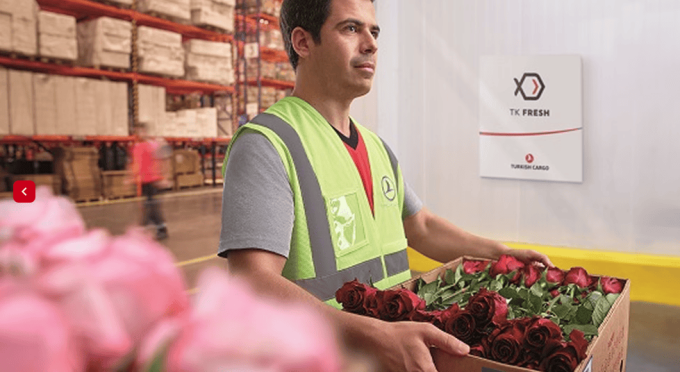

Credit: Turkish Airlines
Nairobi appears to be moving beyond its traditional role as a flower-export gateway, with international cargo operators seeing new two-way flows emerging across perishables, ecommerce, pharmaceuticals and other time-sensitive cargo.
Turkish Cargo, which operates four weekly freighter services to Nairobi, said the Kenyan capital had become one of its busiest freighter operations in Africa, with its role evolving from a predominantly export market into a two-way connection point for East Africa.
The comments come as ground handler Çelebi Aviation takes on Turkish Airlines’ Nairobi operation, providing handling services at Jomo Kenyatta International Airport (JKIA) since early August. The agreement adds Turkish Airlines to Çelebi’s growing customer base in Kenya, which includes British Airways, Emirates SkyCargo, Network Airlines and Astral Aviation.
For Turkish Cargo, the importance of Nairobi extends beyond Kenyan-origin freight. Tarık Parlak, senior vice president for cargo sales at Turkish Airlines, said the carrier’s Nairobi shipments connected to 132 destinations through its Istanbul hub based on full-year 2025 and year-to-date 2026 figures, with Europe accounting for the largest share, followed by the Far East and the Americas.
“Nairobi’s strategic value to us extends well beyond cargo generated in Kenya,” Mr Parlak told Лодстар. “Kenya’s access to the Indian Ocean, together with its road and rail links to neighbouring markets, gives the country an important gateway role in East African trade. Nairobi provides the air cargo connection within that wider logistics structure.”
Perishables, however, remain at the heart of that business. Turkish Cargo said it carried more than 10,000 tonnes of flowers from Nairobi in 2025, while shipments of fresh vegetables increased 21% year on year during the first seven months of 2026, reaching 2,400 tonnes.
Çelebi similarly said flowers remained the largest export category at JKIA, alongside fruit and vegetables, particularly for European markets.
But the more significant development may be on the inbound side. Turkish Cargo said ecommerce shipments arriving from mainly China and Hong Kong had grown by approximately 280% in both revenue and tonnage during the first seven months of 2026. Ecommerce’s share of total inbound tonnage increased from 2% to 7%, although the carrier stressed that the starting base remained relatively small.
“Outbound ecommerce volumes from Nairobi remain limited, but inbound shipments to the wider region, originating mainly in China and Hong Kong, are growing rapidly,” Mr Parlak said. “One segment is not replacing another. Nairobi’s perishable exports are diversifying, while ecommerce adds a new inbound flow to the wider region.”
That shift is also creating demand for more specialised cargo handling. Çelebi said JKIA handled more than 400,000 tonnes of cargo in 2025 and that pharmaceuticals and healthcare products were becoming increasingly important alongside the airport’s established perishables business.
Atilla Korkmazoğlu, president of ground handling and cargo EMEA, at Çelebi Aviation, said the company was investing in infrastructure and equipment, digitalisation, standardised procedures, people and training as part of its development of the Kenyan operation.
“Pharmaceutical and other temperature-sensitive cargo is an important part of this transformation,” Mr Korkmazoğlu said. GDP certification, alongside ISO 9001:2015 and ISAGO, provided the framework and controls required for these increasingly sophisticated cargo flows.
For Turkish Cargo, the changing cargo mix is also influencing how capacity is deployed through Istanbul. Mr Parlak said the carrier was planning capacity, connection options and transit times together as demand shifted between markets, rather than treating each element separately.
The carrier’s flower traffic illustrates that approach. During the first seven months of 2026, flower tonnage from Nairobi to Oslo increased 113%, while volumes to Amsterdam rose 119% and tonnage to Almaty increased 29%. The UK remained its largest market, with 4,400 tonnes carried to Stansted and Heathrow over the period.
Turkish Cargo also sees further potential in special cargo, with its SMARTIST 2.0 investment in Istanbul intended to increase annual handling capacity to 4.5m tonnes, double cold-chain capacity and allocate close to half of total capacity to special cargo operations.
However, Nairobi’s growth is not without operational challenges. Turkish Cargo pointed to pressure on cold-storage capacity during peak periods such as Valentine’s Day and Mother’s Day, as well as apron and aircraft parking constraints. It also highlighted differences in customs processes, digitalisation, banking infrastructure and foreign-currency access across African markets.
Mr Korkmazoğlu said Nairobi already had many of the characteristics of a regional gateway, pointing to its geographic position, established perishables base and connectivity with Europe, the Middle East, and increasingly Asia.
For Turkish Cargo, the next phase is likely to be defined by diversification rather than a replacement of Nairobi’s established export business.
Mr Parlak said the carrier saw its strongest growth opportunities in two directions: the continued diversification of East African perishables moving into Europe, and the development of inbound ecommerce flows from Asia.