
ИДЕНТИФИКАТОР 33174837 ©
Typhoonski | Dreamstime.com
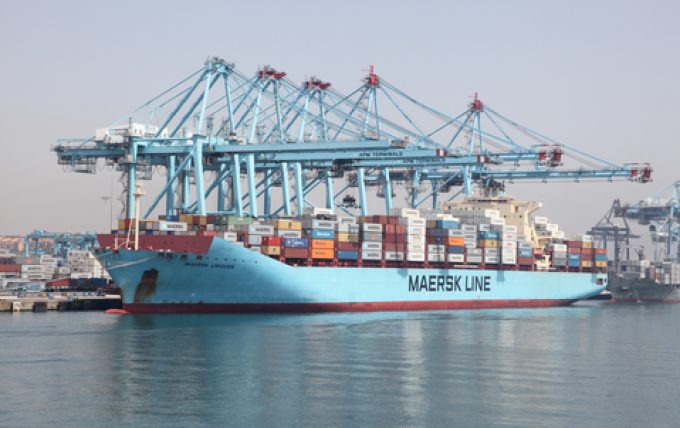
Maersk has overtaken Cosco to become the largest container shipping line in the intra-Asia market by deployed capacity, according to the latest analysis by Alphaliner.
The analyst’s mid-August review revealed capacity on the intra-Asia trade grew 6.2% year on year to just below 2.6m teu. This was slightly ahead of the global container fleet’s growth of more than 5% over the same period, underlining the continued expansion and competitiveness of the intra-Asia market.
Alphaliner’s survey found more than 80 active carriers in the trade, although the majority are small regional and feeder operators. These carriers accounted for 37% of deployed capacity, while mainline operators controlled more than 63%, despite operating fewer ships.
The difference is largely explained by vessel size, with mainline operators averaging 2,699 teu per vessel, compared with 1,338 teu for regional carriers.
SITC, the leading regional operator, illustrates the disparity. Despite operating 109 ships, its 157,000 teu fleet put it sixth among the largest carriers in the trade. Its smaller vessels reflect its focus on direct services to smaller and niche Asian ports.
Maersk operated 108 vessels but had the largest average ship size in the ranking, at 3,176 teu. Its total deployed capacity rose above 340,000 teu, helped by additional Asian shuttle services feeding the Gemini Cooperation’s main east-west loops under its ‘hub-and-spoke’ model.
“There was already a razor-thin spread between number one and two last year,” stated Alphaliner.
Cosco, including Cosco Shipping Lines, OOCL, NGS, Panasia and Co Heung, slipped to second place.
Its capacity was virtually unchanged year on year, rising by about 500 teu, although it deployed more than 120 vessels. This is because its average vessel size fell by about 6%.
CMA CGM was the second-largest capacity gainer, adding around 15,000 teu. Three new services accounted for much of the increase: the Korea-China-Indonesia-Vietnam ‘KI8’, China-Thailand ‘NT8’ and Straits-Malaysia Myanmar-Indonesia ‘BY8’.
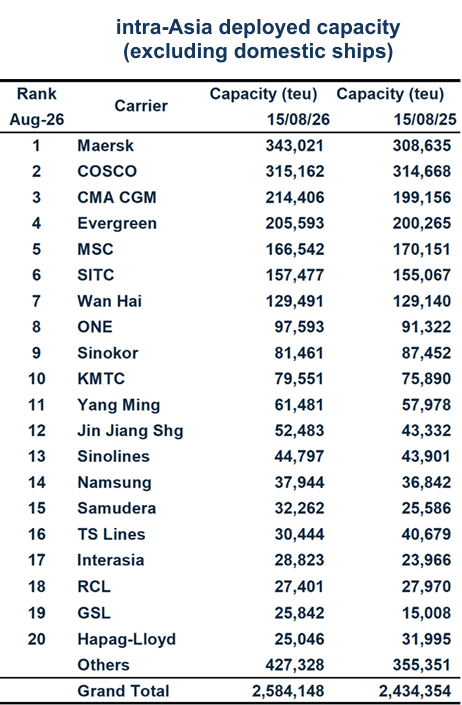
Graph: Alphaliner
Gold Star Line (GSL) recorded the largest percentage increase among the 20 biggest carriers, expanding 72%, or about 11,000 teu, to climb from 26th to 19th.
Samudera increased capacity by 26%, while Shanghai Jin Jiang Shipping, including Hasco, grew 21%. Interasia Lines also entered the top 20 after a 20% increase.
GSL and Interasia displaced Pacific International Lines and Ningbo Ocean Shipping from the top 20, although neither suffered a significant capacity reduction.
At the other end of the table, TS Lines, Hapag-Lloyd and Sinokor recorded the largest reductions. Hapag-Lloyd cut almost 7,000 teu, while Sinokor reduced capacity by around 6,000 teu after withdrawing from several loops.
The intra-Asia fleet’s teu-weighted average age remained about 12 years. TS Lines retained the youngest fleet among the top 20, at six years, while MSC remained the oldest at 21 years.
The survey covered liner services and extra ad-hoc sailings operating across the intra-Asia trade, from the Russian Far East to Myanmar, as recorded on 15 August.