
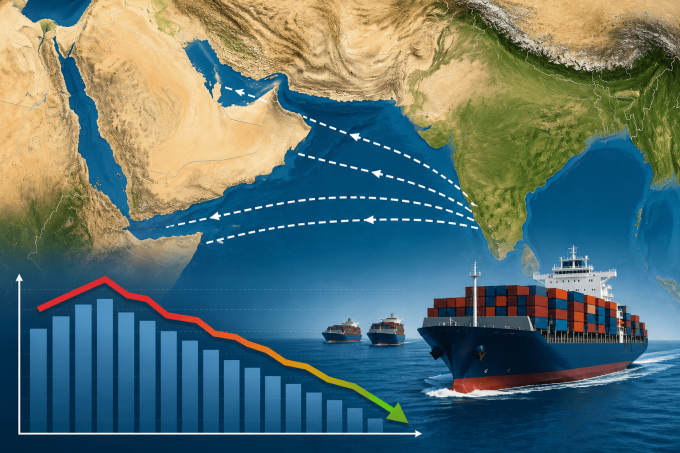
Container shipping rates from India to the Persian Gulf have significantly softened from the peaks recorded since the outbreak of hostilities in February.
Freight rates ex-Nhava Sheva (JNPA)/Mundra to Jebel Ali (UAE) are down by up to 40% from the averages seen two weeks ago, according to data from industry sources.
Companies are now booking cargo for that port pair in the region of $2,100 per 20ft and $3,200 per 40ft, slipping from $3,500 and $4,800, respectively, say sources.
They also reported significant rate declines for other ports of discharge across the Persian Gulf.
Rates ex-Nhava Sheva/Mundra to Dammam (Saudi Arabia) have dropped to $4,700 per 20ft and $5,700 per 40ft, from $5,700 and $6,700, sources said.
They believe the influx of capacity from regional lines looking to exploit the supply chain chaos for profitability, had helped improve supply-demand fundamentals in the war-disrupted corridor.
For example, CULines in late April began two new shuttle services connecting China and India to the Middle East. A fleet of four ships, including the 10,000-teu Express Berlin that CULines had taken over from the downsized SeaLead, has been deployed on one of the standalone loops.
Sources said the downward rate correction was also being driven by the slowing pace of Middle East-bound cargo flows, as mainline carriers had been able to evacuate the majority of containers rerouted to Indian ports, alongside clearing the backlogged Indian export boxes.
“The correction in India–Middle East ocean freight rates is a sign that the market is gradually stabilising after a period of disruption and uncertainty,” Pushpank Kaushik, CEO and head of business development for Indian subcontinent, Middle East & SEA at Hyderabad-based diversified maritime group Jassper Shipping, told The Loadstar.
“While freight rates have softened, the market is not entirely back to normal, as fuel costs, insurance premiums, and regional geopolitical developments continue to influence shipping economics,” he added.
Meanwhile, Maersk has announced a series of Middle East trade relief measures in the form of extended free storage times – broadly 15 days more – for containers that consignees had been unable to clear timely out of Salalah (Oman), Jeddah (Saudi Arabia), and Jebel Ali (UAE).
The carrier is also offering a concessional storage fee for affected transhipment containers at these Middle East hubs.
“As part of our contingency actions and to support customers during this period, we are implementing temporary ‘line detention’ solutions to facilitate the timely return of empty containers and to provide greater flexibility to help you manage your supply chain,” Maersk told customers.
“This means that customers who had contracted less than 15 days of free time now will automatically see their free time allowance extended,” the carrier explained.
The Middle East has boosted the significance of multimodal logistics solutions for cargo movement within the region, with authorities vigorously establishing cross-border customs-enabled green corridors or land-bridge frameworks. The latest was an agreement between Sharjah Ports/Customs and Oman Customs, announced last month.