

Фото: VesselFinder
The Gemini Cooperation partners Maersk and Hapag-Lloyd today announced that four more Asia-Europe services are returning to Suez transits on their headhaul westbound sailings.
The Asia-North Europe AE5 string, the Asia-Mediterranean AE11 and AE12 services, and the India-Europe ME2 service will “transit via the trans-Suez route instead of sailing around the Cape of Good Hope”, joining the AE15 and AE19 Asia-Mediterranean services which are already using the Suez routing.
“The Suez Canal is a vital maritime corridor between East and West and a key driver of efficient global supply chains,” the carriers said in a customer advisory.
“The route through the Suez and the Red Sea is the fastest, most sustainable and most efficient way to serve customers with transport between Asia and Europe.
“By transitioning the AE5, AE11, AE12 and ME2 services to the trans-Suez corridor instead of sailing around the Cape of Good Hope, we will offer more efficient transit times for customers,” they added.
The first vessel to undertake the Suez transit on the AE11 will be the 15,150 teu Antonia Maersk, and on the AE5 the 18,000 teu Marchen Maersk, which are due to depart Tanjung Pelepas on 19 and 21 September respectively, while the ME2’s first vessel will be the 8,650 teu Cornelia Maersk, due to depart Colombo on 24 September.
According to new data from Sea-Intelligence Consulting, published just prior to this latest Gemini announcement, 18% of overall headhaul westbound Asia-Europe capacity has now diverted away from the Cape of Good Hope and returned to the Red Sea and Suez in what the analyst terms a “normalisation” of services.
Meanwhile, routing vessels via Suez on the backhaul sailings to Asia has been considerably more popular amongst carriers keen to relocate their assets to export markets which are currently experiencing severe port congestion due to the recent typhoons, and Sea-Intelligence calculates that 38% of backhaul capacity is now routed via this lane.
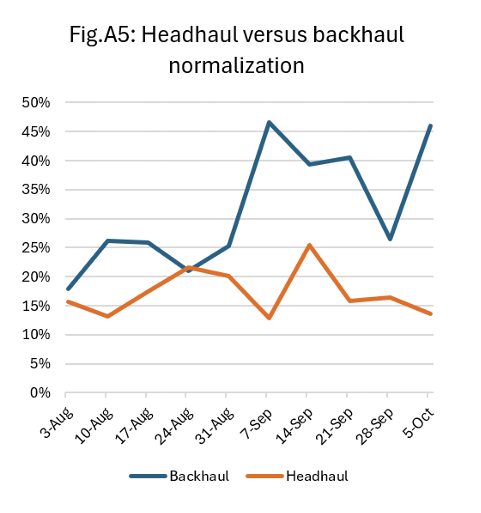
Источник: Sea-Intelligence Consulting
“It is very evident that the carriers favour a normalisation on the back-haul much more than a normalisation on the head-haul,” Sea-Intelligence writes this week.
“Seen as an average over the full month of September, it would be correct to say that the Red Sea crisis is now 27% normalised.
“This can further be broken down, to see the head-haul as 18% normalised and the backhaul as 38% normalised,” it adds.
However, the lightning military advances made by the Houthis in Yemen over the weekend could yet scupper carriers plans for further Red Sea and Suez transits as it once more heightens risks.
“Presently, the Houthis have clearly stated that international shipping is free to pass the Red Sea, with the only exception being Saudi shipping.
“But from a risk perspective, this is also akin to the Sword of Damocles hanging over the head of shipping switching to a Suez routing, as the conditions could change from one day to the next, should the Houthis choose to resume attacks on commercial vessels in the Red Sea,” Sea-Intelligence argues.
Meanwhile, Maersk and Hapag-Lloyd said they would “continue to monitor the security situation in the Middle East region very closely, and any alteration to services within the Gemini Cooperation will remain dependent on the ongoing stability in the Red Sea area and the absence of any escalation in conflicts in the region.
“The safety of the crew, the vessels, and customers’ cargo remains the highest priority,” they added.
Ознакомьтесь с сегодняшним News in Brief podcast, focusing on container shipping resilience.