
For a decade, Colombia’s economically vital oil industry has been caught in a death spiral. A combination of sharply weaker oil prices, rising geopolitical risk and anti-petroleum industry reforms implemented by Colombia’s first leftist president Gustavo Petro deterred investment, causing the operational tempo to decline. The main issue weighing heavily on the oil patch’s outlook is a dire lack of proven petroleum reserves. These are the result of a lack of spending on wildcat drilling and a poor exploration success rate.
After a lengthy delay, Colombia’s regulatory authority, the National Hydrocarbons Agency (ANH), released the 2025 report on the Andean country’s oil reserves. Since the end of the 2020 COVID pandemic, Colombia’s proven oil and natural gas reserves have remained flat. This trend is evident from the 2025 reserve report, where proven or 1P oil reserves totaled just over 2 billion barrels, a nearly 1% decrease compared to a year earlier. Despite that drop, the productive life of Colombia’s 1P reserves grew from 7.2 years for 2024 to 7.6 years.
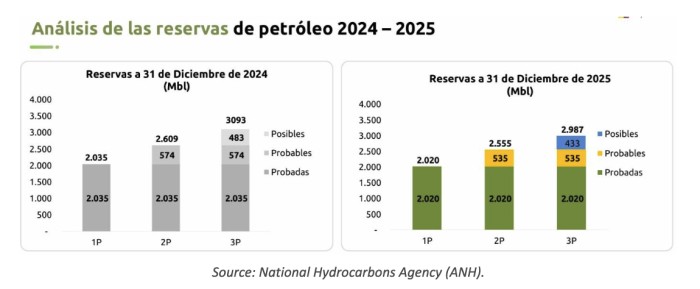
Both proven and probable (2P) as well as proved, possible and probable (3P) reserves also declined, falling 2% and 3% year over year to 2.56 billion barrels and 2.99 billion barrels, respectively. The moderate increase in the productive life of 1P reserves occurred for one simple reason: Colombia’s oil production is in decline, falling to a multiyear low of 724,910 barrels per day for April 2026. Indeed, that number was the lowest output since June 2021, when the Andean country lifted 694,151 barrels daily.
The vast majority of Colombia’s 1P reserves, 74%, are located in the Llanos Basin with 15.3% in the Middle Magdalena Valley and 3.8% situated in the Upper Magdalena Valley. The aging Rubiales field in the Llanos Basin is the largest oilfield on the basis of proven reserves and remains Colombia’s most productive petroleum acreage. For the year-to-date, ANH data shows 11.3 million barrels of oil have been lifted from the Rubiales field, which is nearly double that of the Castilla field, also situated in the Llanos Basin.
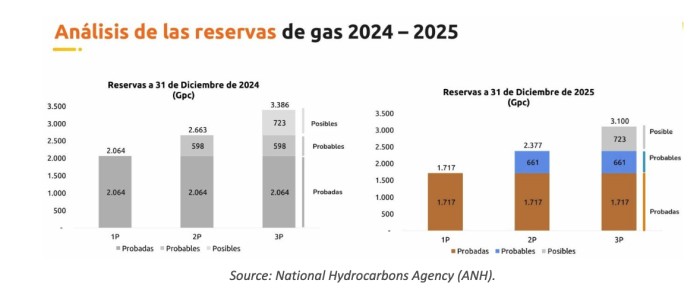
Colombia’s natural gas reserves also fell sharply during 2025. The ANH report shows 1P natural gas reserves plummeted by a whopping 17% year over year to 1.7 trillion cubic feet. Meanwhile, 2P reserves plunged 11% to 2.38 trillion cubic feet and 3P fell 8% to 3 trillion cubic feet.
Like petroleum production, Colombia’s natural gas output continues to spiral lower. April 2026 output plunged 14% year over year to 694 million cubic feet daily, the lowest production volume since January 2026. It is also a worrying 36% less than the same period a decade earlier, when Colombia pumped 1.08 billion cubic feet of natural gas daily.
This is a particularly worrying development with Colombia on the cusp of a severe energy crisis with the latest El Niño weather phenomenon poised to wreak havoc on hydro-electricity generation, on which the country is heavily dependent. You see, hydro plants generate around 65% of all electricity produced in Colombia. Those facilities are dependent on high water levels to maintain production. When water levels plummet due to severe drought, which is predicted to occur in Colombia during the last half of 2026, electricity output plunges.
For those reasons, Bogota is forced to use thermal power plants, most of which are gas-fired. This is responsible for greater demand-side pressures for the fossil fuel, which, along with declining domestic production as well as reserves, is driving ever higher imports of natural gas. This is amplified by Petro’s push to reduce greenhouse gas emissions by decommissioning Colombia’s aging fleet of coal-fired plants and replacing them with gas-powered facilities.
As a result, costly liquefied natural gas (LNG) imports continue to soar, accounting for 17% of the fossil fuel consumed in Colombia. That will surge to 25% during 2026, sharply impacting the economy as natural gas is a crucial industrial and household fuel. Colombia’s growing dependence on natural gas imports is behind the sharp uptick in inflation, which is driving a cost-of-living crisis while placing structural pressure on the country’s balance of payments at a time of fiscal weakness.
The decline of Colombia’s oil and natural gas reserves represents a serious threat to a fragile economy. This stands in stark contrast to a decade ago, when Colombia produced enough natural gas to be self-sufficient and was a major net oil exporter. The parlous state of Colombia’s oil patch, including hydrocarbon output being caught in a death spiral and falling proven reserves, has worsened because of Petro’s energy policies. A combination of ceasing to issue new exploration and production contracts, frequent tax hikes and attempts to ban fracking are all deterring investment.
Colombia’s challenging regulatory environment and rising violence in remote oil-producing regions are disrupting operations and discouraging investment. Consequently, many intermediate drillers and major oil companies slashed spending, with some, including Exxon, exiting the country entirely. Without regulatory reform and lower taxes, a sustained recovery in hydrocarbon reserves and production appears unlikely. Many hope president-elect Abelardo de la Espriella, who takes office on August 7, 2026, will deliver the required changes and revive Colombia’s oil industry.
Мэтью Смит, Oilprice.com
Другие лучшие статьи с сайта Oilprice.com
- UAE Rewrites Offshore Oil Pricing To Capture Asian Markets
- Russia Escalates Kyiv Strikes Days Before NATO Summit Showdown
- Copper’s Next Move Depends On Washington, Not The Strait Of Hormuz