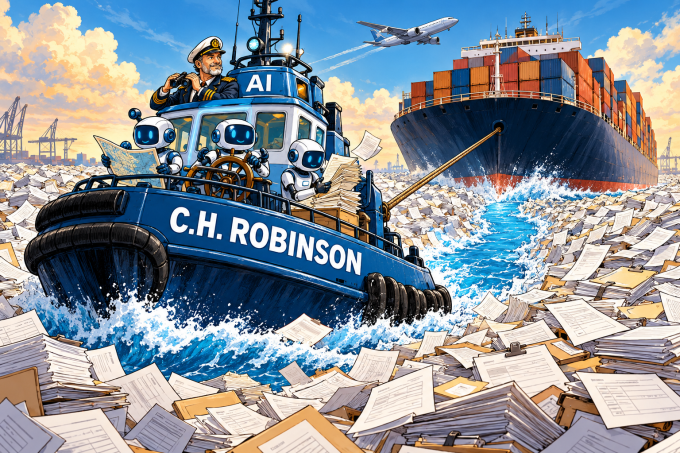

сгенерировано ИИ
CH Robinson is deploying AI agents to recommend freight routings, prepare quotes, and process ocean bookings, arguing that its proprietary technology and customer data will widen its competitive advantage in global forwarding.
The expansion into ocean shipping, airfreight, and customs brokerage includes tasks requiring more than a dozen agents working together, according to the forwarder.
“As we’ve brought our AI playbook to global forwarding, the benefits keep compounding,” said Mike Short, president of Global Forwarding. “Customers have information they need sooner. Data is more consistent. Processes are more predictable.”
But the announcement also reveals how little automation earlier booking technology achieved.
“Before agentic AI, we’d developed digital booking forms and data exchange setups with customers, but over the course of about 10 years achieved only about 5% automation for ocean and air booking requests,” said chief technology officer Mike Neill.
“Why was that such a tough hill to climb? Primarily, because you quote your customer, then it’s their suppliers booking with you. A customer might have 50 suppliers. With our agentic AI, all those booking requests no longer need to be handled manually.”
The forwarder did not outline what percentage of automation was expected, and Mr Neill acknowledged: “We have more work to do automating all the steps for booking, but this is already a major leap forward.”
Its pricing agents have determined and delivered more than 80,000 quotes for over 3,600 customers. The company says quotes previously taking a day for airfreight and two to three days for ocean freight now take two to three minutes.
The work goes beyond retrieving a freight rate. Agents interpret shipping requirements, seek information from external parties, and assess routing options and charges at origin and destination.
Mr Short pointed to the complexity of pricing shipments from Shanghai, where the choice of port and terminal affected inland transport costs and fees.
“The terminal fees at origin and destination change constantly. So another AI agent checks their websites every day and monitors emails for fee notices. That way people in two different time zones don’t have to call every terminal for every price quote.”
Where customers have not specified a port, agents can suggest gateways, inland transport by truck, rail, or barge, and consolidation centres.
Mr Short made rather a sweeping claim for CH Robinson’s position: “With our maturity in using AI to augment our talented experts, only CH Robinson is equipped to transform something as complicated as freight forwarding.”
The firm argues that faster processing brings practical advantages for shippers trying to secure capacity or respond to disruption.
“When plans change or disruptions occur, customers can more quickly evaluate a new routing, mode of shipping, schedule, or price,” said Mr Short.
Ocean booking agents launched in China in August, with deployment across the rest of Asia planned for Q4, and a global rollout expected in Q1 27.
Pricing agents, introduced for North American LCL shipments in 2025, now also cover FCL and airfreight across several regions, with further expansion planned.
In US customs brokerage, AI and automation classify the documents, extract data, and request missing paperwork. CH Robinson claims a 23% reduction in time spent on the affected work, with brokers focusing on validation and compliance.
It’s still hard to tell what the impact will be on the company’s financials; but Q2 forwarding operating profit rose 18.8% year on year, while average employee headcount fell 16.6%. (It’s worth noting that those figures cover an earlier stage of automation, and don’t isolate AI’s contribution.)
Chief strategy and innovation officer Arun Rajan argued that CH Robinson’s advantage lay in combining its technology with operational data.
“Our AI agents continue to operate on 100 trillion data points and a context layer of customer-specific information that simply cannot be replicated elsewhere,” he said.
“While our 450 in-house software engineers and data scientists are still innovating in our trucking and 4PL businesses, now we’re using those advantages to widen our competitive moat in global forwarding.”