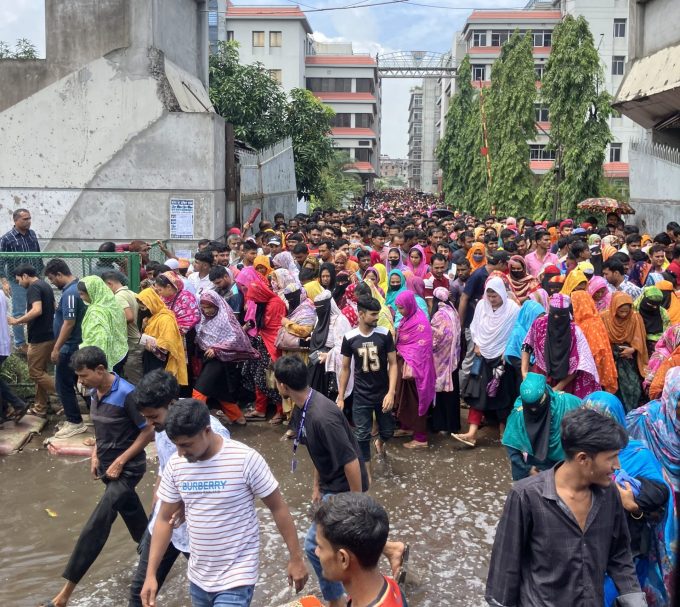

Garment workers in Bangladesh go for a break. August 2026. NahidSultan, Wikimedia Commons, CC BY-SA 4.0.
Bangladeshi garment exporters are turning to costly airfreight to meet delivery deadlines, after weeks of labour unrest disrupted production.
The Bangladesh Garment Manufacturers and Exporters Association (BGMEA) said on Sunday buyers had shifted confirmed orders for 59 million garments, worth $254m, to other countries.
The association put production losses at $428m in free-on-board value, based on a preliminary survey of 317 factories forced to halt production on between one and 16 days this month
More than 600 member factories were affected and the BGMEA warned that losses could rise sharply if the unrest continued, with most export orders at serious risk because factories were struggling to meet delivery deadlines.
Shahedul Islam, BGMEA secretary general, said the unrest had devastated the industry, explaining: “In an effort to retain export orders, factories are being forced to resort to expensive air shipments, offer substantial price discounts, and even face the difficult prospect of outright order cancellations.”
Protests over the minimum wage began in late October. Work stoppages, damage to factories, and road blockades have disrupted production and transport. On Thursday, the Bangladesh Garment Buying House Association estimated the unrest had caused Tk30bn–Tk40bn ($240m–$320m) in economic losses.
Mr Islam added: “The severity of these losses cannot be measured solely in terms of immediate financial figures. An even greater and potentially irreparable blow has been inflicted on the long-term global reputation, reliability, and future prospects of Bangladesh’s garment industry.”
“It is imperative to overcome this critical situation as quickly as possible in the interest of the national economy and the livelihoods of millions of workers.”
Meanwhile, importers using Chittagong port will have more options for storing goods nearby, with MJL Bangladesh adding five warehouses in South Patenga. Each measures 13,500sq ft, and with the existing 20,000sq ft unit, brings the total covered space to 87,500sq ft on a 2ha site.
However, AmeriBangla’s planned US cotton warehouse in Chittagong has been delayed. The facility would allow Bangladesh mills to buy US cotton from local stock. CEO Aswar Rahman told Лодстар a batch of US cotton had already sold while still at sea and would go directly to buyers’ factories.
“Our cotton is in huge demand as its cost is lower than West African product and nearly beats Brazil’s.”
He said the company would use the warehouse when it began bringing in larger consignments and that he was in talks with US growers to import 423 containers of cotton. He said AmeriBangla aimed to scale up shipments from the US to 1,600 containers, or 32,000 tonnes, a month over the next two years.
Meanwhile, at Dhaka’s Hazrat Shahjalal International Airport, the government has assessed sites for two cargo warehouses, one temporary and one permanent, to ease cargo handling bottlenecks.