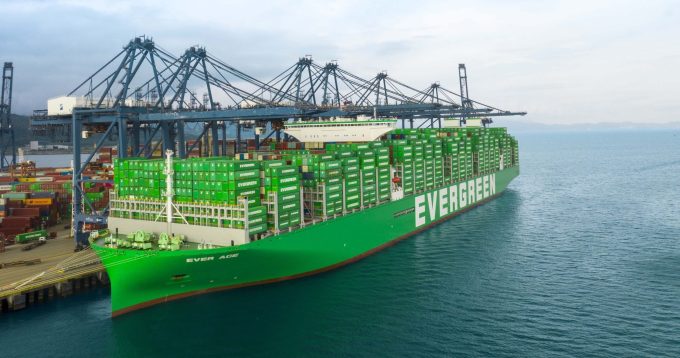

Photo: Evergreen
Evergreen is planning eight ad hoc Suez Canal and Bab-el-Mandeb Strait transits for its Far East–Europe services, according to Alphaliner, alongside four sailings aimed specifically at the Red Sea market.
The Taiwanese carrier’s 16,556 teu Ever Eon made its first Suez transit last weekend, on its way from Rotterdam to Singapore on the Ocean Alliance’s China Europe Shuttle (CES) service.
Three more eastbound CES transits are planned this year, and Ever Even is scheduled to make a westbound passage, reaching Suez on 12 December.
Evergreen is also preparing to restore direct Far East–Red Sea connections through its ad hoc OGRD service, deploying vessels of 7,024-9,466 teu, on a rotation including Jeddah, Sokhna, and Aqaba. The first vessel, the 7,024 teu Ever Superb, is scheduled to depart Qingdao on 14 November.
Meanwhile, Emirates Shipping Line is launching a fortnightly Central/South China-Red Sea (CRC) service, using three vessels of 2,500-4,900 teu on a fortnightly frequency, serving the same three Red Sea ports of Sokhna, Aqaba, and Jeddah, from Shanghai, Ningbo, and Nansha, with the inaugural sailing scheduled to leave Shanghai on 13 November.
The overlapping port choices highlight how the return of direct services could concentrate additional cargo at selected gateways, rather than distributing traffic evenly across the region.
However, the capacity implications could differ considerably between terminals.
DP World reported that its South Container Terminal at Jeddah handled more than 221,200 teu in July, its highest monthly throughput since operations began in 1999, following a 79% year-on-year increase in first-half volumes. The operator has also invested in additional handling equipment and is expanding capacity, preparing for further growth.
Nevertheless, Jeddah has faced operational pressure. In its September update, Expeditors reported congestion at the port, with landside delays of 10-12 days after discharge. The addition of further services could test terminal capacity, while ports receiving fewer calls risk losing traffic and utilisation.
Meanwhile, other major carriers are also progressively restoring longer-haul services through Suez. Maersk and Hapag-Lloyd have confirmed that their ME1 service will return to the canal, joining six other Gemini Cooperation services already using the shorter route.
But the transition could create a second congestion risk at North Europe ports. Flexport warned, in its November European freight market update, that vessels taking the shorter route could arrive alongside ships still sailing around the Cape of Good Hope.
It forecasts arriving vessel capacity at 131% of normal levels in Week 47, with around 40% of that capacity arriving via Suez – the forwarder identified 31 containerships scheduled to arrive via Suez that week, with 61 coming via the Cape.
Flexport considers arrivals exceeding 120% of normal capacity a congestion risk, with at least three weeks forecast to breach that threshold between mid-November and January.
Rotterdam is already under pressure, with average container dwell times reaching 3.37 days in Week 42, and yard utilisation running at between 80% and 90%, according to Flexport.
While the return to shorter Suez routings could cut transit times by seven to ten days, they risk shifting operational pressure between ports rather than eliminating delays across the supply chain.
Listen to our recent podcast with Container Trades Statistics to hear about the container shipping market in Q3!
;Your browser does not support the audio element.