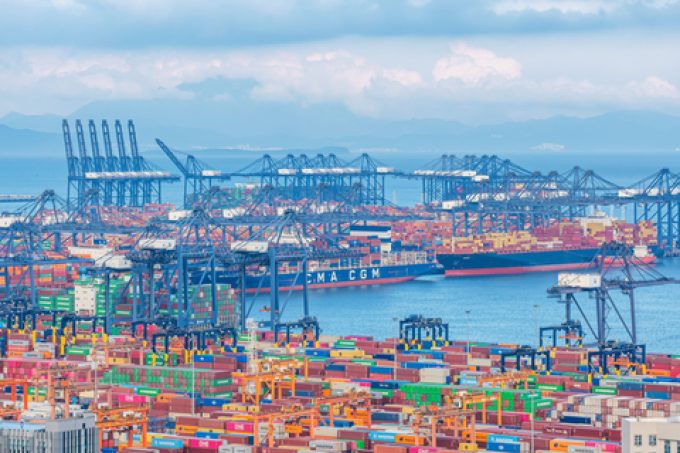

In recent months, a daily review of container terminal utilisation levels has become something of a ‘must-read’ for supply chain planners seeking to understand where boxes may be delayed, and for how long.
That remains an art rather than science, but indicates how the container shipping industry has experienced something of a paradigm shift into an era in which waves of mega-congestion ripple across the port and shipping system.
Terminal occupancy levels – ie, how many containers are sitting in a yard awaiting either a truck or loading on a vessel – continue to sit way above what these facilities were designed to handle.
A small selection from just today, as reported by Kuehne+Nagel: Tokyo AOM yard density is at 113%, up from 96%; Yokohama is above 100%; Busan’s BNCT is around 95% overall, “with laden density near 100% and heavy-discharge ships at risk of lower priority”; and Rotterdam’s ECT is at 94% yard occupancy.
Some of this is beyond terminal operators’ control – they have no say over when vessels arrive, or how delayed they might have been at the previous port; while wars, weather, and other disruptive events are in the hands of the gods – or people who think of themselves as such…
However, in the spirit of supply chain resilience, they could be far better prepared to tackle congestion when it arises.
Drewry’s recent analysis of container port congestion is actually relatively straightforward: the difference in clearing a terminal that is 85%+ utilised and one that is 70% utilised, is massive – a one-day closure at the latter can be cleared in two days; at the former it will take a week; and if multiple disruptions occur, there is very little chance of the former ever clearing completely.
This has been demonstrated clearly over the past couple of months with the arrival of successive typhoons in key Asia loading ports. The effect this had on vessel departures was, ultimately, congestion elsewhere in the world, because those ports too had been operating at 85%+ utliisation.
Why?
Because, as Drewry’s Eleanor Hadland succinctly put it: “No terminal manager gets rewarded for having empty space.”
In fact, the opposite is true. Terminal operators – especially those which have carriers as sister companies – have enjoyed a bumper 2026, as recent third-quarter results demonstrated.
At the same time, their ultimate customers – cargo owners, their freight forwarders, and finally everyday consumers – face increased costs as they witness supply chains fracturing in front of their eyes.
It doesn’t have to be like this, The Loadstar believes.
Port authorities could future-proof their container terminals – which mostly they ultimately own on a landlord basis – by stipulating in concession contracts that a certain amount of nominal terminal capacity must remain unused, except when disruptions demand it.
Your port needs a further 2m teu of container capacity? Stipulate that the operator builds a terminal with a nominal 2.5m teu capacity, thus giving the container supply chain into the port’s hinterland the buffer this year has so clearly shown is needed.