
ID 292741 | Container ©
Jolin | Dreamstime.com
More than one in 10 containers inspected by authorities over the course of 2025 were shown to have safety deficiencies, according to new data published by the World Shipping Council.
The liner shipping lobby group said that during last year a total of 93,079 cargo transport units – most commonly shipping containers but also ro-ro units and trailers – were inspected at ports and identified 9,645 deficiencies, including “incorrect documentation, marking and labelling, improper packing and inadequate cargo securing, all of which can increase the risk of cargo damage, container losses and ship fires”.
The deficiency rate thus stood at 10.36%, a level that was slightly down on 2023 and 2024, but still way above where the level should be, the WSC argued.

Source: World Shipping Council
“Finding deficiencies in more than one in ten inspected units is far too high,” said Joe Kramek, president and CEO of the World Shipping Council.
“Correct declaration, packing, securing and marking are fundamental safety obligations. When these requirements are not met, people’s lives are put at risk,” he added.
Although the IMO formally stopped publishing its annual report into container deficiencies in 2024, the WSC has maintained the programme, “keeping this important safety information accessible to governments and industry”.
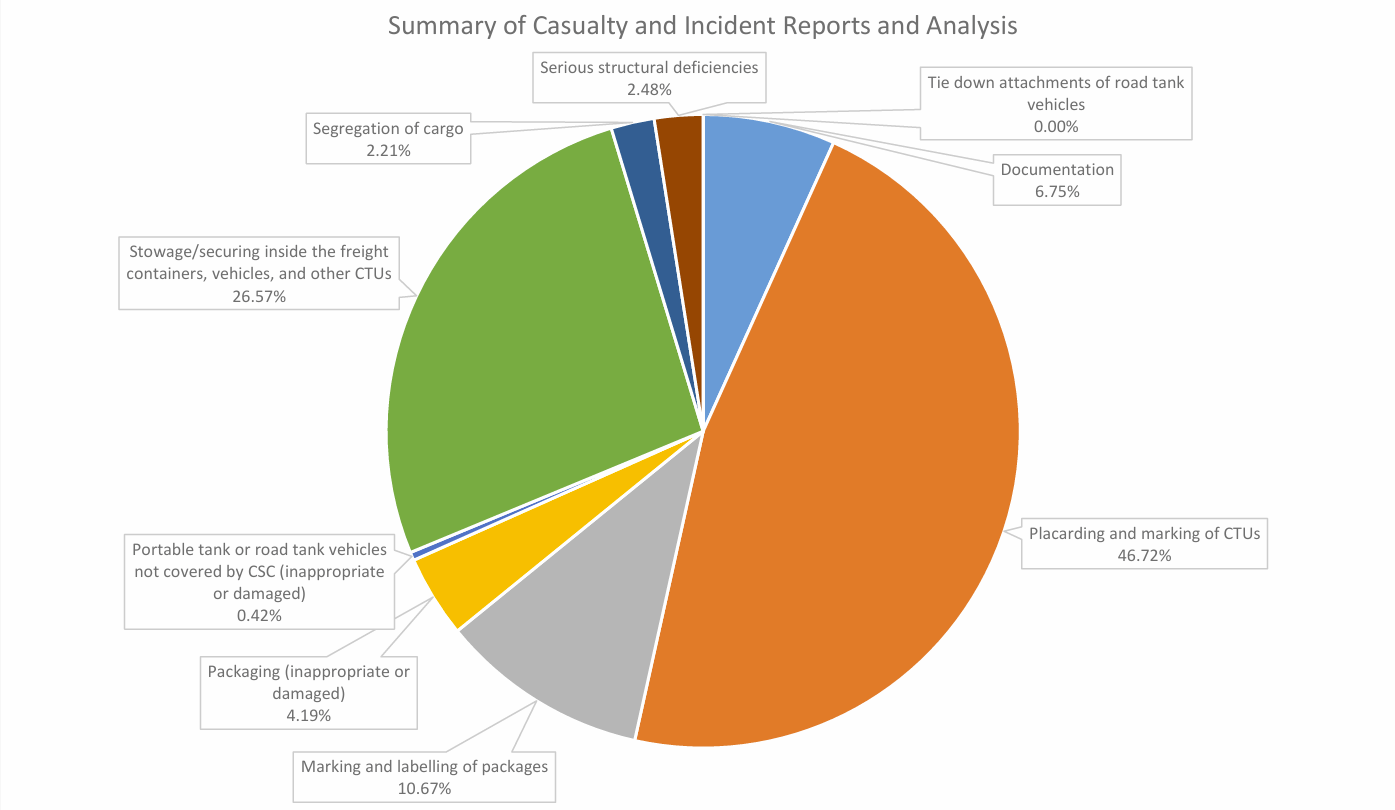
In terms of type of deficiency, the most common form was incorrect marking and placarding of containers, which accounted for 46% of deficiencies; followed by the stowage of cargo side container and road trailers, which accounted for 26% of deficiencies and have often found to be the cause of container stack collapses on board vessels.
The third most common type of deficiency was incorrect marking and labelling of packages inside cargo transport units – recently highlighted as key factor in lithium battery fires – which accounted for over 10%.
Source: World Shipping Council
However, the WSC also noted that the data was comprised of reporting by just seven countries – Chile, Finland, Germany, the Netherlands, South Korea, Sweden and the United States – out of the 170 IMO member states, “leaving significant gaps in the global safety picture”.
“States have a responsibility to enforce cargo safety rules, including through effective inspections,” Mr Kramek continued.
“The fact that only seven Member States reported results is concerning. More governments need to report their inspections so that risks can be consistently identified and action taken,” he added.