
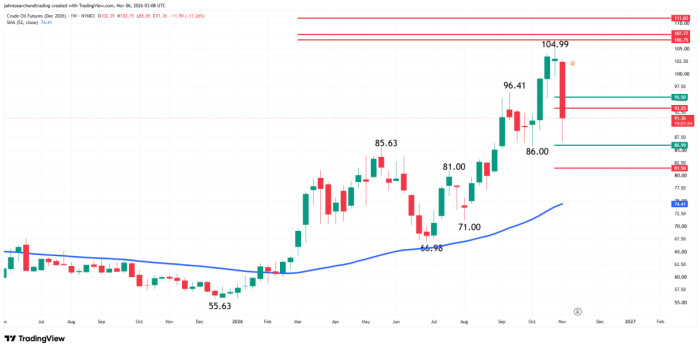
December WTI crude oil is headed for one of its roughest weekly losses in months after the market shed $11.37, or 11.10%, from its opening price of $102.39. Prices posted a weekly high at $102.75 before breaking sharply to $86.65. Early Friday, the contract was trading near $91.58, still down heavily for the week.
The decline was not driven by a sudden collapse in demand or a surprise rise in inventories. Traders began stripping out a portion of the war premium that lifted prices toward the October highs as U.S. midterm results raised hopes for a quicker end to the conflict with Iran.
Election Results Triggered the Break
The sharpest part of the sell-off came after Democrats regained control of Congress. The result increased expectations for political gridlock in Washington and raised the possibility that a Democratic Congress will press the White House to wind down the war.
High gasoline prices had become a major political issue. Vice President JD Vance blamed the conflict for Republican losses, while President Trump indicated there were no immediate plans for new strikes against Iran. The market interpreted those developments as reducing the odds of another major escalation.
That was enough to encourage aggressive profit-taking. WTI had been supported for months by the threat of supply disruptions through the Strait of Hormuz, but traders no longer wanted to hold as much risk premium if the political path was moving toward de-escalation.
The…
December WTI crude oil is headed for one of its roughest weekly losses in months after the market shed $11.37, or 11.10%, from its opening price of $102.39. Prices posted a weekly high at $102.75 before breaking sharply to $86.65. Early Friday, the contract was trading near $91.58, still down heavily for the week.
The decline was not driven by a sudden collapse in demand or a surprise rise in inventories. Traders began stripping out a portion of the war premium that lifted prices toward the October highs as U.S. midterm results raised hopes for a quicker end to the conflict with Iran.
Election Results Triggered the Break
The sharpest part of the sell-off came after Democrats regained control of Congress. The result increased expectations for political gridlock in Washington and raised the possibility that a Democratic Congress will press the White House to wind down the war.
High gasoline prices had become a major political issue. Vice President JD Vance blamed the conflict for Republican losses, while President Trump indicated there were no immediate plans for new strikes against Iran. The market interpreted those developments as reducing the odds of another major escalation.
That was enough to encourage aggressive profit-taking. WTI had been supported for months by the threat of supply disruptions through the Strait of Hormuz, but traders no longer wanted to hold as much risk premium if the political path was moving toward de-escalation.
The price break did not mean the geopolitical risk disappeared. Iranian officials said the two sides remain far from an agreement, and tanker-related incidents in the Persian Gulf continued. However, the market shifted its attention from what could go wrong to what could improve if talks lead to a ceasefire or a shipping agreement.
Gulf Supply Is Recovering
The physical supply picture also became less supportive of high prices. Gulf crude exports, excluding Iran, have reportedly returned close to pre-war levels as producers used alternative pipelines, escorted tanker traffic and ship-to-ship transfers to work around the most dangerous areas.
That matters because the market had been pricing crude as if a long-term supply shortage was unavoidable. Once traders saw that barrels were still moving, the risk premium became more difficult to defend.
Regional exports near 18 million barrels per day suggest the supply system has adapted more effectively than many traders expected. Some shipping remains exposed to military and insurance risks, but the physical market is not as tight as it appeared when fear of a wider conflict was driving prices higher.
This is the main reason the political news had such a dramatic impact. If Gulf exports were still severely constrained, expectations of diplomacy may not have been enough to trigger such a sharp break. But with supply flows recovering, traders had room to liquidate long positions.
Inventory Draws Failed to Stop Sellers
The latest EIA report contained enough bullish information to slow the decline, but not enough to reverse it. U.S. commercial crude oil inventories fell about 900,000 barrels to 409.8 million barrels, marking the fifth consecutive weekly decline. Stocks were about 4% below the five-year average.
Distillate inventories fell 3.6 million barrels to their lowest level since 2003, while gasoline stocks also slipped. Those numbers point to continued demand for refined products, especially diesel and heating oil.
U.S. crude production also reached a record near 14 million barrels per day. Refineries were operating at about 94.5% capacity, helping keep crude inventories under pressure even as supply remains ample.
The drawdown data was supportive, but it could not overcome the broader repositioning. When a market is removing a geopolitical premium, traders tend to focus less on routine weekly inventory numbers and more on whether the source of the supply threat is fading.
Weekly December WTI Crude Oil Futures Technical Analysis
Trend Indicator Analysis
December WTI crude oil futures are trading sharply lower this week after confirming last week’s bearish closing price reversal top. This type of formation is not a change in trend. It often leads to a 2- to 3-week correction equal to about 50% to 61.8% of a major price swing.
The main trend is up, according to the weekly swing chart. A trade through $104.99 will reaffirm the trend. The main trend will change to down on a trade through the recent swing bottom at $86.00.
If the rally resumes through $104.92, then traders may try to test the resistance cluster at $106.75 to $107.77. Above that then the target jumps to $111.03.
The downside will be the focus of the upcoming week.
The short-term range is $86.00 to $104.99. Its retracement zone is $95.50 to $93.25. The long-term range is $66.98 to $104.99. Its retracement zone is $85.99 to $81.50.
The current chart pattern is creating a tricky situation because we’re likely to see a clash between swing traders and value traders. Swing traders may throw in the towel on the long side if stops are hit under $86.00, but value traders could then step in on a test of the retracement zone at $85.99 to $81.50. This could then trigger a volatile short-covering rally back to about the $93.00 to $95.00 area. We can’t get it exact yet until the market stops going down.
A second scenario is one where buyers who came in on this week’s plunge to $86.65 drive the market back above the short-term 50% level at $95.50. If they can sustain the rally over this level, then $104.99 will hit the radar.
Weekly Technical Forecast
The direction of the Weekly December WTI Crude Oil futures contract for the week ending November 13 is likely to be determined by trader reaction to $94.70.
Bullish Scenario
A sustained move above $94.70 will be the first sign that buyers have returned. The signal will strengthen over $95.50. This will put the market in a position to possibly retest $104.99.
Bearish Scenario
A sustained move under $94.70 will indicate that new sellers have entered the market on the rebound from $86.65, the weekly low. If the selling pressure is strong enough to take out $86.00, then look for a further break into $85.99 to $81.50. If short, then watch for a possible technical bounce on a test of this zone. If $81.50 fails, then the selling pressure could intensify with a break back to the 52-week average at $74.41, a strong possibility.
Weekly Forecast
The direction of the Iran talks and Gulf shipping flows will remain the primary drivers next week. A credible ceasefire, a shipping agreement, or further evidence that exports are normalizing could keep pressure on WTI and encourage another test of this week’s low. A renewed military escalation, an attack on energy infrastructure, or a disruption that materially reduces Gulf exports could bring buyers back quickly.
My near-term outlook has turned cautious after this week’s collapse. The market has shown it is willing to remove war premium aggressively when the political outlook improves. However, the situation remains unstable, and the low level of distillate inventories means the oil market could still react violently if the conflict flares again.
Technically, watch the reaction to the short-term pivot at $95.50 to gauge whether new buyers are coming in or if sellers are strengthening their hold. The trend will change to down if $86.00 fails, but new value buyers could be waiting between $85.99 and $81.50. This move could produce a volatile bounce. If $81.50 fails, then look for a possible test of the 52-week moving average at $74.41.