
December WTI crude oil is nearly unchanged for the week, but the flat result hides a rough ride. The contract opened at $99.04, rallied to $101.37, then broke to $95.25 before recovering back to its opening level.
At 00:19 GMT, December WTI crude oil is trading at $99.29, up $0.25 or +0.25% for the week.
The high matched the June contract high. The low came on peace-talk headlines. Neither side won the week. Buyers could not hold the breakout, but sellers could not keep the market under pressure after the break.
The Peace-Talk Trade Did Not Stick
The hardest selling came after Iran’s president discussed mediation efforts with Pakistan’s army chief. Traders saw a possible path to talks and took risk premium out of crude quickly.
The market dropped from $101.37 to $95.25 during the session. That was the week’s biggest move. It also did not last.
There was no direct U.S.-Iran negotiation behind the headline. Iran continued to say that dialogue with Washington was not possible while the country faced a blockade and threats. By the end of the week, traders had pulled WTI back to where it opened.
That tells you the market is still willing to sell a diplomatic headline, but only if it produces something concrete. A meeting about mediation is not the same as a negotiation. Until a real process starts, the peace-talk trade is likely to have trouble holding gains.
Attacks Kept the Risk Premium Alive
The counterweight was the continued…
December WTI crude oil is nearly unchanged for the week, but the flat result hides a rough ride. The contract opened at $99.04, rallied to $101.37, then broke to $95.25 before recovering back to its opening level.
At 00:19 GMT, December WTI crude oil is trading at $99.29, up $0.25 or +0.25% for the week.
The high matched the June contract high. The low came on peace-talk headlines. Neither side won the week. Buyers could not hold the breakout, but sellers could not keep the market under pressure after the break.
The Peace-Talk Trade Did Not Stick
The hardest selling came after Iran’s president discussed mediation efforts with Pakistan’s army chief. Traders saw a possible path to talks and took risk premium out of crude quickly.
The market dropped from $101.37 to $95.25 during the session. That was the week’s biggest move. It also did not last.
There was no direct U.S.-Iran negotiation behind the headline. Iran continued to say that dialogue with Washington was not possible while the country faced a blockade and threats. By the end of the week, traders had pulled WTI back to where it opened.
That tells you the market is still willing to sell a diplomatic headline, but only if it produces something concrete. A meeting about mediation is not the same as a negotiation. Until a real process starts, the peace-talk trade is likely to have trouble holding gains.
Attacks Kept the Risk Premium Alive
The counterweight was the continued targeting of Saudi Arabia, Gulf shipping and oil infrastructure. Houthi attacks reached Saudi targets, including the Shaybah oil field. Vessel attacks and mines near the Strait of Hormuz kept the shipping risk in front of the market.
Saudi production and exports have not suffered a broad disruption. Middle East crude is still moving. That is why WTI could not stay above $101.37.
But traders are no longer treating those barrels as secure. Every attack raises the chance that a future strike hits something that does interrupt production, loading or shipping. That is enough to keep buyers interested after a break.
The market is not trading a confirmed supply loss. It is trading the cost of carrying that risk. That distinction explains the week. Strong export flows kept a lid on prices. The attacks kept sellers from pressing the market after the peace-talk selloff.
U.S. Inventories Gave Buyers Some Help
The U.S. inventory report added to the supportive side of the trade. Commercial crude stocks fell by 3.1 million barrels last week. Gasoline inventories also declined, while distillate inventories rose.
The report was not enough to create another upside breakout. It did give crude buyers something to work with while the Middle East security picture remained unstable.
Refining margins have also stayed firm as the conflict has disrupted fuel markets. That supports crude demand from refiners, even as the market waits to see whether additional supply reaches the system.
The physical market is not showing a panic. Some crude spreads have narrowed in recent weeks. That matters because it shows the market still sees oil moving through the region. The price action is being driven by the threat to future flows, not a full shortage today.
Weekly December WTI Crude Oil Futures Technical Analysis
Trend Indicator Analysis
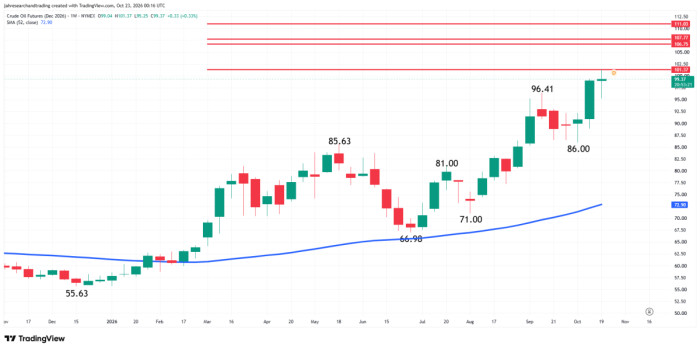
December WTI crude oil futures are trading slightly better this week. The price action appears to be cautiously bullish, with the market seemingly on the cusp of a major breakout to the upside, while at the same time in a position to post a potentially bearish closing price reversal top. The entire week’s range was made in one day, which is an unusual move. The high at $101.37 came first, then the low at $95.25. But prices rebounded quickly to virtually unchanged for the week.
The main trend is up, according to the weekly swing chart. A trade through $101.37 will reaffirm the trend. Taking out $86.00 will change the main trend to down. Given the prolonged move up in terms of price and time, the key level to watch on Friday is $99.04. A close under this price could produce a closing price reversal top. If confirmed, we could see the start of a two-to-three-week correction and maybe a change in trend if the selling is strong enough.
If the rally continues through $101.37, then traders may try to test the resistance cluster at $106.75 to $107.77. Above that, the target jumps to $111.03.
Weekly Technical Forecast
The direction of the Weekly December WTI Crude Oil futures contract for the week ending October 30 is likely to be determined by trader reaction to $99.04.
Bullish Scenario
A sustained move above $99.04 will signal the presence of buyers. This will put the market in a position to possibly break out to the upside, with $106.75 to $107.77 as a strong possible target.
Bearish Scenario
A sustained move under $99.04 indicates that buying is slowing and selling pressure is increasing. If it creates enough downside momentum, then we could see a quick break to $93.69, then $86.00. If the latter fails, the main trend will change to down.
Weekly Forecast
The key issue next week is whether the attacks continue and whether they begin to affect actual barrels. Traders will be watching Saudi facilities, vessel traffic near the Strait of Hormuz, and any sign that Gulf loadings are slowing.
A verified move toward U.S.-Iran talks could take some of the premium out of crude. The market showed that on the break to $95.25. But the headline would need to lead to more than mediation talk.
For now, the risk remains tilted higher. Oil has held its ground despite a sharp selloff and continued proof that Middle East exports are moving. That is a sign that traders are still willing to pay for supply insurance. If the attacks continue without a diplomatic breakthrough, the bid is likely to remain under crude.
Technically, $99.04 is the number to watch on Friday. Close above it and the rally could extend beyond this week’s high at $101.37. Close below it and downside risk emerges.