
© jpg1902 |
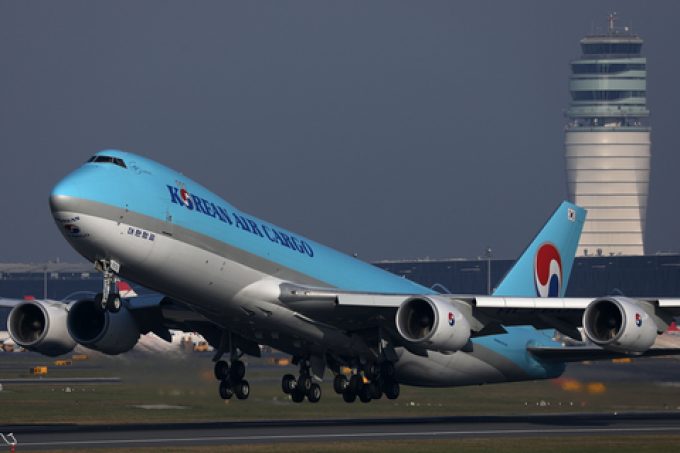
Korean Air is maximising its Asia-Americas cargo capacity, as year-round demand for AI infrastructure overlaps traditional peak-season shipments, keeping the pressure on transpacific space even as global weekly volumes soften.
Jaedong Eum, EVP and head of the carrier’s Cargo Business division, told The Loadstar data-centre expansion had become a primary growth engine for the business.
“Entering the traditional November peak season, we are experiencing compounded capacity pressure on the transpacific, driven by overlapping traditional Q4 consumer goods shipments and robust year-round AI-related hardware demand,” he said.
“Consequently, we are maximising our Asia-to-Americas capacity.”
Europe-bound capacity was less constrained, he added, following a moderation in cross-border ecommerce growth.
The airline was seeking Europe-Asia cargo to improve directional balance, while adjusting its US routes and focusing on yields to manage uneven flows.
Korean Air Cargo prioritises its freighters for outsized, heavy, and specialist project shipments, including AI infrastructure, while deploying passenger belly capacity for ecommerce and express parcels.
Its experience illustrates the increasingly uneven airfreight market. Demand for particular commodities and routes is sustaining capacity pressure, despite limited evidence of a broader peak-season acceleration.
WorldACD’s latest figures, published yesterday, show worldwide average prices rose 2% week on week, to $3.45/kg during 2-8 November, up 31% year on year. Chargeable weight fell 2%, while capacity remained flat.
It attributed rising prices to tight capacity, seasonal passenger aircraft redeployment, and maintenance, adding that an anticipated peak-season surge had yet to materialise.
Taiwan bucked the regional decline. Its US-bound tonnage increased 7% week on week, and 37% year on year, which WorldACD attributed to AI-related exports. Across Asia Pacific, US-bound volumes fell 3% over the week, while prices rose 1%.
Forwarders are also reporting technology-driven growth. Expeditors said in its 3 November results that Q3 air tonnage had increased approximately 13% year on year, with South Asia exports particularly strong. Demand from hyperscalers and their suppliers supporting AI infrastructure was a significant contributor, while limited fleet expansion and aircraft delivery delays constrained capacity.
However, next year could bring some rate relief.
Xeneta forecasts global airline average rates will fall Between 5% and 10%, mainly in the second half, as Gulf capacity returns and fuel costs ease. Its base case puts demand growth at 2%-4%, against capacity growth of 3%-5%.
That outlook depends on an early, lasting Gulf peace agreement – without a recovery, it expects rates to remain close to 2026 levels.
Asia Pacific-North America is likely to retain more of its premium because of AI demand, while Asia-Europe shippers should gain negotiating room. A continued return of ocean services through Suez could also draw less time-sensitive shipments back to sea.
Korean Air, nevertheless, expects the underlying technology demand to endure.
“We do not view this as a cyclical peak,” said Mr Eum, describing AI chips and data-centre construction as a structural, long-term investment cycle.
DHL Global Forwarding’s airfreight head, Henk Venema, also expects pressure to persist on selected Asian export routes, particularly Vietnam, Thailand, and Taiwan to the US.
In DHL’s 2027 outlook, he warned that additional passenger flights would not necessarily provide capacity on the routes where it was needed, or accommodate cargo requiring freighters. Lightly loaded return sectors also leave Asian exports carrying more of the round-trip operating cost.
Carriers are responding with new services. FedEx announced four additional weekly China-US 777F flights on 9 November, alongside a five-times-weekly China–Dallas-Fort Worth connection via Anchorage, targeting semiconductors, servers, and AI infrastructure among other sectors.
Pressure also extends to the Indian subcontinent. India-based Ligi Logistics reported very tight US and Canada capacity in its Week 47 advisory, particularly for larger and urgent shipments, alongside controlled allocations and premium rates on selected Europe and UK services.
DHL GF yesterday announced a twice-weekly Hong Kong–Navi Mumbai–Liège 747F service, its first dedicated flight serving India. It initially targets 25–30 tonnes per flight for the India sectors, or 50–60 tonnes weekly. A Bengaluru–Europe service is planned for March.
Meanwhile, airlines are also broadening access through closer network integration.
Qatar Airways Cargo, IAG Cargo, and MASkargo today announced single-booking access to more than 300 destinations across 60 countries under their Global Cargo Joint Business, with more than 400 destinations ultimately planned.
The partnership coordinates capacity, handling, and connections across their networks. MASkargo CEO Mark Jason Thomas said aligning these processes would translate into “greater routing flexibility, smoother connections, and more consistent service for our customers”.
IAG’s experience illustrates the consequences of losing access to freighter capacity. Its third-quarter cargo traffic fell 13.9%, which the group attributed partly to cancelled third-party long-haul freighter capacity, particularly affecting Asia-Pacific, although revenue increased 3.9%.
An IAG Cargo spokesperson told The Loadstar the carrier had changed its third-party freighter capacity this year as it optimised its network, while adding belly capacity and strengthening partner connections.
The joint business provided “additional flexibility and routing options for customers rather than acting as a like-for-like replacement for individual services”, the spokesperson said.